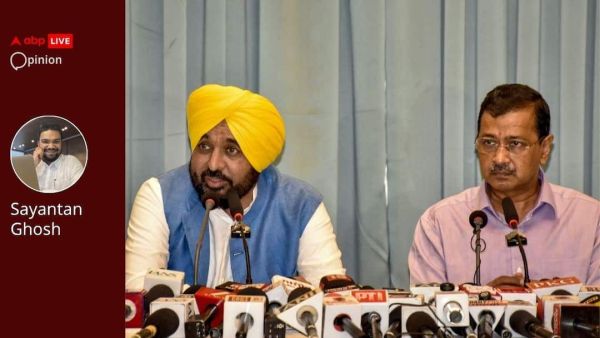
The 2027 Punjab Assembly election is shaping up as a direct contest between the ruling Aam Aadmi Party (AAP) and the principal opposition Congress, with the Bharatiya Janata Party (BJP) and the declining Shiromani Akali Dal (SAD) playing supporting roles. Punjab’s politics has long been distinct from other northern states, defined by strong regional identities, agrarian concerns, and a history of alliances rather than single-party dominance. The BJP has never ruled Punjab on its own and previously relied on its alliance with SAD, which fractured after the 2020-21 farm laws agitation. SAD today struggles with organisational weakness and limited electoral relevance.
In 2022, AAP under Arvind Kejriwal and Chief Minister Bhagwant Mann secured a historic mandate, winning 92 seats with 42% vote share on promises of honest governance, welfare schemes modelled on Delhi, and cleaning up the system. Congress, which had governed from 2017 to 2022 under Captain Amarinder Singh, was reduced to just 18 seats. Five years later, the dynamics have shifted. AAP governs the only major state it controls after its 2025 Delhi defeat, making Punjab a prestige battle. Congress, diminished nationally, sees Punjab as a rare opportunity to demonstrate relevance where it does not directly face the BJP as the primary challenger.
Yet both parties enter the fray burdened by internal vulnerabilities. AAP confronts growing anti-incumbency over unfulfilled or delayed promises, law and order concerns, and a damaging confrontation with the Akal Takht. Congress, despite the potential to capitalise on public discontent, remains paralysed by factional warfare that has repeatedly cost it electoral opportunities. Rumours of possible early polls aligned with other states add further uncertainty. The outcome will hinge on whether AAP can mitigate governance failures or if Congress can finally unite to present a credible alternative.
AAP’s Anti-Incumbency Burden
AAP’s primary challenge stems from the gap between its 2022 campaign guarantees and on-ground delivery. The party heavily promoted the “Delhi model” — free power, education, and health initiatives — but critics point to slowed development, repetitive schemes, and limited innovation tailored to Punjab’s agrarian economy. Law and order have deteriorated under Bhagwant Mann’s government, with rising concerns over crime impacting daily life and investor confidence.
The most prominent example is the women’s financial assistance scheme. AAP’s flagship promise was ₹1,000 monthly to every woman above 18. Implementation began only in July 2026, with the first instalment (three months’ payment: ₹3,000 general, ₹4,500 for SC women) credited just months before the election. While the government hailed it as fulfilling its “final big promise,” the multi-year delay has fueled perceptions of electoral timing over genuine commitment.
Religious Rift with Akal Takht
A deeper crisis emerged from AAP’s confrontation with the Akal Takht, Sikhism’s highest temporal authority. In mid-2026, the Akal Takht declared Bhagwant Mann “anti-Guru” and “Panth virodhi” following allegations involving a controversial video, backed by forensic claims from the Takht. Mann and AAP rejected the edict, presenting counter-forensic evidence and accusing political rivals of orchestration.
The episode has alienated sections of the Sikh electorate, particularly in rural Malwa and Majha regions, where religious sentiment carries significant weight.
This rift compounds existing discontent among Sikh voters who feel the party has not adequately addressed community concerns. AAP’s attempt to position Mann as its chief ministerial face for 2027 now faces the risk of religious backlash, potentially eroding the broad support it enjoyed in 2022.
Congress: Opportunity Squandered by Infighting
Congress should be the natural beneficiary of AAP’s anti-incumbency. It retains a robust organisational network, experienced leaders, and cross-regional appeal across castes and religions. However, persistent factionalism has prevented it from consolidating gains. The 2022 debacle offers a stark precedent: internal rivalry between Captain Amarinder Singh and Navjot Singh Sidhu led to Amarinder’s resignation, his exit to the BJP, and a poorly managed transition to Charanjit Singh Channi as CM face. The Sidhu-Channi tussle further fragmented the party, contributing to its rout.
As of 2026, fault lines persist. State president Amarinder Singh Raja Warring faces open challenges from the Channi camp, with loyalists demanding his removal and pushing Channi as the stronger mass leader. Meetings at Channi’s residence and delegations to the high command highlight ongoing leadership ambiguity. Despite public denials of rifts, these divisions demoralise cadres and erode public confidence. Congress has failed to project a unified narrative or a clear chief ministerial candidate, allowing AAP to portray it as disorganised.
BJP’s Emerging Role
The BJP cannot be dismissed as a marginal player in Punjab’s 2027 electoral landscape. Having severed ties with the Shiromani Akali Dal (SAD) following the contentious 2020-21 farm laws agitation, the party has deliberately charted an independent course, shedding its long-standing junior partner image. It has announced plans to contest all 117 assembly seats on its own strength, signalling confidence in its growing organisational footprint. This strategic shift yielded early dividends in the 2024 Lok Sabha elections, where the BJP nearly doubled its vote share, emerging as the third-largest political force in the state and leapfrogging the weakened SAD in several urban and semi-urban pockets.
A key element of the BJP’s Punjab outreach is its conscious effort to broaden its appeal among Sikh voters. The party has been inducting prominent Sikh faces — leaders who emphasise religious sensitivities, community pride, and Punjab’s unique ethos while avoiding overtly hardline positions that could alienate the devout Sikh population. This calibrated approach aims to neutralise historical baggage from the farm laws and project the BJP as a party sensitive to Sikh institutions and aspirations. Simultaneously, BJP strategists are actively courting disgruntled elements within AAP, particularly MLAs and local leaders frustrated with Bhagwant Mann’s governance style, internal party dynamics, or delayed schemes. Pre-poll defections or post-poll support could prove decisive in a fragmented verdict.
Though its influence remains limited in the rural heartlands of Malwa and Majha, where agrarian and Sikh identity issues dominate, the BJP is making steady inroads in urban centres and among trading communities, youth, and sections concerned about security and narcotics. Its sharp focus on AAP’s governance failures — rising crime, drug menace, youth unemployment, and perceived soft-peddling on radical elements — allows it to position itself as a credible alternative on law and order and development. Issues like alleged conversions and border security are also being highlighted to consolidate Hindu and urban Sikh support.
The Road to 2027
Recent civic body elections in 2026 showed AAP maintaining urban and semi-urban strength despite governance critiques, suggesting anti-incumbency has not yet reached decisive levels. Congress’s continued underperformance in these polls underscores its organisational malaise.
For AAP, retaining Punjab is existential. Success requires accelerated welfare delivery, law and order improvements, and damage control on the Akal Takht front. For Congress, the imperative is internal discipline and a coherent vision beyond criticising AAP. Punjab’s voters, known for demanding accountability, will weigh governance records against leadership credibility.
The 2027 contest remains fluid. Anti-incumbency provides Congress an opening, but infighting risks gifting AAP another term. A unified Congress could capitalise effectively; a fractured one may watch opportunities slip away as the BJP gains ground. Punjab’s electorate, pragmatic and aspirational, will ultimately decide whether promise fatigue defeats the incumbent or self-inflicted wounds sideline the challenger.
Sayantan Ghosh teaches journalism at St. Xavier’s College (Autonomous), Kolkata. He is on X as @sayantan_gh.
-
Can Gregor Kobel Stop Lionel Messi? Switzerland Faces Argentina in World Cup Quarter-Final

-
Karbi Anglong's Land Rights and Job Security Issues Ahead of 2027 Elections
-
UPESSC Recruitment 2026: Applications for Assistant Professor posts reopen; opportunity to fill out the form until July 20..

-
Job opportunity for Class 12 pass-outs: Applications open for Aadhaar Operator and Supervisor recruitment—here's how to apply..

-
UIDAI Recruitment 2026: CSC Invites Applications for Aadhaar Supervisor and Operator Posts Across 17 States