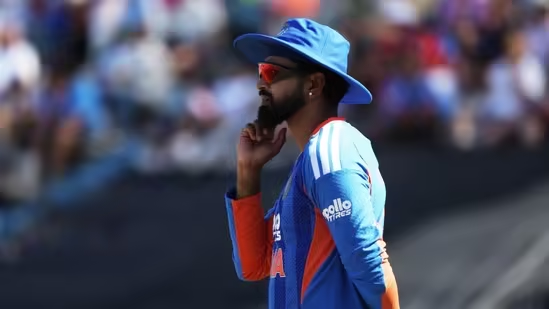
Shreyas Iyer’s appointment as India’s T20I captain appeared entirely logical. He had led Delhi Capitals to an IPL final, taken Kolkata Knight Riders to the title and then guided Punjab Kings into another final. Few contemporary Indian cricketers could present a comparable leadership résumé. When the selectors needed a new captain following the T20 World Cup, Shreyas was described as the standout candidate.
Seven matches in the United Kingdom have complicated that judgment.
India lost both T20Is against Ireland in Belfast and were then beaten 4-0 by England, with the opening game of the five-match series abandoned after India had completed their innings. The world champions, therefore, finished the tour without a victory, losing six of their seven scheduled matches. Ireland defeated India for the first time in international cricket before completing a historic 2-0 sweep, while England inflicted defeats by four wickets, 125 runs, nine wickets and 56 runs.
The sequence does not suddenly invalidate everything Shreyas achieved in the IPL. It does, however, reveal something that his franchise success could never fully establish. Shreyas is discovering that being an excellent IPL captain does not automatically prepare someone for the central challenge of international captaincy.
In franchise cricket, players are generally acquired for predetermined roles. In international cricket, the captain must find roles for the players he has been given. That difference sounds minor. In practice, it changes almost everything.
An auction can buy balance; an international captain must manufacture it
An IPL franchise begins building its team months before the tournament. The management identifies the kind of cricket it wants to play, studies the available player pool and uses the auction to fill specific vacancies.
Need a powerplay aggressor? Buy one.
Need a wrist-spinner for the middle overs? Bid for one.
Need an overseas fast bowler who can operate at the death? Allocate the required budget.
Need a lower-order batter capable of attacking pace from the first delivery? Search specifically for that skill.
There may be compromises caused by budgets and auction dynamics, but the fundamental process is role-driven. Players are purchased because their established skills fit a requirement within the team.
Shreyas benefited from that structure at Punjab Kings. Priyansh Arya and Prabhsimran Singh could attack the powerplay. Shreyas could control the middle overs. Shashank Singh, Marcus Stoinis and the all-rounders provided options later in the innings. Arshdeep Singh had a defined responsibility with the new ball and at the death, while Yuzvendra Chahal offered a specialised middle-overs threat. Punjab’s retained core itself reflected that balance across batting, bowling and all-round depth.
The captain still had to make decisions. He still had to manage personalities, read match-ups and respond to pressure. But many of the most important questions had already been answered during recruitment.
International cricket begins at the opposite end. India cannot enter an auction and purchase a seam-bowling all-rounder because Hardik Pandya is unavailable. They cannot find another Jasprit Bumrah because the bowling attack lacks control at the death. They cannot sign a specialist finisher if most of the country’s best available batters naturally prefer the top four.
The selectors choose from the Indian talent pool. The captain and coaching staff must then convert that talent into a coherent XI. Shreyas was given several high-quality cricketers for Ireland and England. He was not necessarily given a balanced team.
India’s squad included Abhishek Sharma, Sanju Samson, Ishan Kishan and Vaibhav Sooryavanshi – four players whose most natural position is near the top of the order. Shreyas and Tilak Varma both operate primarily through the middle. Shivam Dube was the most obvious specialist power-hitter, while Axar Patel and Washington Sundar offered all-round depth without replicating Hardik’s combination of pace bowling and late-innings hitting. Bumrah was also absent from the squad.
That is an abundance of ability, but ability and balance are not interchangeable. The first requirement of international captaincy is therefore not tactical cleverness. It is creating clarity from overlapping resources.
India rarely possessed that clarity during the tour. Samson began the England series in the XI. Sooryavanshi then replaced him at Old Trafford and opened alongside Abhishek, with Ishan continuing in the top order. For the final match, Sooryavanshi was removed, and Samson returned. Within a short series, the team appeared to be simultaneously evaluating its opening combination and teenage prodigy.
That made it difficult to determine what the actual competition was.
Was Samson competing with Ishan for the wicketkeeping position? Was he competing with Sooryavanshi to open? Was Ishan an opener being accommodated lower down, or had India already decided that No.3 was his long-term position? Was Sooryavanshi selected because the team urgently required his attacking style, or primarily because his IPL season had made his omission almost impossible?
A franchise normally resolves such questions while constructing the squad. India were attempting to resolve them during international matches.
This is where Shreyas’ responsibility begins.
A national captain cannot merely distribute opportunities among deserving players. He must establish a hierarchy. That occasionally means telling an accomplished batter that his preferred position is unavailable. It can mean backing one wicketkeeper for an entire series while another waits. It can also mean protecting a teenager from becoming the visible symbol of the team’s uncertainty.
The batting order at Bristol offered the clearest example. With Shreyas Iyer batting well, India promoted Dube ahead of Tilak. Dube made 22 from 23 deliveries, while Tilak was pushed down the order. Shreyas eventually finished unbeaten on 80, but India reached only 158 for seven. England chased the target in 13.5 overs, losing one wicket.
Sending Dube ahead of Tilak was not indefensible in isolation. Dube is an exceptional hitter against certain types of spin, and a captain should be prepared to alter the order according to match-ups. But flexibility works only when it operates within a clear structure.
If Dube was promoted to attack a favourable match-up, the team needed to ensure he did so immediately. If Tilak was India’s better all-condition middle-order batter, pushing him down reduced the number of deliveries available to one of the players most capable of adapting to the surface. A match-up should solve a problem. It should not create uncertainty about who owns the innings. International captaincy is not about assigning a permanent number to every batter. It is about giving every batter a permanent understanding of his function.
Dube’s role could be to enter whenever a specific spin match-up appears, regardless of whether that happens in the seventh over or the 15th. Tilak’s role could be to control collapses while retaining the ability to accelerate. Shreyas could take responsibility for setting the tempo through the middle. But those responsibilities must be established before the crisis arrives.
India too often appeared to be inventing roles in response to the scoreboard. The same problem affected the bowling attack.
The whole fault was not Iyer’s
At Old Trafford, Arshdeep dismissed both England openers in the first over, and Axar conceded only 20 from his four. India had England under pressure for much of the chase. Yet the absence of a second dependable pressure bowler became decisive. Ravi Bishnoi’s 17th over included two back-foot no-balls, two free-hit sixes and 29 runs as Jacob Bethell transformed the match. England chased 191 with an over remaining.
The no-balls were execution errors, not captaincy errors. Shreyas could not deliver the ball for Bishnoi. But the larger issue concerned India’s bowling architecture. Who was the designated wicket-taker through the middle? Who was the controlling spinner? Who partnered Arshdeep at the death? Which bowler could be trusted after an expensive over rather than protected from the next one?
At Punjab, those answers were substantially embedded in the squad. With India, Shreyas had to discover them under international pressure.
Trent Bridge made the problem even more visible. England reached 201 for seven before India were dismissed for 76, their record defeat by runs in T20Is. During the collapse, Axar was promoted after the top order had fallen, another move that looked more like an emergency response than part of a settled batting framework. Shreyas called the performance “atrocious” and demanded greater individual responsibility.
He was right to demand responsibility. Yet international leadership also requires reducing the number of decisions players must make amid chaos.
A batter performs more freely when he knows whether he has been selected to maximise the powerplay, absorb pressure or attack the final overs. A bowler operates with greater conviction when he knows which phase belongs to him. Clarity does not guarantee execution, but uncertainty makes poor execution far more likely.
This is the most important lesson Shreyas must take from the six defeats. At the franchise level, he could look at his XI and recognise specialists recruited for specific phases. With India, he cannot search for a Punjab Kings equivalent in every position. There may be no direct equivalent.
India may need Ishan to transform from a natural opener into a genuine No.3. They may need Dube to become a match-up weapon rather than a conventional fixed-position batter. They may need Axar to accept greater responsibility as a finisher. They may need Prince Yadav or another inexperienced seamer to learn difficult overs while playing international cricket.
The captain’s question can no longer be limited to: Which player should I use? It must become: What does India need this player to become?
That is a harder form of leadership. It demands long-term conviction because the immediate results may be poor. It also requires the captain to distinguish between experimentation and confusion.
Experimentation has a hypothesis. Confusion merely produces change.
India’s tour contained too much of the latter: changes to the opening combination, movement within the middle order and no settled ownership of the difficult bowling phases. By the final match, England could post 257 for three, with Jos Buttler making 131 and Harry Brook an unbeaten 95, before India fell 56 runs short despite half-centuries from Ishan and Tilak.
The defeats cannot be placed entirely on Shreyas. The selectors chose the squad, the coaches share responsibility for defining roles, and the players repeatedly failed to execute basic skills. India also travelled without two cricketers – Bumrah and Hardik – whose presence can mask structural weaknesses, as each performs several difficult functions.
Shreyas deserves time. Seven matches are not enough to erase a leadership record built over several IPL seasons. But the six defeats are enough to challenge the assumption on which his appointment was based.
His IPL achievements proved that Shreyas could command teams that had been constructed with recognisable roles. International captaincy is now asking whether he can construct a functioning team from an imperfect collection of available players.
That will require firmer calls, fewer overlapping experiments and greater clarity about what India expect from each member of the XI. It may also require Shreyas to abandon some of the instincts that served him well in the IPL.
An auction provides a captain with solutions. International cricket hands him a group of cricketers and asks him to solve the team himself. Shreyas Iyer is learning the difference in the most unforgiving way possible.
-
Maharashtra: Rs 3,541 cr overspend flagged in Ladki Bahin scheme
-
Sachin Tendulkar Applauds Jannik Sinner's Champion Mindset After Wimbledon Win
-
Jawahar Navodaya Vidyalaya Admission 2026: How To Apply, Eligibility, Required Documents & Selection Process

-
Ram Temple Donation Row: SIT May Visit Ayodhya Soon, Question Trust Members

-
Fashion fix: If you hate ironing clothes, it's time to add plissé dresses to your wardrobe