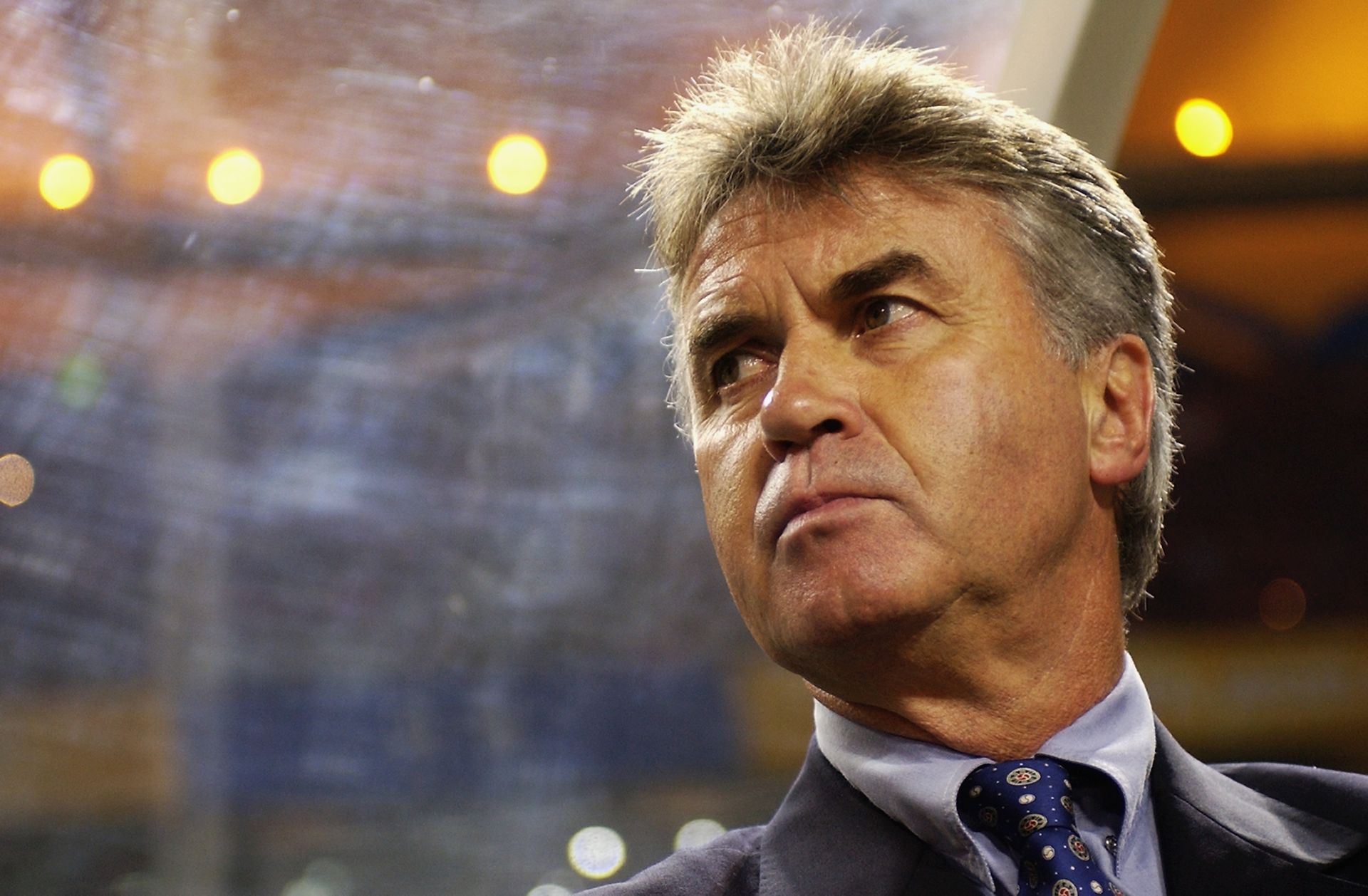
Guus Hiddink’s legacy in South Korean football is firmly cemented, with the Dutch manager famously leading the national team to an extraordinary fourth-place finish at the 2002 World Cup.
When Hiddink took charge of the Taegeuk Warriors, the team had never advanced beyond the group stage in a World Cup. Under his leadership, they transformed into one of the tournament’s most memorable underdog stories, defeating heavyweights such as Italy and Spain along their remarkable journey.
More than twenty years later, Hiddink has reflected on the overwhelming response he received in South Korea, which even included an offer of a villa on the scenic volcanic island of Jeju.
This admiration went far beyond the football pitch. The former Chelsea and PSV Eindhoven manager admitted that he was often taken aback by the intensity of affection shown towards him.
“Sometimes, I found it a little awkward how people in South Korea looked at me and how happy they were with me,” Hiddink told FourFourTwo. “They called me in Korean the ‘Boss of Bosses’. I thought, ‘Yes, that’s really enough now.’”
He went on to explain, “A newspaper even proposed a Korean name for me, and banners appeared in the stadiums reading ‘Hie Dung-gu for president’. Some joked that I could have run for president if I had become a citizen. It was all nonsense.”
“I was made an honorary citizen of Seoul and offered various gifts. It’s considered impolite to refuse, but I couldn’t accept everything. I was offered a villa on Jeju Island, but I didn’t see myself going there for a weekend if I moved back to Europe,” he recalled.
Despite the humour and attention surrounding his fame, Hiddink continues to cherish his close connection with South Korea.
“I return to South Korea once or twice a year,” he said. “Every time, I’m welcomed with open arms. With my partner’s initiative, we set up the Guus Hiddink Foundation. Through it, we’ve built several football pitches across South Korea, including ones designed for blind children. These fields have padded walls and balls with bells inside. I once tried playing blindfolded myself, but I didn’t move an inch.”
Hiddink also shared his hopes of expanding the foundation’s work to North Korea. “We wanted to do something similar in North Korea. I’ve been there, and trucks with materials were ready, but due to political reasons, it didn’t go ahead. After the 2002 World Cup, we even played a friendly match against North Korea in Seoul,” he said.
“That was a unique occasion. The night before, we had a dinner with both South Korean and North Korean squads. There was heavy supervision from their side – or rather, security – as they didn’t want any players to defect. The game ended in a diplomatic 0-0 draw!”
Hiddink’s influence extended far beyond South Korea. His quiet Dutch hometown of Varsseveld became an unexpected tourist attraction after the 2002 World Cup.
“My birthplace, Varsseveld, in the Dutch countryside, started seeing many South Korean visitors after the World Cup. My eldest brother, who has sadly passed away, was very entrepreneurial – he came up with the idea of selling small jars of soil that I had walked on,” Hiddink revealed with a smile.
“It actually did quite well. My family – I grew up with five brothers – followed all my adventures very closely.”
-
Will Rahul Dravid Coach England? Former India Player Emerges As Surprise Candidate: Report
-
Why Are German Companies Moving Jobs Abroad? India Emerges As A Key Beneficiary
-
India Mourns Former Qatar Emir Sheikh Hamad, PM Modi Calls Him 'Visionary Leader'
-
Harry Kane vs Erling Haaland: Who truly stands as the world’s finest striker?

-
PM Kisan 24th Installment: Expected Release Timeline and Essential Tasks Farmers Should Complete Now