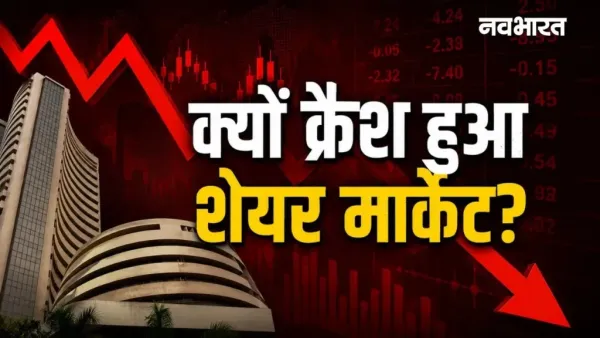
Why Share Market Crash On Wednesday: The continuous rise in the Indian stock market for the last five trading sessions came to a halt on Wednesday, July 8. Where with the beginning of the market, a decline was seen in both the major indices Sensex and Nifty. At one time during trading, BSE Sensex fell by almost 2,000 points, while NSE Nifty fell by 593.5 points (about 2.4%) to a low of 23,805.20.
The BSE Sensex closed at 76,503.60, down 1,677.12 points or 2.15 per cent, while the Nifty-50 closed at 23,882.05, down 516.65 points or 2.12 per cent. The market breadth remained weak, with financials, FMCG, oil & gas, private banks and healthcare stocks leading the losses. Realty was one of the few sectors that were trading in positive territory.
IndiGo shares fell by 5.02%
Very little stock was left from this selloff. Among Sensex stocks, Trent fell by only 0.17 per cent, followed by Infosys which fell by 0.21 per cent and Titan which fell by 0.34 per cent. While Sun Pharma was trading 0.75 percent down and Tata Steel 0.87 percent down. Because of which he became the strongest performer of the day. On the other hand, Indigo fell by 5.02 percent, emerging as the biggest loser.
After this, shares of Maruti Suzuki closed down by 4.11 percent, Hindustan Unilever by 3.32 percent, Bajaj Finance by 3.08 percent, Kotak Mahindra Bank by 2.93 percent, Mahindra & Mahindra by 2.85 percent, ITC by 2.82 percent, Bharatiya Electronics Limited by 2.70 percent and Reliance Industries by 2.35 percent.
Why did the Indian stock market crash?
Tension increased in West Asia: Investor sentiment weakened after America launched new attacks on Iran, due to which geopolitical concerns increased again. Washington suspended Iran’s oil export license after the attack on three tankers in the Strait of Hormuz, raising fears of supply disruptions despite the ongoing ceasefire. The sharp decline came as US President Donald Trump told reporters at the NATO summit in Ankara, Turkey that we struck very, very strongly last night against very dangerous people in Iran. Trump further said that they (Iran) are sick, there is something wrong with them. On the agreement between America and Iran, he said that I think it is over.
Crude oil continues to rise: after this, brent crude oil Crude rose 4.25% to $77.31 a barrel, while WTI crude rose 4.22% to $73.41 a barrel. Rising oil prices are generally considered bad for India, which is heavily dependent on crude oil imports, as it can increase import bills, increase inflationary pressures and increase input costs for businesses.
Accelerating ups and downs: India VIX, often referred to as the market’s fear gauge, surged 25.62 per cent to 14.58, indicating growing uncertainty in the market and caution among participants.
Pressure on global market: Asian equities declined, with Japan’s Nikkei 225 and South Korea’s Kospi in the red. A weak trend from Wall Street, where US stocks closed lower overnight, also dampened investor confidence.
Rupee weak against dollar: in early business indian rupee It fell 20 paise to 95.16 against the US dollar. Dealers attributed the decline to rising geopolitical tensions, higher crude oil prices and strengthening of the US dollar, while weak domestic equity markets put further pressure on the local currency.
How will the market move on July 9?
According to a Bussiness report, Ajit Mishra, SVP at Religare Broking, says that Nifty has fallen below its support zone of Rs 24000-₹24,150. It is also below its key moving averages. Due to this, its technical structure seems weak in the short term. He said that the next support is in 23,650-23,800 zone. In case of bullishness, Nifty will face resistance in 24,150-24,300 zone.
-
If your skin is sensitive, then use these 5 jewelery materials. Skin Allergy Free Jewelery For Sensitive Skin

-
Who was Chezhiyan? National Award Winner Passes Away at 57 in Chennai

-
Strengthen temple traditions in villages, says RSS leader Vanniarajan

-
Rohit Pawar’s allegation – Government is protecting the contractors who fund the ruling parties. Rohit Pawar Alleges Govt Shielding Contractors Who Fund Ruling Parties
-
Shivamogga Tailor Booked for Allegedly Impregnating Woman on False Promise of Marriage