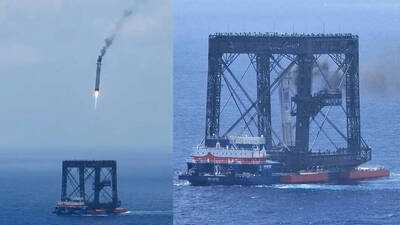
In a significant advancement for its space exploration efforts, China has successfully retrieved a reusable rocket booster for the first time during the inaugural flight of its Long March-10B rocket. The launch took place from Hainan, southern China, at 12:15 p.m. local time (04:15 GMT) on Friday. Approximately six minutes post separation from the upper stage, the first-stage booster made a controlled descent and was recovered on a floating platform, marking a historic achievement in China's space program.
Mao Ning, spokesperson for the Chinese Foreign Ministry, shared a video of this accomplishment on social media, calling it a pivotal moment. "Today marks a historic day in China's space program! The Long March-10B has successfully completed its first flight and recovered its first stage using a sea-based net. This is the nation's first controlled rocket recovery, representing a significant step towards reusable launch capabilities," she stated.
The development of reusable rockets is seen as a major innovation, as traditionally, rocket stages are discarded after use. The ability to recover and reuse boosters, which are among the most costly components of a rocket, can significantly reduce the expenses associated with satellite launches and future space endeavors. This achievement also positions China closer to creating reusable rocket systems akin to those developed by SpaceX and Blue Origin. SpaceX successfully landed its reusable Falcon 9 rocket after an orbital flight in December 2015, while Blue Origin achieved a similar feat with its New Glenn rocket in November 2025.
Earlier this year, China attempted its first reusable rocket recovery with the Long March-10A, which successfully completed a controlled descent before landing near a recovery platform. The Long March-10B is capable of transporting at least 16 metric tons to low-Earth orbit and has been compared to SpaceX's Falcon 9. However, unlike the Falcon 9, it does not autonomously land on a pad or drone ship; instead, it employs landing hooks to catch a net on a floating platform at sea.
This successful mission has also positively influenced investor confidence, leading to a 10% increase in shares of China Spacesat and China Satellite Communications, the maximum daily gain permitted under China's market regulations.
-
Financial Horoscope Today, July 11, 2026: Aquarius Signs Will See Financial Gains, Know the Status of Other Signs

-
Pisces Tarot Horoscope Today, July 11, 2026: Recognition and respect await Pisces; pay extra attention to health

-
MP: Railway police officer held for supplying opium to smuggler

-
Shubman Gill Receives Prestigious Wimbledon Honour, Joins Sachin, Virat & Rohit In Elite Club

-
India, New Zealand Elevate Ties To Strategic Partnership; PM Modi, Luxon Unveil Roadmap To 2030