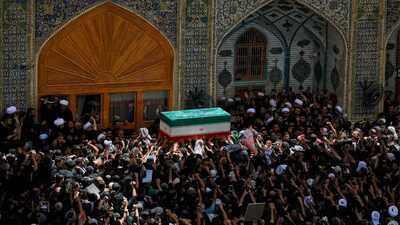
New Delhi: Iran’s slain Supreme Leader Ayatollah Ali Khamenei was buried in his hometown of Mashhad early Friday, ending nearly a week of funeral ceremonies and public mourning.
Khamenei ruled Iran for almost 37 years. He was killed in US and Israeli airstrikes on February 28, which marked the beginning of the latest Middle East conflict. His body was laid to rest at the Imam Reza Shrine, one of the holiest places in Shia Islam.
Khamenei became only the second Iranian ruler to be buried in Mashhad. Nader Shah was the first. He was buried in the city after his assassination in 1747, following a reign of nearly 11 years.
Large crowds attend processionFuneral processions began last Saturday. Iranian authorities closed streets and airspace in Tehran and other cities as large crowds gathered to mourn Khamenei. The late leader ruled Iran with an iron grip for decades and pursued a confrontational policy towards the West.
Huge crowds packed the route between the Danesh intersection and the Imam Reza Shrine in Mashhad. Authorities had to transport Khamenei’s body by air to the holy site because of the gathering. Iranian state media broadcast visuals of mourners lining the funeral route and surrounding the convoy that carried his body. The state broadcaster also showed people holding anti-Trump banners during the procession.
Successor absent from funeralAccording to Iran International, Khamenei’s eldest son, Mostafa Khamenei, led the funeral prayers. However, Mojtaba Khamenei, the second eldest of Khamenei’s four sons and his successor as Iran’s Supreme Leader, did not attend the ceremony. The former leader’s three other sons were present. Iranian authorities did not immediately give a reason for Mojtaba Khamenei’s absence.
Burial amid renewed fightingThe burial took place amid renewed hostilities between Iran and the United States. Washington carried out strikes for two consecutive days after blaming Tehran for attacks on civilian tankers in the Strait of Hormuz. Iran retaliated against the US action, raising fears of a wider military escalation in the region.
The two countries had signed a Memorandum of Understanding in June to bring an end to the conflict. The agreement set out a 60-day ceasefire and a roadmap for further negotiations. The document was first drafted on June 14 and formally took effect on June 17. The renewed exchange of attacks has now placed the ceasefire and planned negotiations under serious strain.
-
Opportunity to pursue B.Tech at engineering colleges in UP; AKTU has reopened the registration process for UPTAC..

-
CCI Recruitment 2026: Applications for various posts at CCI start today; check full details here..

-
Scholarships: These Australian universities offer scholarships to Indian students; find out the details..

-
UP Bus Conductor Recruitment 2026: Recruitment for bus conductor posts is underway in these UP districts; apply by this date..

-
Indian Navy SSC Officer Recruitment 2026: Recruitment announced for SSC Officer posts in the Indian Navy..