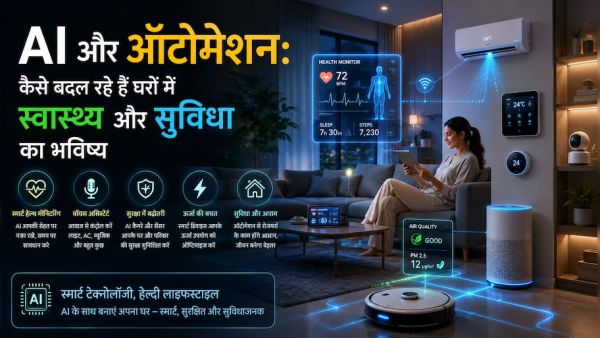
In the last few years, Artificial Intelligence (AI) is no longer a technology limited only to big tech companies or offices, but it has quietly become the most essential part of our homes. Moving beyond money transactions and finding routes, AI has now reached our living rooms, kitchens and bathrooms. According to recent global reports, the global AI market is expected to exceed US$1.8 trillion by the end of this decade. This technology is now not just for entertainment, but has become the foundation of the ‘Smart Home Ecosystem’ being created keeping in mind people’s health and a better, stress-free lifestyle. Solution will be found before the disease, not after the disease. It has been the habit of Indians for decades that when our health deteriorates, we run towards the doctor or the solution. For example, when cough or shortness of breath increases, one thinks of air purifier or in case of stomach upset, one worries about TDS of water. But AI and automation have now completely changed this thinking. Predictive Technology: Modern smart homes now understand their surroundings, learn from user habits, and anticipate potential health problems and take necessary action in time. Record boom in the market: This is why the global smart home market, which was worth about US $ 128 billion in the year 2024, is expected to grow rapidly to more than US $ 537 billion by 2030. Changed thinking after COVID-19: Health and hygiene became the first priority. The biggest reason behind this technological revolution is the changed mindset of people after the COVID-19 pandemic. Now people have become very serious about their immunity and healthy lifestyle. From India’s big metros to Tier-2 and Tier-3 cities, cheap internet, smartphone penetration and Internet of Things (IoT) based gadgets have taken smart living to every home. AI Air Purifier and Smart Water Filter: Strict protection on breath and water In this era of increasing pollution, keeping the indoor air pure has no longer become a luxury but a compulsion. Smart Air Purification: Unlike traditional filters, AI-based air purifiers live monitor the particulate matter (PM 2.5), humidity, bacteria and allergens present in the air. If there is a sudden increase in pollution outside, these systems automatically increase their cleaning speed and go into sleep mode to save power when the room is vacant. Water purifiers that become doctors themselves: Now AI water purifiers have come to purify water, which continuously check the TDS level of water. They automatically monitor the life of the filters and, based on local water quality, alert the user in advance through the mobile app when servicing is required. Nowadays, long-life filters lasting up to 2.5 years and subscription-based maintenance models have made this easier. Smart Kitchen and Chimney: Settings change on voice command This AI change is not limited to air and water only, but is now making your kitchen hi-tech too. Modern smart kitchens have started automatically suggesting healthy recipe options based on the eating habits, calorie needs and preferences of the family members. At the same time, AI chimneys installed in kitchens now auto-adjust their suction power and settings by sensing the smoke level through voice command, gesture control, IoT connectivity and directly through the mobile app. You will get relief from small daily decisions and mental fatigue. The biggest advantage of these advanced home automation technologies is not just to show off the gadgets, but to reduce the mental burden of small daily decisions (Decision Fatigue) from the human mind. ‘Is the water safe to drink?’, ‘Is the air in the room clean?’, or ‘Is the food cooked properly?’—all these concerns are now monitored by AI itself 24 hours a day. These systems work quietly in the background and send notifications to the user only when actual human action or a filter change is required. With this, instead of becoming a cause of mental stress, our home becomes a safe space that gives us mental peace. Foreign models will have to be changed according to India’s needs. Even though these technologies work by tracking the data and habits of the users, maintaining data privacy, consumer trust and transparency will be the biggest challenge for the companies. Seeing the way the challenges of environment and urban life are increasing in India, India will have to avoid merely copy-pasting the smart home model of western countries. We will have to customize this technology keeping in mind the structure of Indian houses, availability of electricity and water and special habits of the families here. The future belongs to a world where technology will not shout through screens on the walls, but will remain silent in the background, making our lives safe, sustainable and healthy.
-
Real Madrid Unlikely to Raise Contract Offer for Vinicius Jr., Maintaining Pre-World Cup Position

-
12 Transfers You Might Have Missed During the World Cup Knockout Rounds

-
4 Zodiac Signs Attract Major Abundance & Luck On Friday, July 10, 2026

-
In the month of Shiva, glass bangles are just fashion? Find out what the benefits are

-
The mystery of the pink lake amidst the blue sea, science is hidden behind the color of Lake Hillier.