At this unique temple in Maharashtra, Lord Ganesha has three trunks and a secret underwater chamber; how travellers can reach here
ETimes | July 9, 2026 6:40 PM CST
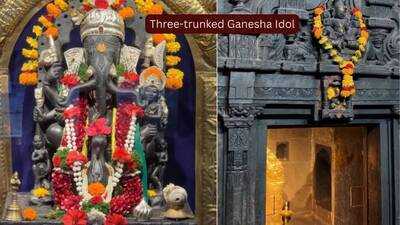
India is dotted with numerous famous temples which are dedicated to Lord Ganesha. In most of these shrines, we can see Ganesha seated on his faithful mouse, holding four arms and a single trunk. But did you know there is a temple in Pune’s Somwar Peth which challenges the familiar image of the beloved deity. This is known as Shree Trishunda Ganpati Temple which is home to one of India's rarest Ganesha idols . Here the deity features six-arms and three trunks riding a peacock instead of the traditional mouse.
Yes, you read that right. Another unique feature of the temple is the underground samadhi that remains submerged for most of the year and opens only on Guru Purnima. Sounds fascinating, right? This makes Shree Trishunda Ganpati Temple one of Maharashtra's most unique lesser-known spiritual destinations.
Why is the temple called Trishunda?
Far from the madding crowd, this 18th-century temple is perfect for travellers who enjoy discovering heritage sites with remarkable stories, architecture and mystery. Those wondering why the temple is known so, here’s a little history:
"Tri" means three, while "Shund" means trunk.
The presiding deity is known as Trishund Mayureshwar Ganapati. The idol features three trunks, six arms and is seated on a peacock (Mayur). It is a rare form of Lord Ganesha. The idol is carved from black basalt stone.
Many believe that the three trunks symbolize Brahma, Vishnu and Mahesh or Shiva, the three principle gods of Hinduism. Some link it with the past, present and future.
History of the temple

The temple was built between 1754 and 1770 during the Peshwa era. Historians believe that the architecture beautifully combines Rajasthani, Malwa and South Indian influences, making it a unique heritage site in Maharashtra.
One of the most intriguing carvings shows British soldiers restraining a rhinoceros, believed to reference the aftermath of the Battle of Plassey (1757). This is a rare form of contemporary political history being immortalised in temple art.
The mysterious underwater chamber
What adds to the mysterious aspect of the temple is perhaps the underwater chamber which is hidden in the basement. It is basically the samadhi (memorial shrine) of Bhimjigiri Gosavi, the ascetic credited with establishing the temple. Only on the day of Guru Purnima the water drains temporarily. Devotees can descend through the narrow passageways and pay their respects.
Inscriptions that reveal a multicultural past
Another feature that makes the temple a must visit for history lovers is the presence of inscriptions in Sanskrit, Devanagari and Persian (Farsi).
How to reach
The temple is located in Somwar Peth.
Nearest railway station: Pune Junction (around 2–3 km)
Nearest airport: Pune International Airport (approximately 10–12 km)
From Pune Junction or airport, taxi or app-based cabs are readily available.
Nearby attractions
You can pair your visit with:
Dagdusheth Halwai Ganpati Temple
Shaniwar Wada
Lal Mahal
Whether you're a devotee, history lover or just a curious traveller, this splendid temple is a must visit.
Yes, you read that right. Another unique feature of the temple is the underground samadhi that remains submerged for most of the year and opens only on Guru Purnima. Sounds fascinating, right? This makes Shree Trishunda Ganpati Temple one of Maharashtra's most unique lesser-known spiritual destinations.
Why is the temple called Trishunda?
Far from the madding crowd, this 18th-century temple is perfect for travellers who enjoy discovering heritage sites with remarkable stories, architecture and mystery. Those wondering why the temple is known so, here’s a little history:
"Tri" means three, while "Shund" means trunk.
The presiding deity is known as Trishund Mayureshwar Ganapati. The idol features three trunks, six arms and is seated on a peacock (Mayur). It is a rare form of Lord Ganesha. The idol is carved from black basalt stone.
Many believe that the three trunks symbolize Brahma, Vishnu and Mahesh or Shiva, the three principle gods of Hinduism. Some link it with the past, present and future.
History of the temple
The temple was built between 1754 and 1770 during the Peshwa era. Historians believe that the architecture beautifully combines Rajasthani, Malwa and South Indian influences, making it a unique heritage site in Maharashtra.
One of the most intriguing carvings shows British soldiers restraining a rhinoceros, believed to reference the aftermath of the Battle of Plassey (1757). This is a rare form of contemporary political history being immortalised in temple art.
The mysterious underwater chamber
What adds to the mysterious aspect of the temple is perhaps the underwater chamber which is hidden in the basement. It is basically the samadhi (memorial shrine) of Bhimjigiri Gosavi, the ascetic credited with establishing the temple. Only on the day of Guru Purnima the water drains temporarily. Devotees can descend through the narrow passageways and pay their respects.
Inscriptions that reveal a multicultural past
Another feature that makes the temple a must visit for history lovers is the presence of inscriptions in Sanskrit, Devanagari and Persian (Farsi).
How to reach
The temple is located in Somwar Peth.
Nearest railway station: Pune Junction (around 2–3 km)
Nearest airport: Pune International Airport (approximately 10–12 km)
From Pune Junction or airport, taxi or app-based cabs are readily available.
Nearby attractions
You can pair your visit with:
Dagdusheth Halwai Ganpati Temple
Shaniwar Wada
Lal Mahal
Whether you're a devotee, history lover or just a curious traveller, this splendid temple is a must visit.
READ NEXT
-
Telangana software engineer charged with first-degree murder in US
-
SC slams civic bodies over Delhi, Lucknow fire tragedies
-
IND vs ENG 4th T20I: Toss Result & Complete Playing XIs
-
'No One Wants To Take Her': Sushmita Dev's Sharp Swipe At Mahua Moitra After Joining BJP

-
Top 10 | ABP LIVE Evening Bulletin: Top News Headlines from 9 July 2026 - Evening