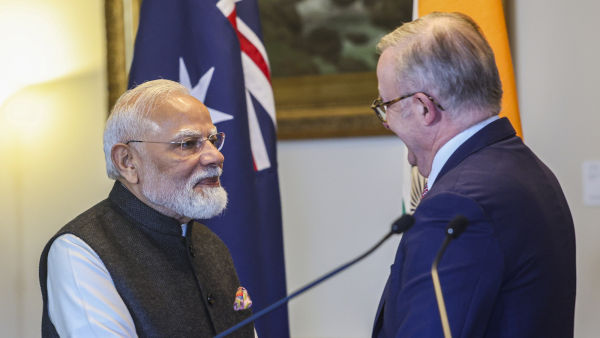
Melbourne: India and Australia on Thursday, July 9, sealed a raft of landmark pacts spanning civil nuclear energy, maritime security and critical minerals sectors, as Prime Minister Narendra Modi and his Australian counterpart Anthony Albanese reinforced the vital role of the bilateral partnership in ensuring a peaceful Indo-Pacific.
Modi held wide-ranging talks with the Australian leader, a day after landing in Australia from Indonesia in the second leg of his three-nation tour that is aimed at boosting trade and defence ties against the backdrop of an increasingly fractured geopolitical environment.
Following the Modi-Albanese meeting, the two sides unveiled an India-Australia joint declaration on defence and security, a joint statement on energy ties and a roadmap for collaboration in cyber, critical technologies and supply chains.

The pact on civil nuclear energy will facilitate the commercial supply of uranium from Australia to India to help New Delhi‘s nuclear power projects.
The two sides also decided to work expeditiously on the proposed Comprehensive Economic Cooperation Agreement as well as on a bilateral investment protection pact.
“Today, we have signed an important agreement in the field of nuclear energy. This will open the way for uranium supplies from Australia to India and give new impetus to our clean energy objectives,” Modi said in his media statement.
“Our cooperation in critical minerals is vital to our strategic security and clean energy transition. With this in mind, today we have launched the Australia-India Partnership on Cyber, Critical Technologies, and Supply Chains,” he said.
Modi said both sides will also work together on a critical minerals corridor.
The prime minister also mentioned growing engagement between the two countries in the defence domain and emphasised the importance of a free and stable Indo-Pacific.
The new initiatives to bolster defence ties came amid growing concerns over China’s increasing military muscle-flexing in the Indo-Pacific.
“The Indo-Pacific is not just the confluence of two oceans. It also symbolises the shared aspirations of like-minded democracies like India and Australia,” he said.
“Today, we have issued an important Joint Declaration to enhance cooperation in defence and security. Through the India-Australia Defence Innovation Corridor, we will work to connect defence startups and industries,” he said.
The prime minister said the India-Australia Maritime Security Collaboration Roadmap will give new impetus to shared efforts in the Indo-Pacific.
“We will also move forward together in shipbuilding, ship repair, and maintenance,” he said.
Modi also said that India and Australia recognised that terrorism poses a serious challenge not just to any one country, but to all of humanity.
“Therefore, our fight against terrorism is shared, our resolve unwavering, and our cooperation continues to strengthen,” he said.
“We also believe that the tensions and conflicts raging in many parts of the world can only be resolved through dialogue and diplomacy. Together, we will further strengthen peace, stability, freedom of navigation, and a rules-based order throughout the Indo-Pacific region,” he said.
In his remarks, Albanese said Australia’s relationship with India has never been more consequential than it is today.
The Australian prime minister said the pact on nuclear energy will facilitate uranium exports from Australia to India for peaceful purposes.
“The arrangement facilitates Australian uranium exports to India to help increase the share of non-fossil fuel power capacity, providing an additional market for the Australian resources sector,” he said.
Albanese said the two sides are focusing on diversifying ties to grow from strength-to-strength.
“Six years into our strategic partnership, Australia’s relationship with India has never been more consequential than it is today. Our partnership has never been stronger,” he said.
“We share a focus on deepening and diversifying the relationship between our countries so we can continue to grow from strength to strength.”
“Today, we have done exactly that across the breadth of our relationship. With new landmark agreements, we are expanding our relationship across defence and security education, science and technology and energy security and critical minerals,” he said.
Albanese said the joint declaration on defence and security cooperation will provide for deepening “practical partnership”.
“Australia values India as a top-tier security partner and the declaration reflects our shared commitment to a peaceful, stable and prosperous Indo-Pacific region.”
“We will boost strategic coordination, increase the complexity of our defence exercises and further build interoperability between our defence forces,” he said.
-
Norway Team Doctor Provides Clarity on Illness Concerns Before England Quarter-Final

-
World Cup 2026: Four Football Icons Battle for a Golden Boot That Could Redefine History

-
Erling Haaland Says Beating Brazil Feels 'Unreal' as Norway Star Reflects on Stunning World Cup Triumph

-
Mughal period example of religious pluralism: Michael Calabria
-
Plug Types: 2-pin and 3-pin plugs—is it just a difference in design, or are there safety reasons too?