Title 10 of the U.S. Code was adopted in August 1956 as a six-part federal law. The code outlines how the branches of the U.S. Armed Forces and the Department of Defense are structured, what their respective roles are, and which activities and missions they’re responsible for. Subtitle C (Section 8062) pertains to the Navy and requires it to maintain no fewer than 11 aircraft carriers at all times. It mandates other requirements, including having at least 31 operational amphibious warfare ships (10 of which must be amphibious assault ships) and 10 carrier air wings.
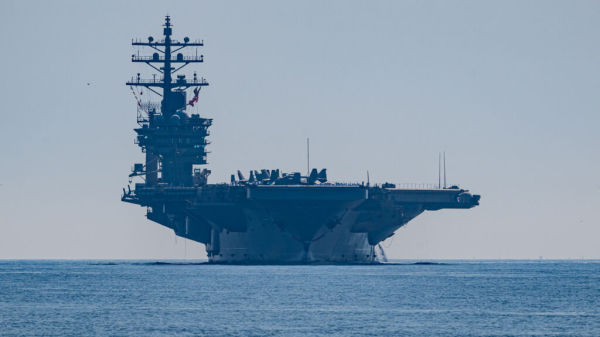
The Navy does, in fact, have 11 nuclear carriers in 2026, but just barely. Of those, four — well, technically five, but there’s a caveat — are currently deployed. The four Nimitz-class carriers in active use are the USS Theodore Roosevelt (CVN-71), the USS Abraham Lincoln (CVN-72), the USS George Washington (CVN-73), and the USS George H.W. Bush (CVN-77).
The fifth is the USS Nimitz, which is the longest-serving carrier in the U.S. Navy’s history. However, it’s been parked in New York Harbor on public display at the International Naval Review as part of the Navy’s 250th anniversary celebration, and is also scheduled for decommissioning in 2027 — or, well, that’s the plan. The other six carriers are unavailable for much of 2026 as they’re at their respective home ports in various stages of Planned Maintenance Cycles (PMCs), which the Government Accountability Office has found typically finish late 75% of the time, thus putting a serious strain on fleet readiness.
Aircraft carriers are difficult to maintain
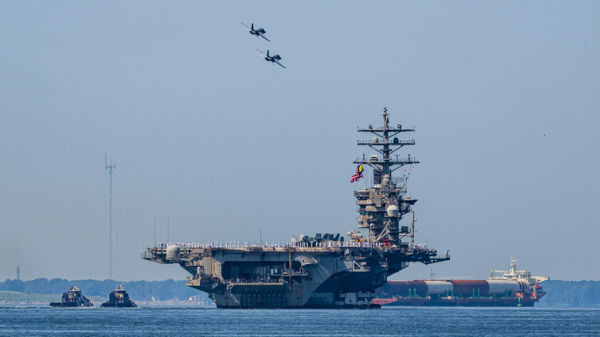
The USS Theodore Roosevelt (CVN-71) is currently at Joint Base Pearl Harbor-Hickam (Hawaii) taking part in the 2026 Rim of the Pacific (RIMPAC) exercise, a 30-nation event that runs through July 31. The USS Abraham Lincoln (CVN-72) forms the Abraham Lincoln Carrier Strike Group and is in the midst of supporting Operation Epic Fury in the Arabian Sea. The USS George H.W. Bush (CVN-77) is also in the Arabian Sea, while the USS George Washington (CVN-73) is conducting its first patrol of 2026 in the Philippine Sea.
As for the USS Nimitz, this iconic ship was set to be decommissioned in May 2026, but this was postponed by 10 months to March 2027 due to delays with the USS John F. Kennedy (CVN-79), the Navy’s next Ford-class aircraft carrier. The Nimitz finished its mid-life Refueling and Complex Overhaul (RCOH) more than two decades ago, in 2001, and there are serious questions as to whether it’s even capable of going back out to sea, even in a pinch.
The USS John F. Kennedy, already a good two years behind schedule, is set for delivery in March 2027 and will allow the Nimitz to retire. There have been many delays over the years, with the most recent issues (as of 2026) tied to delays in testing and certification of new aircraft carrier technologies that the Navy has not used before, primarily the Advanced Arresting Gear (AAG) and Advanced Weapons Elevator (AWE).