New materials are not created overnight; their development is often a slow, iterative process and in most cases, the work has to stop for reasons beyond the control of even the brightest minds in material science.
Put simply, scientists spend months reading research papers, designing experiments, testing formulations and analysing failures before arriving at a commercially viable product. Even then, a promising discovery may never reach production if it cannot be manufactured economically or integrated into existing factory infrastructure.
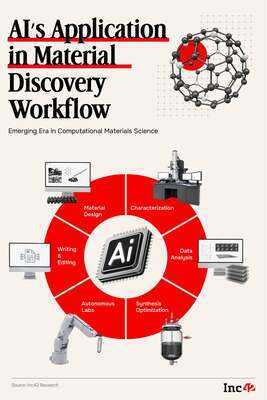
Mumbai-based deeptech startup Novyte Materials is betting that AI can reduce years of industrial R&D into months by automating repetitive scientific tasks, but beyond leveraging AI for new material discovery, the startup’s focus is also on how agentic AI can solve the key problem of real-world optimisation for new materials, which is often the key pain point.
Founded in 2025 by chemical engineer Ajaz Khan and incubated at the Institute of Chemical Technology (ICT), Mumbai, Novyte is building AI models that help chemical and materials companies optimise existing products, discover new formulations and automate large parts of industrial research and development.
Materials science involves identifying or designing new materials with specific properties and functions to meet technological, industrial, or scientific needs. AI’s opportunity in the field is huge.
According to research firm Market.us, the global AI in Materials Discovery Market size is expected to be worth around $5.5 Bn by 2034, from $536 Mn in 2024, growing at a CAGR of 26.4% during this period.
Globally, AI-driven materials discovery has attracted significant investment, with startups such as CuspAI, Orbital Materials and Citrine Informatics building AI for new materials design and enterprise R&D.
While many focus on discovering novel materials, Novyte is betting that automating the process of formulation optimisation and enabling businesses to commercialise materials will be equally important.
Novyte’s Formula: Leveraging AI For Material OptimisationWhile much of the conversation around AI in science has focused on discovering breakthrough materials, Khan says that is only a small part of what industrial R&D teams actually do.
Most chemical manufacturers spend years refining existing formulations like changing ingredient concentrations, replacing hazardous chemicals, improving product performance or adapting formulations for different production environments. This optimisation and refinement involves repeated literature reviews, experiments and trial-and-error, consuming significant time and resources.
Novyte’s platform called Novyte Q attempts to automate much of that work. The startup has built chemistry-aware AI models that understand scientific literature, reaction pathways and material properties.
Khan said the platform analyses hundreds of research papers, suggests possible formulations, recommends experimental pathways and uses reinforcement learning alongside density functional theory which is an industry-standard quantum chemistry technique. to evaluate whether proposed materials are likely to be chemically stable.
According to the founder, Novyte’s AI agent reviews between 500 and 1,000 scientific sources in each iteration, completing multiple rounds before generating recommendations.
The company says the platform supports research from Technology Readiness Level (TRL) 1 through TRL 7, covering literature review and pathway identification to live optimisation during laboratory experiments. “We are able to even reverse engineer competitor materials, speciality chemicals, just from the technical data sheets (TDS) and material properties,” said Khan.
This platform is sold on an annual basis to companies that deploy the software within their own infrastructure using customer-owned GPU hardware, allowing proprietary research data to remain on-premise.
“A speciality chemicals manufacturer deployed Novyte on premise to replace a hazardous additive and hit target spec in roughly 40 trials against an internal baseline of around 200, cutting both lab work and timeline by about 58%,” Khan told Inc42.
Currently, Novyte’s main business comes from Novyte Q, although the company plans to expand the business to materials discovery using custom AI models through a discovery platform called Psi. “Novyte’s long-term strategy is to go beyond discovering materials and build what he calls the ‘synthesis layer’ that helps customers turn AI-generated candidates into manufacturable products,” said Khan.
Notably, in June, Novyte signed a royalty agreement with Chemvera Specialty Chemicals, a global specialty-chemicals manufacturer to develop, manufacture, and commercialize a high-value specialty chemical for the polymer industry. This manufacturing partnership will see the startup develop and synthesise AI-discovered material candidates, with Chemvera responsible for manufacturing and distribution.
Novyte has also begun working with a growing roster of leading chemical and materials companies, including Manipal Specialty Chemicals, Primacy Industries and many more applying Novyte’s platform to their materials and formulation challenges.
When asked whether current AI models are truly ready for the challenges of material science, Khan said that generation of material candidates is not the challenge. Most companies in this space can produce millions of ‘stable’ structures, but these materials often fail when tested under real-world manufacturing conditions or cannot be synthesised at all.”
“Synthesisability is mostly ignored, so models hand you beautiful structures with no plausible route to make them. And property prediction stays shallow exactly where industry needs it, in mechanical, thermal, and corrosion behavior, with no loop feeding experimental failures back in,” said Khan.
Novyte’s moat isn’t about generation, but materials that have stability, that keep physics in the loop and that are synthesisable. The process still requires human guidance and intervention. “Humans stay in the seats that matter: defining the problem and constraints, sanity-checking routes before we commit lab time, and making the final go or no-go call. We compress the search and the drudgery, not the scientist’s judgment.”
The Key: Cracking The Industrial R&D MarketAbout six months into commercialisation, the company has built what Khan describes as a high-single-digit base of paying customers while continuing to run evaluations with additional enterprises. He did not reveal specific revenue figures.
Implementation typically takes around two weeks, according to the company, while customers begin outperforming their own literature-based research processes within roughly six weeks.
Khan says several have already expanded deployments by increasing seat counts by 30% to 50%, initiated second R&D projects within their first year and begun discussing multi-year agreements.
In December 2025, early stage fund Thiea Ventures, focused on AI and deeptech led a ₹4.5 Cr pre-seed round in the startup.It also saw participation from Sandesh Paturi, cofounder, Venwiz and Niharika Jain, director at Chemvera. Additionally, Novyte is part of NVIDIA’s Inception programme, through which it has received a $40,000 compute grant, access to its GPU infrastructure and technical support for training its AI models.
India has few direct rivals, although globally the field is crowded with companies such as Aionics, Cusp AI, and Orbital Materials. Other materials science startups in India work in different spaces than Novyte.
Bengaluru-based materials science startup Whizzo raised $4.2 Mn in January last year in a round led by Lightspeed, along with participation from BEENEXT. Besides investing in R&D capabilities, the startup wants to create a design lab for engineered textiles for the fashion industry.
Another example is RF Nanocomposites, founded in 2021 by Vishal Kumar Chakradhary, which operates in the defence sector, manufacturing and developing radar-absorbing materials.
But global companies have the capital advantage and deeply entrenched supply chain ecosystems for the materials science space.
Cambridge-based CuspAI signed a term sheet for a $400 Mn funding round valuing it at about $2.6 Bn — up by $1Bn in just nine months. Enterprise materials-informatics platform Citrine Informatics anchor the incumbent tier. Flagship Pioneering spun out Lila Sciences with a $200 Mn seed round, and Periodic Labs, founded by ex-OpenAI and Google DeepMind employees that raised a $200 Mn seed led by Andreessen Horowitz at a $1 Bn valuation.
Collectively, these and similar startups deploying AI to invent new materials for the physical world have raised over $1.3 Bn in just the past two years.
Large AI companies and frontier model makers are also entering the space. Recently, Anthropic said its researchers are exploring how its Claude model can analyse data from nuclear magnetic resonance (NMR) machines, a technique chemists use to study the composition and structure of new materials.
The relatively thin competition in India and advanced nature of the field means a great opportunity for Novyte to grow. However, challenges still stand.
“How does a business built on the idea of generalised AI materials discovery deliver venture returns? That’s the bottom line that I still have trouble with,” Bryce Meredig, the founder of Citrine, had said in an interview.
To this, Novyte’s Khan adds, “This is the valley of death that kills most materials programs, and it’s why we deliberately built more than a discovery model. The stack is three layers: the AI-Scientist that discovers and optimises, the physics and quantum-chemistry engine that validates, and synthesis workflows that translate a target into an actual procedure, meaning precursors, conditions, and a characterisation plan.”
Finding a promising material is only the first step; synthesising it and making it work within existing manufacturing processes remains the harder challenge.
[Edited by Nikhil Subramaniam]
The post Novyte Banks On Agentic AI To Solve The Optimisation Puzzle In Materials Science appeared first on Inc42 Media.
-
Hyderabad: Extramarital affair couple drinks poison on train

-
Police arrest habitual phone, bike thief in Rajendranagar

-
Canada invites Telangana CM to visit for trade, investment ties

-
Rahul Gandhi Alleges UGC-NET Paper Leak, Claims Sociology Exam Was Sold

-
Four persons forced into Bangladesh in 2025 brought back to India