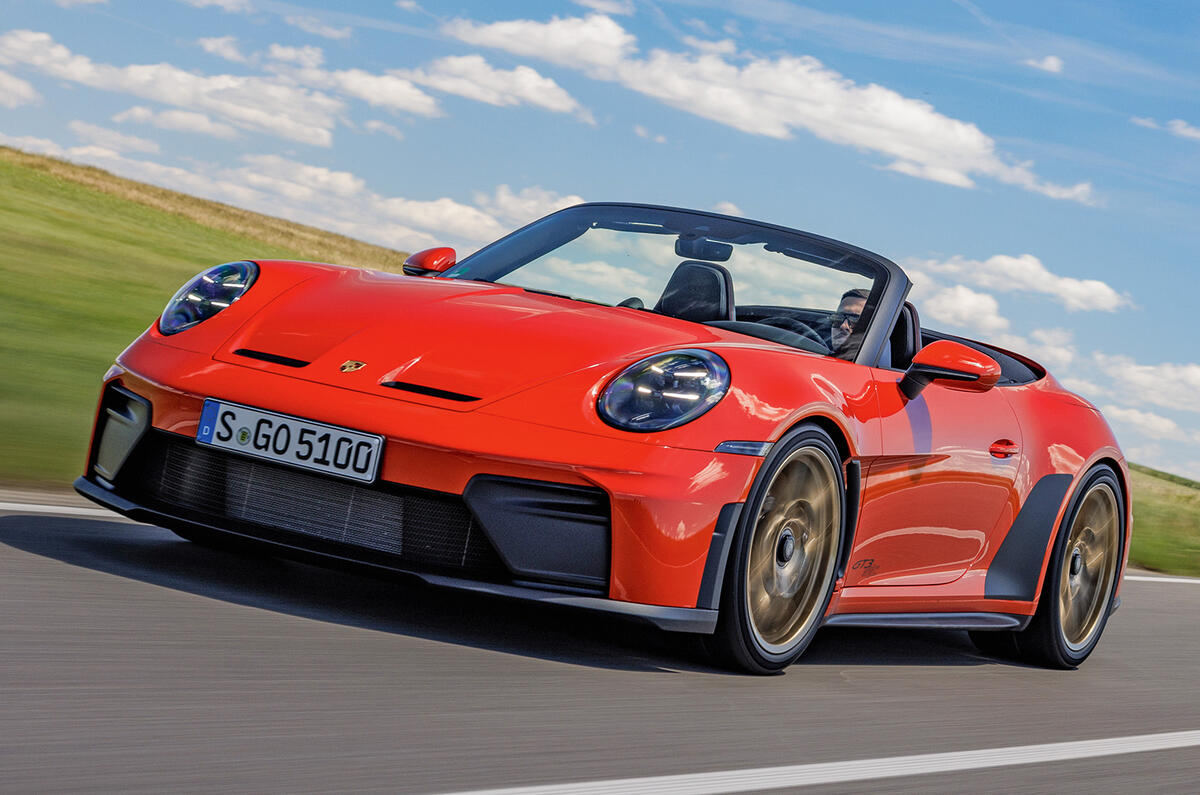
The Porsche 911 GT3 S/C may sound like a niche within a niche, but it’s exactly that – a cabriolet version of one of the most driver-focused cars Porsche has ever built. Essentially, this is the open-top interpretation of the 911 GT3, and if you think that sounds contradictory – given convertibles are often less rigid than coupés – you’re not the only one.
“The number one question people ask is ‘why?’” admits Andreas Preuninger, head of Porsche’s GT division. But the S/C – which stands for Sports Convertible – is Porsche’s answer to a simple idea: what would the most enjoyable road-only 911 be like?
This isn’t a track weapon but rather a car designed for the pure pleasure of driving on scenic roads. It carries the same mechanical purity as the GT3 Touring, but with the added appeal of open-air sound, something Preuninger notes is “one of the top three reasons people buy a Porsche GT.”
Owners of previous Porsche Speedsters and Spyders, who dealt with manual roof mechanisms, told Porsche they would happily accept an extra 10kg for the convenience of an electric folding roof. The GT3 S/C delivers exactly that, and early demand has been so strong that Porsche admits, “we should have done it sooner.”
Like any convertible, it’s heavier and slightly less torsionally stiff than a coupé. The GT3 S/C gains 74kg over the coupé, with only about 30kg coming from the roof, which borrows magnesium-rich structure from the 911 Turbo S. Porsche’s GT team was surprised this wasn’t more widely promoted, given how lightweight the mechanism is. The rest of the extra mass comes from reinforced bodywork, ensuring torsional rigidity remains impressively high at around 27kN/deg. Porsche then worked to remove roughly 75kg elsewhere to keep the car’s overall weight comparable to the GT3 coupé.
To achieve this, the S/C comes with the coupé’s Lightweight Package as standard. That means magnesium centre-lock wheels saving 9.1kg, carbon-ceramic brakes saving 20.3kg, and carbonfibre body panels – including the front wings and doors from the 911 S/T, which aren’t available on the GT3 Touring. The bonnet is also carbonfibre, and the car gets carbonfibre suspension components from the Weissach Package. Rear seats are deleted, and it’s manual-only. Fully fuelled, the GT3 S/C weighs 1497kg – just 35kg more than a manual GT3 (1462kg) – a negligible difference once options or PDK are considered.
Weight distribution, naturally, changes slightly. Yet Porsche insists the S/C drives just as sharply as the coupé. Preuninger even claims that if you were blindfolded (though he doesn’t recommend it), you’d struggle to tell them apart. “It’s not a convertible with GT parts,” he says. “It’s a GT car with a different bodyshell.”
Mechanically, it’s identical to the coupé. The same 4.0-litre naturally aspirated flat-six revs to 9000rpm, producing 503bhp at 8500rpm and 332lb ft of torque at 6250rpm. It’s a dry-sump motor with titanium connecting rods and individual throttle bodies. Power goes to the rear wheels through a six-speed manual gearbox – no PDK option here. Adding the dual-clutch automatic would mean another 30kg, and as Preuninger says, “it’s a driver’s car; you should have as many points of interaction as possible.” Around two-thirds of GT3 Touring buyers already opt for the manual, so Porsche expects similar take-up.
The suspension setup is unchanged from the GT3 Touring – not merely adjusted to mimic it, but exactly the same. “We thought development would need major tuning,” Preuninger explains, “but we didn’t have to do anything.” Early tests with softer settings reduced precision, so Porsche returned to the original baseline. “It’s not magic,” he adds, “because it’s no heavier than a standard GT3 Touring.”
The GT3 S/C is priced at £206,245 on the road. Once you account for the Lightweight Package and other options, that aligns closely with what a similarly equipped coupé would cost. Production isn’t strictly limited; the S/C will be part of the GT3 range until it can no longer meet Euro 7 emissions regulations, which take effect from November next year.
Exclusive to the convertible is the Street Style Package, a decorative option priced at £24,110. Inside, the lightweight sports seats place you in a focused, upright driving position. The traditional ignition switch remains – you twist a key-shaped lever instead of pressing a button, something Porsche says feels more intuitive if you stall. The pedals have a firm feel, and the manual gearshift is short and precise.
The engine’s responsiveness means you can be slightly clumsy with shifts, but its linear power delivery makes it easy to get perfect changes. The combination of engine and gearbox remains one of the GT3’s purest pleasures, and losing the roof only amplifies that experience. The sound through tunnels or wooded roads is intoxicating, and with the wind deflector in place, buffeting is nearly eliminated.
Dynamically, it feels every bit a GT3. The steering is razor-sharp, the body control is tight (with two-stage adaptive damping – Sport mode suits road use best), and agility remains exceptional. That deep connection between driver and machine remains fully intact.
After several months away from a coupé, I wondered if I was imagining subtle differences. On reflection, there may be a touch more rearward weight bias and slightly less fingertip steering precision than in a coupé, especially one fitted with a roll cage. But for a road car, that’s hardly a flaw – the extra movement adds to driver feedback and involvement.
Or perhaps it’s all in the mind. The fact that it’s hard to say for certain shows just how true to the GT3 essence this car remains. As Preuninger sums it up: “It’s not a cabriolet pretending to be a GT3 – it is a GT3, just with more air and sound.”
Porsche 911 GT3 S/C – Verdict: A soft-top version of one of the world’s greatest driver’s cars. Can you tell the difference? Barely – and the fun remains undiminished.
| Technical Specification | |
|---|---|
| Price | £206,245 |
| Engine | 6-cylinder horizontally opposed, 3996cc, petrol |
| Power | 503bhp at 8500rpm |
| Torque | 332lb ft at 6250rpm |
| Gearbox | 6-speed manual, RWD |
| Kerb weight | 1497kg |
| 0–62mph | 3.9sec |
| Top speed | 194mph |
| Economy | 20.6mpg |
| CO₂, tax band | 310g/km, 37% |
| Rivals | Aston Martin Vantage Roadster, Ferrari 296 GTS, Mercedes-AMG SL 53 |
-
'We Let You Down': Folarin Balogun Apologises To Fans After Belgium Ends After USA's World Cup Campaign, Promises Stronger Return

-
UDISE+ 2025-26 Report: Government Schools Lose Nearly 86 Lakh Students As Private Schools Gain Over 88 Lakh Enrolments

-
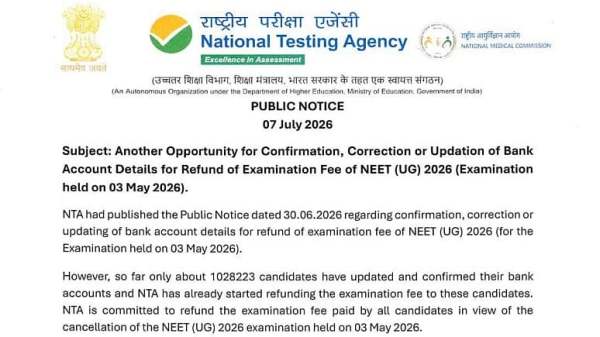
NEET UG 2026 Fee Refund: NTA Extended Bank Account Update Portal; Complete Details By July 14
-
Main Vaapas Aaunga Box Office Collection: Imtiaz Ali's Film Nears ₹100 Crore Worldwide After 25 Days

-
'Violence Doesn’t Raise Eyebrows, But Sexuality Becomes Problem': Toxic Actor Reacts To Criticism Over 'Objectifying' Female Characters In Teaser