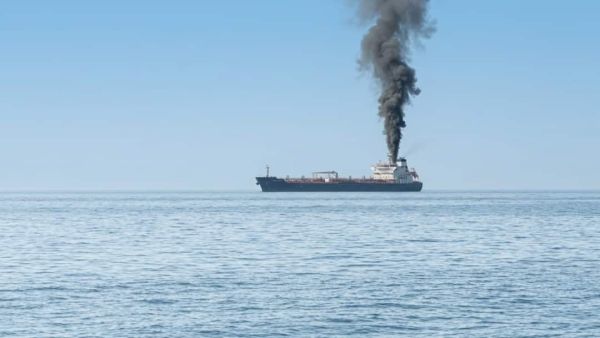
Three commercial tankers were struck on Tuesday in the Strait of Hormuz, marking the latest attacks on vessels transiting one of the world's most strategically important maritime routes.
The United Kingdom Maritime Trade Operations (UKMTO) said the third vessel was hit by a drone after two other tankers had earlier come under projectile attacks in the waterway connecting the Persian Gulf to the Gulf of Oman.
According to the UKMTO, the third ship sustained minor damage, no injuries were reported and the vessel continued its voyage.
Two Earlier Attacks Trigger Fire And Structural Damage
Earlier in the day, the UKMTO reported that two tankers had been struck by projectiles in separate incidents.
One tanker, travelling off the coast of Oman, caught fire after being hit. Iranian state television reported that the liquefied natural gas tanker had come under attack after allegedly ignoring warnings, though it stopped short of officially claiming responsibility.
The location of the second tanker at the time of the attack was not immediately disclosed. The vessel reportedly suffered structural damage, but no injuries were reported among those on board.
The UKMTO said authorities were investigating the incidents and noted that the first strike caused no environmental damage.
Qatar Blames Iran
Iranian state television, citing anonymous sources, suggested that Tehran had targeted a Qatari liquefied natural gas tanker, identified as Al Rekayyat. However, no official claim of responsibility was issued by Iranian authorities.
Qatari Foreign Ministry spokesperson Majed Al-Ansari condemned the attack, describing it as an "unacceptable attack" on international navigation and global energy security. In a post on X, he said Qatar holds Iran "fully legally responsible" for the incident and called it a "serious and explicit violation" of international law.
Dispute Over Shipping Routes
The latest attacks come amid heightened tensions over navigation through the Strait of Hormuz.
Iran has repeatedly stated that vessels transiting the strait should use only routes approved by Tehran and has warned that any interference by US forces would be met with a "rapid and decisive reaction."
However, the Joint Maritime Information Center, a multinational body overseen by the US Navy, advised commercial shipping on Monday that the route near Oman's coastline had been expanded and remained open for all traffic.
According to data firm Kpler, at least 108 ships crossed the Strait of Hormuz over the weekend using various routes.
Iran-US Talks Remain On Hold
The attacks occurred as negotiations between the United States and Iran remain stalled.
Washington is seeking a broader agreement with Tehran aimed at fully reopening the Strait of Hormuz, scaling back Iran's disputed nuclear programme and securing a permanent end to the war that began on February 28.
Speaking at the White House on Monday, US President Donald Trump said he preferred reaching an agreement with Iran but warned of consequences if negotiations failed.
"I'd rather make a deal, because I don't want to affect 91 million people," Trump said. "We can knock down their bridges in one hour. We can knock out their energy supply."
Under an interim arrangement, Iran and the United States agreed to allow ships to pass through the strait without charges for 60 days. Tehran has since maintained that it should control shipping routes and eventually levy transit fees, a proposal opposed by the United States and several Gulf Arab states.
-
'Oh My God 2' Director’s Next 'Ohh My Dog' Teaser Promises Heartwarming Family Drama

-
‘A bit premature’ – Wayne Rooney questions England’s exuberant dressing-room celebrations after Mexico World Cup win as John Stones playfully fakes injury

-
Prithvi Shaw, Ayush Badoni Had Affairs With Viral Sejal Pawar From Pranit More Show? Pics & Audio Viral On Social Media

-
President Droupadi Murmu Unveils Trophies Of Durand Cup Tournament 2026 At Rashtrapati Bhavan

-
FMGE June Result 2026 Declared At natboard.edu.in; What's Next For Qualified Candidates?