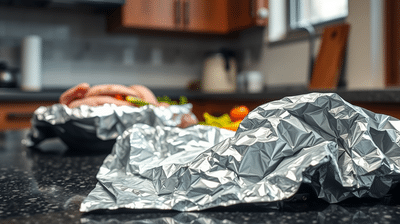
Aluminium foil has been a fixture in kitchens for generations, wrapped around sandwiches, draped over leftover curry, and pressed tightly over half a tomato to keep it from drying out. It feels harmless enough, a thin sheet of metal doing nothing more than sealing in freshness. Yet a growing body of food safety research suggests that foil is not quite as inert as it looks, particularly once it comes into contact with certain types of food for any length of time. Under the right conditions, tiny amounts of aluminium can actually migrate out of the foil and into whatever it is wrapped around, raising a legitimate question about whether foil is really the best choice for storing leftovers.
Why acidic and salty foods are the real problem
The biggest factor determining whether aluminium leaches out of foil and into your food comes down to a food's acidity and salt content. According to, researchers who tested beef, chicken and fish wrapped in commercial aluminium foil found that the leaching that occurs during cooking is not negligible, and that eating these foods regularly alongside other aluminium containing foodstuffs could bring a person's weekly intake close to the tolerable weekly limit set by regulators. The same research explained that low pH values in food encourage greater aluminium release, meaning acidic dishes like tomato based curries, citrus fruit, or anything with a vinegar based marinade are considerably more likely to pull aluminium out of the foil than something plain and neutral like rice or bread.
Why heat makes the leaching problem noticeably worse
Temperature plays just as significant a role as acidity, and the combination of heat and prolonged contact is where most of the concern really lies. The same study found that seasoning, particularly salt, tends to increase how much aluminium transfers into food during cooking, while sugar added to a dish appears to have the opposite effect, forming a kind of protective coating that actually reduces how much aluminium leaches out. Researchers also observed visible microscopic damage to the foil itself under close inspection after baking, tiny holes forming on its surface as a direct result of contact with the food, physical evidence that the foil genuinely breaks down rather than simply sitting there as an inert barrier throughout the cooking process.
What this means specifically for storing leftovers
While much of the existing research has focused on cooking food directly in foil rather than simply using it to store leftovers afterward, the same basic chemistry still applies whenever foil sits in direct, prolonged contact with acidic or salty food, even at cooler refrigerator temperatures. Leftover dishes like pasta in tomato sauce, marinated meat, or citrus heavy salads are exactly the kind of food most likely to encourage aluminium to migrate into the meal over time, particularly if the foil is left in place for a day or more rather than just a few hours. For genuinely non acidic, low moisture leftovers such as plain rice, bread, or dry roasted vegetables, the risk is considerably lower, since these foods lack the acidity or salt content needed to meaningfully accelerate the process.
Should you actually be worried about this
Nutrition and food safety experts generally agree that occasional, moderate use of aluminium foil is unlikely to cause any real harm, since the human body is normally able to process small amounts of aluminium without difficulty. The concern is less about any single meal and more about cumulative, repeated exposure over months and years, particularly for people who frequently cook or store acidic and salty foods in foil as a matter of daily habit. Aluminium has been studied as a known neurotoxin capable of accumulating in the brain and central nervous system over long periods. Some research has pointed to elevated aluminium levels in the brains of people with Alzheimer's disease. However, scientists have been careful to stress that this kind of association does not prove that dietary aluminium exposure through cookware or foil is actually a direct cause of the condition.
What to use instead for everyday leftovers
Food safety authorities including the United States Food and Drug Administration generally recommend airtight containers with proper lids or sealed storage bags as a safer default for most leftovers, since these also do a better job of slowing down spoilage compared to foil, which allows more air exposure and can let food dry out or absorb refrigerator odours. Glass containers in particular avoid the aluminium leaching issue entirely and work well for reheating food directly, since they can usually go straight from the fridge into a microwave or oven without needing to be transferred first. Foil still has its place for genuinely short term, low risk situations, wrapping a sandwich for a few hours, transporting a dish for a potluck, or covering something briefly to prevent it drying out, but for anything acidic, salty, or destined to sit in the fridge for more than a day, reaching for a proper container is the safer habit to build.
-
UP Emerging As India's Textile Hub, Says Minister Rakesh Sachan At Bharat Tex-2026

-
Files Related To India's Largest Nuclear Plant Surface On Dark Web

-
Peak XV-Backed Finova Capital's FY26 PAT Dips 11% To ₹165 Cr

-
Ather Opens QIP, Sets Floor Price Of ₹1,169.70 Per Share

-
Direct vs Regular Mutual Funds: How a Small Fee Difference Can Potentially Add ₹50 Lakh to Your Wealth