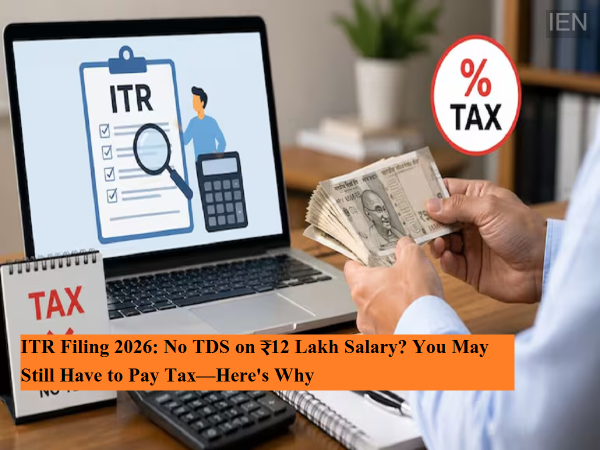
ITR Filing 2026: Zero TDS Doesn't Always Mean Zero Tax Liability Under the New Tax Regime
Many salaried taxpayers are surprised to discover that even though no Tax Deducted at Source (TDS) was deducted from their salary during the financial year, they may still have to pay income tax while filing their Income Tax Return (ITR).
This situation has become more common after the changes introduced in the Union Budget 2025, which increased the rebate available under Section 87A in the new tax regime. As a result, many employees whose salary falls within the eligible limit have seen tax-free monthly payslips throughout the year.
However, when they begin filing their ITR and include income from fixed deposits, savings account interest, rent, or other sources, they may unexpectedly see a tax liability appear.
Here's why this happens and what taxpayers should understand before filing their returns.
Why Your Employer May Not Deduct TDS
Employers calculate TDS only on the salary they pay to an employee.
For example, if your annual gross salary is around ₹12.75 lakh, the standard deduction of ₹75,000 under the new tax regime reduces your taxable salary to ₹12 lakh.
Since the taxable salary falls within the rebate limit prescribed under Section 87A (subject to applicable conditions), your employer may legitimately deduct zero TDS from your monthly salary.
This often leads employees to assume that they will not have to pay any income tax.
TDS and Final Tax Liability Are Not the Same
The biggest source of confusion is treating TDS and final income tax liability as the same thing.
TDS is simply a mechanism to collect tax in advance based on the information available with the employer.
Your employer generally does not know about:
-
Interest earned on bank fixed deposits
-
Savings account interest
-
Rental income
-
Freelance or consulting income
-
Other taxable earnings
-
Certain investment gains
When you file your Income Tax Return, all eligible sources of income are added together to calculate your total taxable income.
If your total income exceeds the rebate threshold, your final tax liability may increase even though no TDS was deducted from your salary.
Why Additional Income Can Create a Tax Liability
The rebate under Section 87A is based on the total taxable income, not only your salary.
Suppose:
-
Taxable salary after standard deduction: ₹12 lakh
-
Bank FD interest: ₹25,000
-
Savings account interest: ₹15,000
Your total taxable income becomes ₹12.40 lakh.
Since your total income now exceeds the rebate limit (subject to the applicable provisions of the tax law), the tax computation changes and you may have to pay tax while filing your ITR.
This often surprises taxpayers who assumed that a zero-TDS salary automatically meant zero tax.
Chartered Accountant Explains the Situation
Tax professionals say this is one of the most common areas of confusion during the ITR filing season.
According to Chartered Accountants, many salaried employees whose employers deducted no TDS under the new tax regime are later surprised when additional income—such as bank interest—is included while filing the return.
The final tax payable is determined on the total taxable income, not merely the salary considered by the employer for TDS purposes.
In addition, income taxed under special provisions, such as certain capital gains, may not qualify for the rebate in the same way and could attract tax separately, depending on the applicable provisions.
Marginal Relief Can Reduce the Tax Burden
Crossing the rebate threshold does not automatically mean that a taxpayer will face a very large tax bill.
The government provides marginal relief to ensure that taxpayers whose income exceeds the rebate limit by a small amount are not subjected to a disproportionately high tax burden.
Under this relief, the additional tax payable is generally restricted so that it does not exceed the amount by which the income crosses the specified threshold, subject to the applicable rules.
Example of How Marginal Relief Works
Consider the following illustration:
-
Gross annual salary: ₹13.10 lakh
-
Standard deduction: ₹75,000
-
Taxable salary: ₹12.35 lakh
In this case, the taxable income exceeds ₹12 lakh by ₹35,000.
Although the tax calculated under normal slab rates may be significantly higher, the benefit of marginal relief can substantially reduce the tax payable, depending on the applicable provisions.
This mechanism prevents taxpayers from facing an excessive tax burden merely because their income exceeds the rebate threshold by a small margin.
What Taxpayers Should Do Before Filing ITR
Before submitting your Income Tax Return, it is advisable to calculate your entire taxable income, rather than relying only on your salary figures.
Review all possible sources of income, including:
-
Fixed deposit interest
-
Savings account interest
-
Rental income
-
Capital gains
-
Dividend income
-
Freelance earnings
-
Any other taxable receipts
Reconciling these figures in advance can help avoid unexpected tax demands while filing your return.
Final Takeaway
Receiving a salary without any TDS deduction does not automatically guarantee that no income tax is payable.
Under the new tax regime, employers calculate TDS based only on salary information available to them. However, the Income Tax Department computes your final tax liability after considering your total taxable income from all eligible sources.
If additional income pushes your taxable income beyond the applicable rebate limit, tax may become payable even if your salary remained TDS-free throughout the year.
Taxpayers should therefore review all sources of income carefully before filing their ITR for Assessment Year 2026-27, ensuring that the return accurately reflects their complete financial picture and any tax liability arising from it.
-
LPG Rule Changes 2026: OTP Verification, e-KYC and Delivery Authentication Now Mandatory for Gas Cylinder Delivery

-
Indian Railways' New AI System to Predict Waiting Ticket Confirmation, Faster Booking Platform Coming Soon

-
UIDAI Offers Free Aadhaar Email Update Through New App for Six Months

-
WATCH: Vaibhav Sooryavanshi Reveals First Person He Told About His India Debut
-
Pakistan Deputy PM's Relative Accused In Gangrape Case; Probe Turns To Alleged Crypto Dispute