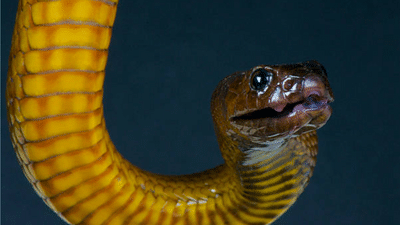
The snake that could kill 100 people, but almost never bites
The Inland Taipan , whose venom is potent enough to kill more than 100 adults in a single bite, has recorded only a small handful of confirmed human envenomings worldwide, and herpetologists say its remote habitat and shy temperament are the reason.
Start with the venom itself, because that's the part that gets all the attention. Based on lab testing measuring lethal dose in mice, the Inland Taipan is widely regarded as the most venomous snake on the planet, its venom substantially more toxic drop for drop than any tested sea snake, and it's also considered the most toxic reptile venom ever measured against human heart cell cultures. A single bite is estimated to carry enough venom to kill more than 100 adult humans.
And yet, despite that number, there has never been a single recorded human death from an inland taipan bite. Not one. Roughly 11 people are known to have been bitten by the species, and every one of them survived, largely because they got antivenom and first aid quickly, and most of them were professional snake handlers dealing with captive snakes rather than random encounters in the wild.
That gap, between the venom's raw lethality and its almost nonexistent body count, is the entire story here. As Forbes contributor and herpetologist Scott Travers put it, the snake's remote habitat and its "generally non-aggressive nature" mean bites are exceedingly rare, and most people alive will simply never cross paths with one.
Why the deadliest venom on earth barely gets used on humans
The core answer is geography. The Inland Taipan lives in the sparse grasslands, scrublands, and semi-deserts of central Australia, some of the most remote and inhospitable terrain on the continent. It's diurnal, meaning it's active during the day, and it rarely stays above ground for long. According to the Australian Museum, the species is "rarely encountered in the wild by the average person" specifically because of how remote its territory is and how briefly it surfaces.
Temperament matters just as much as geography. Despite an old nickname, "fierce snake," that suggests something aggressive, multiple sources describe the opposite personality. The Australian Museum notes that compared to its more short-tempered cousin, the coastal taipan, the inland taipan is actually quite shy, and many reptile keepers consider it a placid animal to handle. It gives warning before it strikes too, raising its forebody into a tight S-shaped curve as a threat display before ever committing to a bite.
There's also a deeper evolutionary reason the venom exists at all, and it has nothing to do with people. The inland taipan is a mammal-hunting specialist, feeding almost entirely on long-haired rats and similar rodents in the wild. Its venom evolved to drop a fast-moving warm-blooded animal as quickly as possible, not to deal with humans at all. Travers explained it plainly in a recent Forbes piece: humans are essentially an evolutionary accident from the snake's point of view, "large, unfamiliar mammals that just so happen to react very badly" when exposed to venom that was built for an entirely different target.
When bites do happen
The rare cases where people have been bitten make clear why doctors treat any envenoming as a genuine emergency.
A 2012 case out of Australia showed the same urgency. A 17-year-old boy was bitten on the hand in the Hunter Valley region of New South Wales and was rushed to a hospital equipped to handle the bite. The teenager survived after receiving antivenom within the required window. "We had anti-venom in stock, we keep what's called polyvalent anti-venom and that covers all of our snakes," toxicologist Geoff Isbister told ABC News.
The bigger picture on snake danger
Despite carrying the most lethal venom on record, the inland taipan isn't considered the world's most dangerous snake in practice, because "dangerous" depends heavily on how often a species actually encounters people. The coastal taipan, its close relative, produces less potent venom but has bigger fangs, delivers more venom per bite, and lives much closer to populated coastal regions of Australia, which makes it responsible for far more real-world bites.
-
Centre Issues Notice To Telegram To Crack Down On Pirated Films & OTT Content; Seeks Action Report In 15 Days

-
One killed, another injured in accident in Ibrahimpatnam

-
Hyderabad gym trainers held for supplying steroid injections

-
Three of family end life in Karnataka’s Koppal due to debt

-
Ekta Kapoor slammed over AI-made Lord Krishna scene in ‘Kyunki’