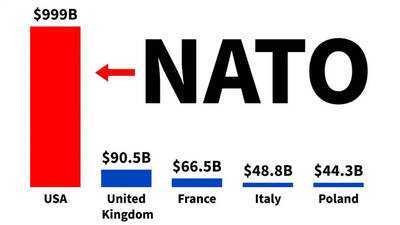
President Donald Trump has once again directed his criticism towards NATO allies in Europe, questioning the rationale behind the United States bearing what he perceives as an unfair share of the alliance's military responsibilities, especially when support is lacking during crises. In a recent post on Truth Social, Trump highlighted the disparity in defense spending between the US and its European counterparts, specifically mentioning the United Kingdom and France. He stated, “It’s absurd for the USA to continue on this unbalanced path when the relationship lacks reciprocity. They were not there for us,” emphasizing his point with a repeated assertion: “They were not there for us!!!” This statement seems to stem from Trump's dissatisfaction with the response of certain European nations regarding the US's military actions in Iran, particularly after complaints about limitations on bases, airspace, and logistical assistance.
NATO Spending Discrepancies Highlighted
Trump's remarks reference the military expenditures of individual NATO nations rather than their contributions to a collective alliance fund. A comparison by Al Jazeera of the figures mentioned in his post with NATO's projected 2025 spending revealed that, while there were minor differences, the overall figures were consistent. However, Trump's argument extends beyond mere numbers; he emphasizes the issue of reciprocity. He contends that the US is dedicating military resources at a level significantly higher than that of its European allies, who have not reciprocated with similar support during American military engagements in Iran.
US Defense Secretary's Response
This issue has escalated beyond social media, as US Defense Secretary Pete Hegseth announced a six-month review of American military forces in Europe during a NATO defense ministers' meeting in Brussels on June 18. Hegseth stated, “This will be a thorough review,” aimed at ensuring NATO is progressing towards Europe taking the lead in its own defense.
Tensions Over Military Operations
Hegseth criticized NATO nations that allegedly denied access to bases, airspace, or logistical support during recent US military operations against Iran. He argued that these restrictions not only complicated US operations but also unnecessarily endangered American personnel, stating, “These allies jeopardized the safety of American troops by denying them access that should never have been in question.” His comments resonate with Trump's earlier complaints about the lack of operational support from some allies.
Increased Defense Spending Amidst Tensions
The timing of this dispute is notable, as NATO members have significantly increased their military spending in response to a deteriorating security situation in Europe. Secretary-General Mark Rutte reported that European allies and Canada collectively added approximately $90 billion to their defense budgets last year, marking a significant increase from previous levels. However, the Trump administration is advocating for more than just increased budgets; it is pushing for European militaries to assume primary responsibility for the continent's conventional defense, allowing US forces to focus on other regions.
Strategic Shifts in US Military Planning
Recently, the United States has communicated to its allies that military assets typically available during a major NATO crisis, such as aircraft carriers and additional fighter squadrons, may no longer be guaranteed. American military planners are increasingly considering the potential for simultaneous security challenges in various regions, including a possible confrontation with China.
NATO's Nuclear Posture Update
Additionally, there have been developments regarding NATO's nuclear strategy. Following the Brussels meeting, the alliance's Nuclear Planning Group released its first formal statement in nearly two decades, reaffirming the role of nuclear forces as the ultimate guarantee of NATO's security. Ministers agreed to enhance planning, modernize delivery systems, and adapt the alliance's deterrence framework.
-
CBSE to Announce 10th Supplementary Exam Results Soon

-
Leaders at UAE summit highlight resilience as a strategic priority for business and governance

-
Bihar's Bankipur By-Election: Prashant Kishor's Potential Candidacy Sparks Interest

-
Indian Defence Acquisition Council Approves Major Procurement Proposals
-
EPFO Portal Update: Login to EPFO member portal resumed after maintenance, but this special service is still down..