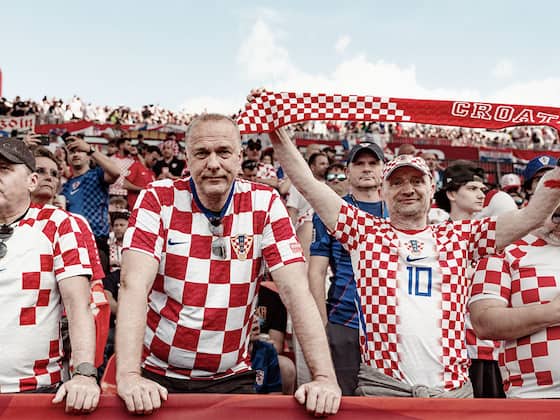
Croatia’s golden generation has led the nation to remarkable heights — finishing as runners-up and third place in the last two FIFA World Cups. In 2026, the team’s second group-stage clash took place in Toronto, where the city’s vibrant Croatian community turned out in full force to cheer their heroes.
Toronto, Ontario, known for its diversity and shaped by waves of global migration, proudly hosts one of the largest and most spirited Croatian communities outside Europe.
According to CP24, a large portion of the more than 130,000 Canadians of Croatian descent reside in the Greater Toronto Area. This makes the city the cultural heartbeat of Croatian life in North America — a place where tradition and heritage are both preserved and constantly renewed. Football, in particular, remains a vital thread that unites generations and reinforces their cultural identity.
Successive waves of Croatian migration, especially during and after the breakup of Yugoslavia, transformed the Greater Toronto Area into a haven where language, customs, and community could be rebuilt far from the homeland.
Over time, Toronto evolved from a settlement hub into a stronghold of Croatian identity, where belonging is both protected and passed down. Football, more than any other pastime, acts as a bridge linking the past and present, allowing Croatian-Canadians to carry forward their pride and resilience.
This is why football holds such deep emotional value here. For Croatian-Canadians, their national team represents far more than a sporting symbol — it embodies endurance and unity.
“Croatian football is a unifying force for the people of the country,” said one Croatian supporter at Toronto Stadium during the Croatia–Panama group-stage match. “After enduring the breakup of Yugoslavia and the Civil War, football brought people together and gave them hope. What this small country has achieved on the biggest football stage is extraordinary — it’s a source of immense pride and inspiration for every generation.”
That sense of pride resonates across the community. Croatia’s current golden generation, which achieved a runner-up and third-place finish in the last two World Cups, continues to produce world-class talent at every level. The 2026 FIFA World Cup squad features veterans like Luka Modrić (40), Ivan Perišić (37), and Andrej Kramarić (35); established stars including Mateo Kovačić (32), Mario Pašalić (31), and Josip Stanišić (26); and promising young players such as Joško Gvardiol (24), Petar Sučić (22), and Luka Vušković (19).
“To us, the players are amazing,” another Croatia fan shared. “We’re so proud of their work and discipline. And I absolutely love Modrić — he’s incredible. Just look at what he’s accomplishing at his age. We always give our best. Last World Cup we came third, before that in Russia we were runners-up. This time, we’re aiming for number one.”
Her enthusiasm captured the collective optimism of Croatian-Canadians, who view each tournament as another opportunity to express their pride on football’s grandest stage.
This deep-rooted passion underscores the words of Ivan Grbešić, a board member of the Canadian-Croatian Chamber of Commerce, who remarked that “Toronto is unique because this is not simply a host city.”
For the Croatian diaspora, Toronto is more than just a venue — it’s a home ground in every cultural sense. It’s a place where the community isn’t dispersed but deeply connected.
Growing up in Brampton, just outside Toronto, and playing football across the Greater Toronto Area, I witnessed firsthand how Croatian-Canadian football culture shaped local pitches, clubs, and communities. This heritage is inseparable from Croatian identity. Football isn’t merely part of the culture — it defines it.
Through a shared history of struggle, migration, and sporting pride, Toronto — often overlooked in football circles despite its passionate diversity — came alive on match day. The city’s energy transformed into a powerful display of unity and pride.
The match became more than a contest; it was a celebration of heritage, migration, and sport converging into one vibrant expression. For Croatian-Canadians, it was a chance to honour both their national team and the generations of resilience and community-building that brought them here. Under the floodlights, Toronto felt less like a host city and more like an extension of Croatia itself, as the diaspora’s collective voice rose together — unmistakable and unmissable.
Photography by Justin Knight for Urban Pitch.
-
Malik Tillman’s sensational free kick revives American hopes despite Folarin Balogun’s controversial red card: Key takeaways from USMNT’s World Cup win over Bosnia and Herzegovina

-
World Cup Day 21: Kane saves England while Belgium shock Senegal in late drama

-
How the Azteca's Altitude Could Test England in Their 2026 World Cup Clash with Mexico
-
Spain vs Austria: Full list of presenters, pundits, and commentators for World Cup clash
-
Harry Kane’s 2025-26 goal tally places him among football’s modern-day greats: Comparing his record-breaking season with Messi and Ronaldo