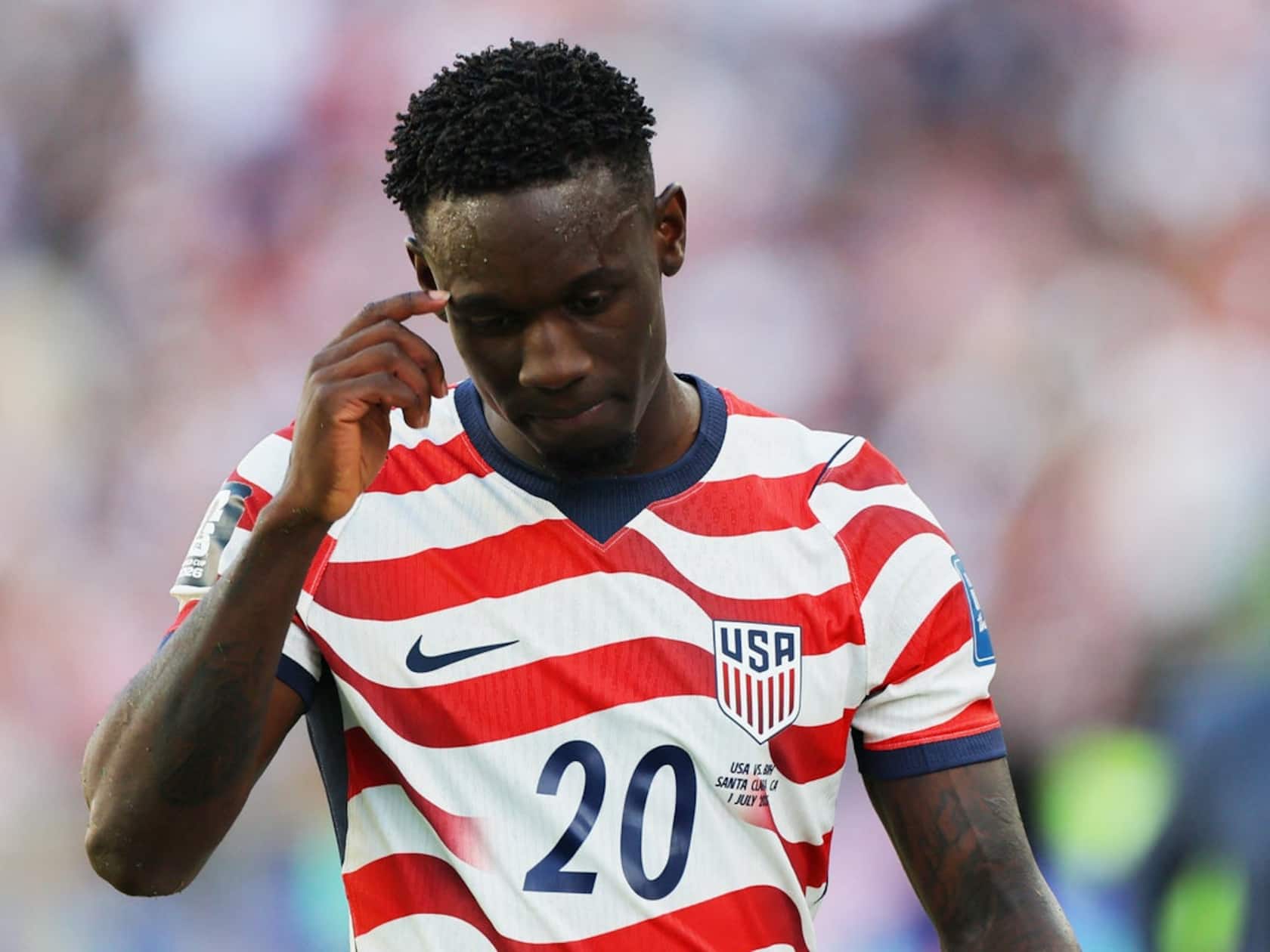
Mauricio Pochettino was among many left perplexed on Wednesday night. Under normal circumstances, the United States claiming only their second-ever World Cup knockout victory, defeating Bosnia and Herzegovina, would have been a cause for celebration and national pride. Instead, Pochettino and his team departed Santa Clara for their base in Irvine, 400 miles south along the Californian coast, filled with frustration and disbelief.
The controversy overshadowing the USA’s deserved triumph centred on Folarin Balogun’s red card in the second half — a decision that quickly became the main topic of discussion. Pochettino voiced his discontent, saying, “It’s never a red card; there was never any intention to step on the player,” before adding, “It should be possible to appeal the red card…”
It was a genuine question. When a journalist informed him that under FIFA’s current rules such an appeal is impossible, his disbelief was clear. According to Article 66.4 of FIFA’s regulations: “A sending-off automatically incurs suspension from the subsequent match. The FIFA judicial bodies may impose additional match suspensions and other disciplinary measures.”
That clarification means not only is there no avenue for appeal, but the only possible change to Balogun’s one-match ban could be an increase to two or three games. The lack of flexibility — denying teams the chance to contest and review such decisions — seems astonishing, particularly for a tournament as prestigious as the World Cup.
Midfielder Tyler Adams summed up the mood concisely after the match: “Typical Fifa.”
FIFA would likely argue that the introduction of VAR (Video Assistant Referee) eliminates the need for an appeals process, as referees can review and overturn decisions in real-time. In this case, Brazilian referee Raphael Claus initially missed Balogun’s studs catching Bosnian defender Tarik Muharemovic during a challenge for the ball.
The VAR team — Juan Soto (Venezuela), Nicolas Gallo (Colombia), and Jerome Brisard (France) — instructed Claus to review the footage on the pitchside monitor. As is often the case, once a referee is sent to the screen, the outcome is almost inevitable. Claus was shown a series of super-slow-motion replays and still images before issuing the red card.
Balogun was subsequently dismissed for “serious foul play,” defined as “challenging for the ball with excessive force or endangering the safety of an opponent.” The frozen image looked damning — a still frame that, on its own, could easily convince onlookers that the decision was justified.
However, two major inconsistencies emerge. The first concerns the incident itself. As Pochettino rightly pointed out, there was no clear intent from Balogun; it appeared to be a routine clash of legs, something seen countless times in every match. The unfortunate point of contact made it look worse than it was. The broader issue, though, lies in how IFAB’s (International Football Association Board) VAR guidelines are applied.
According to IFAB, slow-motion replay should be used only for factual determinations — such as a player’s position or the ball’s location — while normal speed should be used to assess the intensity of an offence. So why was Claus repeatedly shown slow-motion clips? The incident didn’t happen in slow motion, and judging it that way distorts its reality.
The second inconsistency involves recent precedent. In the same round of matches, Lionel Messi opened his 2026 World Cup campaign with a hat-trick against Algeria. Yet earlier in that game, the Argentina captain avoided punishment for a remarkably similar challenge on Aissa Mandi in the 30th minute. VAR reviewed the incident but took no action. The lack of uniformity in such reviews continues to frustrate players and fans alike.
When asked about the comparison, Pochettino responded: “For me, neither are red cards.” Indeed, the logic is simple — if Balogun’s tackle warrants a red, then Messi’s should have received the same treatment.
Given this inconsistency, it’s difficult to justify why the United States cannot even lodge an appeal. The rule leaves Balogun suspended for the upcoming last-16 clash against Belgium in Seattle on Monday — arguably the most significant match of his career.
For the player who has been the USA’s standout performer this summer, the suspension is a devastating blow. More concerning, however, is that the decision is irreversible under FIFA’s rigid framework. Once again, football’s global governing body appears out of touch with common sense.
-
This is not Pakistan: Cyberabad cop accused of communal slur
-
World Cup Central: Tuchel Seeks Redemption for England’s 1986 Heartbreak at the Azteca

-
WhatsApp Username Debate: Will Hiding Phone Numbers Reduce Or Fuel Frauds?

-
FDA Issues Serious Recall for Popular Potato Chips Due to Salmonella Risk

-
Elena Rybakina downs Caty McNally, reaches Wimbledon 3rd round: Stats