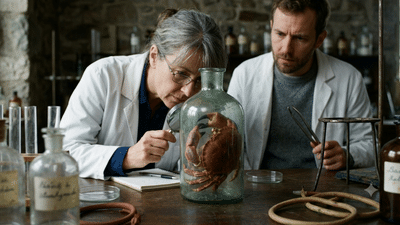
Back in July 2022, a research team from Hiroshima University was carrying out a routine survey about 500 metres off Sesoko Island in Okinawa when they noticed a discarded wine bottle drifting on the surface. That's nothing unusual. Floating debris often attracts young fish looking for shelter, creating tiny ecosystems in the open sea. But when the team pulled the bottle aboard, they found a surprise waiting inside.
A live swimming crab, Portunus sanguinolentus , was sitting comfortably inside.
At first glance, it seemed impossible. The crab looked far too large to have entered through the bottle's narrow neck. The opening measured just 24 millimetres across. The crab inside stretched more than 88 millimetres wide and weighed over 42 grams. There was simply no way an animal that size could have squeezed through.
The story immediately reminded the researchers of Salamander, a haunting Japanese folktale about a creature that eats happily inside a cave until one day it realizes it has grown too large to squeeze back out. It's a tale about a prison built by appetite. And floating off the coast of Japan, they found something that felt strangely similar—not in fiction, but in the middle of the ocean.
So how did it get there?
That question led researchers Hajime Sato and Yoichi Sakai to investigate. Their findings, published in the journal , revealed a story that was far stranger than anyone expected.
The crab hadn't entered the bottle as an adult. It had slipped inside when it was still a tiny juvenile, small enough to pass easily through the opening. Then it stayed and grew.
Instead of becoming a death trap, the bottle became an unexpected home. Juvenile fish regularly swam inside seeking shelter, and the crab simply ate them. DNA analysis of its stomach contents showed it had been feeding on species such as rough triggerfish and sergeant major fish. Algae growing along the bottle's inner surface also became part of its diet.
With food arriving almost at its doorstep, the crab continued growing until the bottle that had once been an easy refuge became a prison.
The researchers even worked out how long it had likely been trapped. Goose barnacles attached to the outside of the bottle provided the clue. Because barnacles grow at fairly predictable rates, they act like tiny biological clocks. Measuring them suggested the bottle had been drifting for roughly two months before it was collected. That's likely how long the crab spent living inside its floating home, completely cut off from the outside world despite being surrounded by open ocean.
The researchers noted that similar cases of crabs trapped inside bottles have been documented in Japanese waters before.
-
World Cup Day 21: Kane saves England while Belgium shock Senegal in late drama

-
How the Azteca's Altitude Could Test England in Their 2026 World Cup Clash with Mexico

-
Spain vs Austria: Full list of presenters, pundits, and commentators for World Cup clash

-
Harry Kane’s 2025-26 goal tally places him among football’s modern-day greats: Comparing his record-breaking season with Messi and Ronaldo

-
Govt Sends Notices To Telegram & Signal Over Username Feature