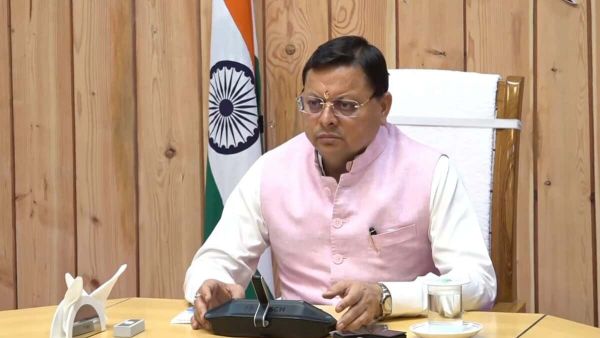
Dehradun: The Uttarakhand government on Wednesday, July 1, officially replaced the state’s Madrasa Board with the Uttarakhand State Minority Education Authority, bringing educational institutions belonging to all six notified minority communities under a single regulatory framework, officials said.
Launching the new authority at a function in Dehradun, chief minister Pushkar Singh Dhami said it is Uttarakhand’s responsibility — a land that has nourished the entire world with its stream of knowledge — to set an ideal in the realms of education and values.
“The Uttarakhand State Minority Education Authority (USMEA) came into effect on July 1, 2026, following the dissolution of the Madrasa Board,” he said. During the event, he also distributed recognition certificates to various minority educational institutions.

USMEA milestone for all of India’s education system: Dhami
The chief minister said the USMEA would be a milestone not only for Uttarakhand but also for India’s education system.
Drawing a parallel with the implementation of the Uniform Civil Code (UCC) in the state, he said just as the UCC represented “One Nation, One Law,” the Minority Education Authority marked the beginning of “One Nation, One Education” from Uttarakhand.
He said the government’s objective is to ensure that every child, regardless of class, region or community, receives quality education and strong moral values.
Dhami said, “When a child receives a good education, they not only improve their own future but also make an invaluable contribution to the betterment of their family, society, and country.”
“Today, we are not merely launching an institution; we are laying a strong foundation for a future that will give wings to the dreams of every child in the state,” he said.
‘Not intended to affect any one community’s religious identity’
Dhami said establishing USMEA was not intended to affect any community’s religious identity, traditions or rights, but to expand access to better educational opportunities for all minority groups.
“We aim to strike a balance between faith and modernity,” he said, adding that children from minority communities should remain connected to their religious and cultural heritage while also becoming proficient in science, mathematics, computer education, languages and modern technologies.
Dhami said the authority would function not merely as a recognition body but also as a mechanism to improve educational quality, teacher training, transparency and the effective implementation of the National Education Policy (NEP).
He expressed hope that USMEA would transform the lives of thousands of students and help make Uttarakhand a leader in quality education.
USMEA was established under the Uttarakhand Minority Education Act, 2025, which the state Assembly passed during its Monsoon Session in Gairsain last August and which received the Governor’s assent in October.
Under the law, educational institutions run by all six notified minority communities — Muslims, Sikhs, Jains, Buddhists, Christians and Parsis — are now eligible for minority institution status.
Earlier, such recognition in Uttarakhand was limited to institutions belonging to the Muslim community.
Minority Affairs Secretary Parag Madhukar Dhakate said institutions seeking minority status must first obtain affiliation from the state’s Education Department before applying online for recognition through the Minority Education Authority.
He said Uttarakhand is the first state in the country to introduce a uniform recognition system for educational institutions belonging to all notified minority communities through a single Minority Education Authority.
-
63 People Booked in $8 Million Luxury Car Theft Network Involving Over 90 Stolen Vehicles

-
TRS chief Kavitha arrested during protest in Hyderabad

-
Palestine: Sonia Gandhi piling moral pressure on Narendra Modi

-
Leaning out of bus window proves fatal for ITI student

-
Hindutva worker stops woman washing clothes at Ganga, ignores others