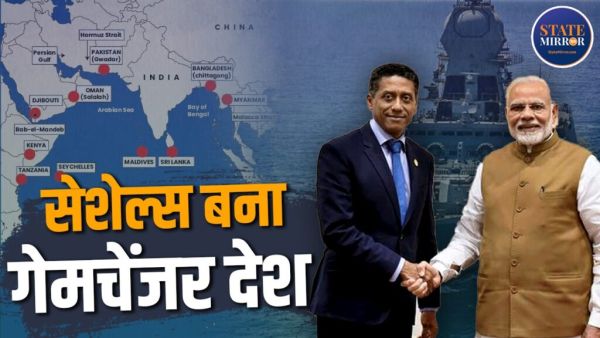
Amid the changing geopolitical equations in the Indian Ocean, the agreements signed between India and Seychelles are once again in the headlines. This partnership is considered important in terms of maritime security, strategic cooperation and regional influence at a time when China is continuously trying to increase its presence in the Indian Ocean region. At the same time, it is trying to surround India from all sides through its neighbours.
According to India’s Ministry of External Affairs, Seychelles is one of India’s most trusted maritime partners in the Indian Ocean region. Defense cooperation between the two countries has been ongoing since the 1980s, while in the last decade the partnership has expanded to maritime security, blue economy and Indo-Pacific strategy.
India’s strategy has not been to directly surround any country, but to strengthen its maritime capabilities, partnerships and surveillance networks in the Indian Ocean region. But strategic experts believe that cooperation with bilateral countries like Seychelles can help India keep an eye on China’s growing maritime activities and maintain regional balance.
Why is Seychelles so important?
Seychelles is a small but strategically important island located in the Indian Ocean. It is located between the eastern coast of Africa and the western maritime region of India. Its geographical location makes it important for monitoring sea routes.
This is the means of transport necessary for energy and trade for a large part of the world through the Indian Ocean. Oil supplies from the Middle East, Europe-Asia trade routes and maritime communication lines pass through this region. Therefore, the presence of any big power in this region impacts global politics. Other than this:
- Seychelles is a group of 115 islands. Its Exclusive Economic Zone (EEZ) is spread over approximately 13 lakh square kilometers, while its land area is only 459 square kilometers.
- It is located close to major sea routes leading to the east coast of Africa, the Mozambique Channel and the Arabian Sea.
- More than 80% of the world’s maritime trade (by volume) and about 60% of global oil trade takes place through sea routes, in which the Indian Ocean plays an important role.
What are the India-Seychelles agreements?
Many important agreements have been signed between India and Seychelles on defence, maritime security, blue economy, capacity building, maritime surveillance and development cooperation. Their objective is to strengthen security cooperation between the two countries in the Indian Ocean region, increase surveillance of maritime activities and jointly deal with challenges like illegal fishing, smuggling and piracy. Under this strategic partnership, India has also supported Seychelles in defense equipment, training, financial assistance and development of maritime infrastructure.
Important factors of agreement
Maritime Security Cooperation – Joint cooperation on maritime security, piracy, smuggling and illegal fishing in the Indian Ocean.
Cooperation under SAGAR vision – Seychelles is considered a key maritime partner under India’s Security and Growth for All in the Region (SAGAR) policy.
Coastal Surveillance Radar System (CSRS) – India helped establish a coastal surveillance radar network in Seychelles, enabling 24×7 surveillance of maritime activities.
Information Sharing (Maritime Domain Awareness) – Both countries exchange information to maritime activities, suspicious vessels and security.
Defense Training – The Indian Navy and Coast Guard provide regular training to Seychelles defense personnel.
Defense equipment and military support – India has provided Patrol Vessels, fast interceptor boats, aircraft and other security equipment to Seychelles. These include patrol boats like INS Tarasa, Dornier-228 Maritime Surveillance Aircraft, fast interceptor boats for the Coast Guard and coastal surveillance radar network. This enables better monitoring of ship movements throughout the Indian Ocean.
Joint Naval Exercise – The navies and coast guards of both the countries conduct joint exercises from time to time.
Hydrographic Survey – The Indian Navy helps in ensuring the safety of navigation by conducting hydrographic surveys of the maritime areas of Seychelles.
Capacity Building – Institutional cooperation in defence, maritime law enforcement and disaster management.
Blue Economy Cooperation – Partnership in fisheries, sustainable use of marine resources, marine research and environmental protection.
Health and Development Projects – India has provided grants and loan assistance for hospitals, housing, education, IT and digital projects.
Line of Credit (LoC) – India provided financial assistance for Seychelles’ infrastructure and development projects.
China’s growing presence and India’s concern
Over the past decade, China has rapidly expanded ports and logistics networks in the Indian Ocean region under its Belt and Road Initiative (BRI). Strategic experts widely link it to China’s ‘String of Pearls’ strategy. China’s growing presence in Pakistan’s Gwadar, Sri Lanka’s Hambantota, Myanmar’s Kyaukphyu and Djibouti has been a matter of strategic concern for India.
China also established its first overseas military base in Djibouti in 2017, significantly increasing its military reach in the Indian Ocean compared to before. Apart from this, China’s increasing interest in several strategic projects in South Asia, including the Tista River region of Bangladesh, is also seen as a challenge for India.
Apart from this, China is also trying to increase its participation in other strategic projects of South Asia including Tista River Basin of Bangladesh.
Strategic advantage for India
India’s SAGAR (Security and Growth for All in the Region) policy was announced by Prime Minister Narendra Modi in 2015. Its objective is to make the Indian Ocean region secure, stable and inclusive. Under this policy, India is continuously strengthening defense and security cooperation with many maritime countries including Seychelles.
Apart from this, India is also promoting regional maritime cooperation through initiatives like QUAD and Indo-Pacific Oceans Initiative (IPOI). Although Seychelles is not a member of QUAD, it is considered an important partner of India’s security network in the Indian Ocean. These agreements will strengthen India’s maritime surveillance capability, increase its strategic reach to Africa and the Western Indian Ocean, improve the security of maritime trade routes and make it easier to keep an eye on China’s growing naval activities. Besides, India’s role as a ‘net security provider’ and regional credibility will also be strengthened. It is true that Seychelles is not a member of QUAD, but it is considered an important part of India’s security network in the Indian Ocean.
Is this a strategy to corner China?
India officially describes these agreements not against any country, but as part of its policy to strengthen the free, open, inclusive and rules-based maritime order in the Indian Ocean. However, strategic analysts believe that increasing defense and maritime cooperation with Seychelles, Mauritius, Maldives, Sri Lanka, Oman and other partner countries gives India a strong strategic edge in the Indian Ocean.
In such a situation, it would not be appropriate to call these agreements a strategy to directly corner China, but it can definitely be said that these are important steps to strengthen India’s policy of ‘Strategic Balancing’ amidst the growing influence of China.
Let us tell you that Prime Minister Modi stayed in Seychelles on a three-day state visit from 27 June 2026 to 29 June 2026. During this, he participated as the chief guest in the 50th Independence Day celebrations of Seychelles and 9 agreements were signed between the two countries.
-
Legs becoming weak in youth, swelling, pain and difficulty in walking

-
What increases the risk of cataracts at a young age? Diabetes is the main reason, know the detailed information provided by expert doctors

-
Why Did Techie Yousuf Imran Quit His Rs 9.4 Cr Google Package? Here’s The Reason

-
Toyota Hilux 2026 India Launch: Premium design, hybrid engine and price details revealed

-
Nothing Phone 4b confirmed with Snapdragon processor ahead of launch