Everybody wants to own the media, and the country’s fastest-growing new-age consumer brands are no exception.
Faced with rising customer acquisition costs, ad fatigue and diminishing returns from performance marketing, brands are increasingly asking a simple question: why keep renting attention when you can own it?
Historically, this strategy has played out through acquisitions. Mensa Brands’ (now BRND.ME) acquisition of MensXP, iDiva and Hypp, Nykaa’s Little Black Book, and Honasa’s buying of Momspresso are some of the key examples, which weren’t merely inorganic expansion moves aimed at boosting revenue but bets to own consumer attention and build direct relationships with audiences.
Several digital-first consumer brands are today doing the same by building their own media capabilities or investing heavily in original content to build communities around their products.
Bombay Shaving Company is a case in point. The men’s grooming startup has scaled 100Days.co, a platform founded in 2021 as a growth initiative for portfolio brands. It has since evolved into a full-stack digital commerce platform that also produces content in-house to help established consumer brands build and scale their D2C businesses.
Similarly, notable brands, including athleisure startup Blissclub, healthy snacking company The Whole Truth and audio wearables startup boAt, are endeavouring to create content either by owning a studio or joining hands with content creators to shoot podcasts, short films or conduct spot interviews.
So, why are brands investing so aggressively in media? Let’s find out in this edition of The Checkout.
The Race To Own Consumer AttentionAccording to Rajeswar Rao, the vice-president of B2C and digital marketing at Clovia, an innerwear brand, customer acquisition today is different from what it was even five years ago.
Earlier, a compelling product image and a strong call-to-action were often enough to drive conversions. Today’s customer journey is much less linear. It involves consuming multiple pieces of content before even clicking on an ad.
Modern consumer brands have become exceptionally good at solving the traditional building blocks of business, viz., finding PMF, building efficient supply chains, understanding consumer behaviour and targeting the right audience. Yet, none of this guarantees sales.
So, how to push the customer to make a purchase? How to keep them engaged with the idea of the brand? And how to retain them?
To address this, a majority of D2C founders these days have made themselves comfortable with the idea of picking up a mic and creating their own content. The playbook has proven helpful in building brand credibility, earning consumer trust and strengthening connection with their audience.
In sectors like beauty and personal care (BPC), where third-party manufacturers make near-identical goods for multiple labels, there is a high likelihood that products will be copied. So, how do you prove that you are different in a market already flooded by similar products? Even branding is no longer a moat.
“So what actually remains as a moat is your audience. Even if you build something genuinely differentiated, the only way to get it to your user fast is by having a community of your own already,” said All In Capital’s cofounder Aditya Singh.
The Economics Of Owning AttentionFor years, brands relied heavily on Meta and Google to buy consumer attention. However, with these being the sole customer acquisition channels, consumers are usually bombarded with advertisements, making it difficult for brands to stand out.
“We mostly have one place to acquire users, which is Meta. With so many brands, clutter-breaking today is becoming harder. So, having your own content and a unique content strategy helps. Having brand-owned media also helps increase return on advertising spend (ROAS),” Singh said.
Traditionally, for instance, if a product is worth ₹1,000, and the brand is spending ₹500 on these platforms to sell the product, the gross remains ₹500. “It is like paying the customer to make a purchase,” Singh said.
This is why brands are investing in media properties, creator ecosystems, communities, newsletters, podcasts and original content. This allows them to build direct, long-term relationships with consumers and ultimately increase ROAS.
“One viral reel and the brand’s ROAS skyrockets, ultimately reducing cash burn,” he added.
With this, performance marketing is witnessing diminishing efficiency now. Audiences experience creative fatigue quickly, acquisition costs continue to rise, and incremental media spending doesn’t always produce proportional growth.
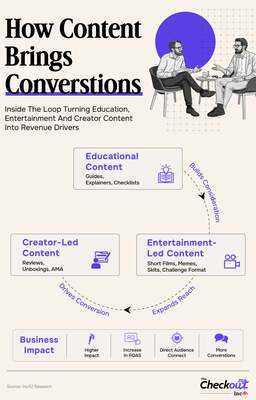
On the other hand, high-quality content improves the efficiency of every stage of the marketing funnel. It attracts more qualified audiences, improves engagement rates, increases time spent evaluating products and builds purchase confidence before customers reach checkout.
While brands are experimenting with different content and owned media playbooks, it’s important to understand what drives real results. Rao feels that there is no universal winner. Different content strategies work for different problems.
Speaking about Clovia, he said that creator-led content has emerged as one of the strongest acquisition drivers. This is because it helps customers visualise products, understand fit and functionality, and enables more confident purchase decisions.
Apart from videos, brands are building communities to spark conversation. For instance, activewear startup Blissclub started as a community for women to talk about fitness and body image challenges.
On YouTube, brands like boAt, SUGAR Cosmetics, and The Whole Truth, among others, have taken over the content charge with formats like podcasts, web series, educational content and customer interactions.
How Sustainable Is The Media Moat?The harder question is whether owned media is a durable moat or simply the other side of the same spending problem, with a content team instead of a media-buying team. The market already has its cautionary stories. BRND.ME sold its media channels while Honasa shut the community.
All In Capital’s Singh said that product and content go hand in hand. “The brands that work well combine a great product with great marketing and great content — all three, not just the last one.”
While content can strengthen conversions, retention remains heavily dependent on the product itself. Nutrabay’s founder Shreyans Jain said brand-owned media only works to an extent.
“I believe owned media — other than email, SMS, or WhatsApp channels for existing customers — doesn’t work at scale beyond a certain point if it’s under the same brand name rather than a differently branded extension. Some consumers may perceive it as a conflict of interest from a trust perspective,” Jain said.
Raj frames the same risk from the other direction. Clovia, he said, doesn’t measure content through the ROI of a single campaign, but through the cumulative value it builds across acquisition, retention, organic visibility and brand equity over years, treating it less as a media business to be monetised on its own and more as compounding brand IP. The consensus is that while content can serve as a strong moat, it cannot drive long-term retention unless the product itself emerges as the hero.
SPOTLIGHT | How Invisel Is Protecting Homes With Nanotechnology- Invisel deploys a nano-particle shield through its products that protects home surfaces like fabric, wood, and marble from staining by beading liquids before penetration.
- It handles end-to-end manufacturing for its products, which include stain repellents for sofa, fabrics, marble, granite, glass and tiles, along with wood and leather protectors and enhancers. It also offers professional cleaning services.
- The brand follows an omnichannel approach, selling products on its own website, ecommerce and quick commerce marketplaces.
Quick Commerce Race Heats Up: The battle for India’s quick commerce market is intensifying as Amazon Now and Flipkart Minutes unveil aggressive expansion plans. While Flipkart has scaled to 1,000 micro-fulfilment centres across 130 cities, Amazon aims to expand to 300 cities, signalling a fresh race to capture the country’s fast-growing quick commerce opportunity.
Leadership Churn At Swiggy Instamart: Swiggy’s quick commerce arm has seen the exits of COO Ankit Jain and CBO Hari Kumar amid its aggressive expansion push. The changes come as the company battles mounting losses, ramps up investments in quick commerce, and navigates uncertainty around its proposed transition to an inventory-led operating model.
AllHome Bags Series B: PharmEasy’s cofounders have raised ₹200 Cr in a Series B round led by Bessemer Venture Partners for their second venture, AllHome, which operates as a “house of brands” marketplace for architectural and interior design products.
Honasa’s Nutraceuticals Bet: Mamaearth parent Honasa Consumer is looking to acquire a majority stake (58%) in nutraceuticals company Fluence Pharma for ₹135 Cr, marking its expansion into the nutrition and supplements space. The company plans to buy the remaining stake over the next 5-7 years.
The Deep Dive The Operator’s QuestionHow can D2C brands build and monetise owned media effectively?
The cofounder and CMO of Dogsee Chew, Sneh Sharma Khanal, highlighted a few strategies to monetise owned media.
Build Trust Before You Build Reach: People don’t follow founders because they’re founders. They follow them because they’re honest. Share the wins, hard decisions, failures and lessons learnt. When people trust you, they don’t just buy your product, they believe in your brand. That trust compounds far longer than any paid campaign.
Create Conversations, Not Content: Owned media shouldn’t feel like another advertising channel. The goal is to build a community where customers, partners and industry peers participate, ask questions and contribute ideas. When people feel heard, they become advocates, and that community becomes one of the strongest competitive advantages a brand can have.
Let Commercial Outcomes Follow Value: Every podcast, newsletter, or LinkedIn post doesn’t need a product plug. Focus on teaching, inspiring, or entertaining. If you’ve built credibility and a loyal audience, monetisation naturally happens through higher brand preference, lower customer acquisition costs, stronger retention, partnerships, and eventually, products people already trust before they buy.
“For me, founder-led media isn’t about becoming a creator. It’s about making the brand more human. In a world full of AI-generated content and polished marketing, authenticity is becoming one of the rarest and most valuable assets a business can own.”
The post D2C’s New Media Playbook appeared first on Inc42 Media.
-
Understanding Suspension Rules in the Knockout Stage of World Cup 2026

-
Morocco Edge Netherlands on Penalties to Reach World Cup Last 16

-
Gary Lineker backs Didier Deschamps as most qualified to win World Cup, slams FIFA for blocking France’s tribute to coach
-
Family terrified as bikers chase car on Hyderabad–Warangal highway

-
Delhi SIR process to include persons whose homes have been demolished, says poll panel