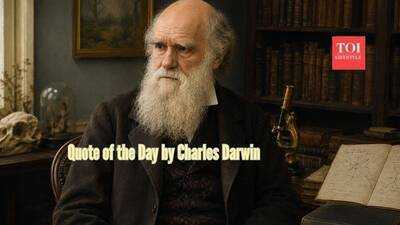
Charles Darwin is one of the few scientists who changed our understanding of the natural world. His theory of evolution by natural selection revolutionised biology and had a profound impact on fields as diverse as psychology, anthropology, medicine, and philosophy. Before Darwin , it was a common view that all of the living species had remained unchanged since their creation. Darwin demonstrated that life is constantly changing . Species evolve over millions of years through natural processes . His ideas caused fierce controversy in his own lifetime, but are now regarded as one of the greatest scientific achievements in history.
The childhood
Charles Robert Darwin was born in 1809 in Shrewsbury, England into a rich and educated family. His father Dr Robert Darwin was a successful doctor, and his grandfather Erasmus Darwin was a respected doctor, inventor and natural philosopher, who had already suggested the possibility of species changing over time. As a boy Darwin collected shells, insects, birds' eggs, rocks and plants. He did not spend hours in formal studies but in watching nature. His interest in the living world would later form the basis of his scientific career.
Darwin went to the University of Edinburgh to study medicine, his father’s wish. But he hated surgery, and found medical studies dull. He then went to Christ's College, Cambridge, with the intention of becoming a clergyman. But even then his real love was natural history. He studied botany, geology and zoology and made friends with a number of leading scientists. The Voyage of the Beagle 2.
The turning point in his life came in 1831 when he was asked to join the survey ship HMS Beagle as its naturalist. The trip lasted almost five years and took him to South America, Australia, New Zealand, Africa and a number of islands all over the world. During the voyage Darwin collected thousands of plant, animal and fossil specimens. He pointed out differences in species of animals living in different environments. One of his most influential stops was the Galápagos Islands, where he noticed that similar birds and tortoises differed slightly from island to island. These observations implied that species were not fixed but slowly adapted to local conditions.
He found fossils of giant mammals that had gone extinct, which looked like animals that still live in South America. He began to wonder if current species had evolved from ancient ancestors rather than been separately created.
THE EVOLUTION OF THE THEORY OF EVOLUTION
In England in 1836, Darwin spent more than twenty years studying his collections and pondering his observations. He read widely, did experiments, and wrote to scientists all over the world. Slowly he shaped his theory of evolution. Darwin suggested that all species produce more offspring than can survive. People are naturally different, and some of those differences make survival and reproduction more likely. Those who have good characteristics pass those characteristics to their offspring. These small changes add up over many generations to create new species altogether. He called this process natural selection, often abbreviated as "survival of the fittest. It is important to mention Darwin did not say the strongest survive but the fittest for the environment.
Origin of Species
Darwin was reluctant to publish his ideas because he knew they would challenge long held religious and scientific beliefs. But when Alfred Russel Wallace, the naturalist, independently came to a similar theory Darwin made up his mind to publish his work. In 1859 he wrote On the Origin of Species, one of the most influential scientific books ever written. The book claimed that all living things are descended from common ancestors and evolve through natural selection.
The publication caused a lot of debate. Some scientists immediately accepted Darwin's evidence, others rejected his conclusions vehemently. For religious groups , especially the idea that humans and other animals shared a common ancestor was deeply offensive . But over time, more and more evidence from genetics, fossils, anatomy and molecular biology supported Darwin's basic ideas.
Other books
Throughout his life, Darwin continued to write, refining and improving his theories. Some of his most important works are:
1. The Origin of Species (1859)
His classic work on evolution by natural selection
2. The Descent of Man (1871)
In this book Darwin wrote about human evolution, sexual selection and morality. He argued that human beings had evolved from earlier animal ancestors.
3. The Expression of the Emotions in Man and Animals (1872)
Darwin studied the evolution of facial expressions and emotions and showed similarities between humans and other animals.
4. The Variation of Animals and Plants Under Domestication (1868)
He looked at selection and inheritance in domesticated animals.
5. The Formation of Vegetable Mould, Through the Action of Worms (1881)
It was one of his last books, and showed the importance of earthworms for soil formation – a sign of Darwin’s continuing interest in even the smallest details of nature.
Contributions to Science
Darwin's contributions do not end with evolution. His greatest achievement was the formulation of evolution by natural selection . This provided biology with a unifying explanation for the diversity of life . His work laid the groundwork for modern evolutionary biology. Darwin also revolutionised the study of biogeography, demonstrating the significance of geographic isolation in the evolution of species. His work helped to advance comparative anatomy, ecology, animal behaviour, botany and geology. Later his theories became combined with genetics to form the Modern Evolutionary Synthesis which still forms the basis of biological science today.
Darwin’s ideas also benefit modern medicine. Evolutionary principles directly apply to understanding how bacteria develop antibiotic resistance or how viruses change through mutation.
Personality and Life
In 1839 Darwin married his cousin Emma Wedgwood. They had 10 children. Several died young. Emma was a permanent source of emotional support for him throughout his life. Darwin was plagued by ill health for many years, suffering from fatigue, nausea, headaches and digestive problems. These health problems did not stop him from doing research and writing nearly every day. Friends described him as modest, patient, honest and unusually cautious in weighing the evidence. Darwin spent decades compiling facts before he made conclusions, not rushing to publish bold claims. He died on 19 April 1882 and was buried in Westminster Abbey, something only Britain’s greatest are allowed.
Quote of the Day
One of the most iconic quotes of Charles Darwin taken from the The Descent of Man is,
“Man has an instinctive tendency to speak, as we see in the babble of our young children, but no child has an instinctive tendency to bake, brew, or write.”
Darwin distinguishes two types of human abilities. First are the natural instincts – abilities that humans are born with because they evolved over thousands of generations. This category includes speech. All over the world, children start babbling without any formal instruction. They are biologically wired to learn language While you need to hear a language in order to speak it fluently, the basic ability for language is part of human nature.
The second category is learned cultural skills, such as baking bread, brewing drinks, reading, writing, farming or building machines. These are not biological legacies. A newborn baby doesn't just know how to write an essay or bake a loaf of bread. These skills are to be taught by parents, teachers and society. Darwin’s observation highlights the remarkable partnership between biology and culture. Evolution has given humans the cognitive abilities to learn, to imitate, to reason, and to communicate. Culture fills those abilities with the knowledge accumulated over generations.
Also, his statement underscores the need for education. Human civilisation is not built by children taking in knowledge directly, but by each generation passing its discoveries on by teaching, language, books, and shared traditions. Knowledge of science, literature, cooking, architecture, and technology all continue to exist because they are learned, not instinctive. It is also a reminder that humans share many biological features with other species but our ability to build and transmit culture is remarkable. Animals may inherit instinctive behaviours, but humans construct civilisations by teaching each other ever more complex skills.
Darwin's insight still very relevant in the world today. Modern children may pick up spoken language naturally, but they still need guidance for mathematics, programming, scientific thinking, music, cooking or artificial intelligence. These achievements are the product of education, practice and cultural transmission, not mere instinct. Charles Darwin changed the way mankind thought about life . He showed that over vast amounts of time species change and adapt through natural selection . His careful observations, his rigorous scientific methods and his willingness to challenge accepted beliefs made biology a modern scientific discipline. His books still resonate with scientists, educators, philosophers, and students all over the world.
-
Brazil vs Japan: World Cup Knockout Clash Ends in Stunning Result

-
Pisces Tarot Horoscope Today, June 30, 2026: Focus on finances and seize new opportunities

-
Libra Tarot Horoscope Today, June 30, 2026: Emotional strength will shine, wisdom and experience will bring rewards

-
Capricorn Tarot Horoscope Today, June 30, 2026: Avoid haste when seizing opportunities, stay guarded against greed and temptation

-
Aquarius Tarot Horoscope Today, June 30, 2026: Health continues to improve, focus on early rising