The implementation of the 8th Pay Commission remains one of the most closely watched developments for central government employees and pensioners. While the government has not yet announced the official implementation date or finalized the fitment factor, discussions around possible salary revisions continue to gain momentum.
Recently, economist Sharad Kohli shared his projections regarding the likely fitment factor and the possible timeline for the revised pay structure. Although these are personal estimates and not official announcements, they have generated significant interest among government employees awaiting salary revisions.
Here's a detailed look at what has been predicted and what is officially known so far.
No Official Announcement on Fitment Factor Yet
The Central Government has not announced the final fitment factor for the 8th Pay Commission.
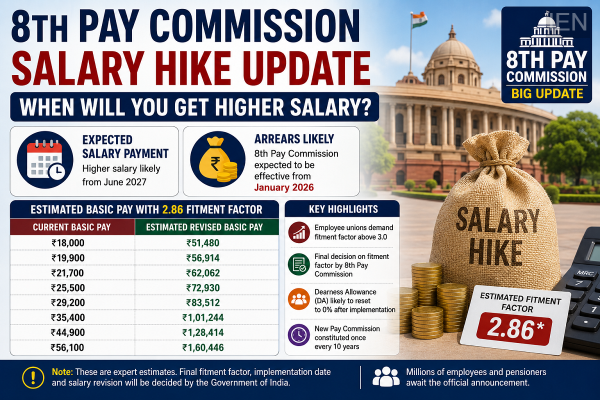
Employee unions have already submitted their recommendations to the commission, with many demanding a fitment factor of above 3.0 to provide a substantial increase in basic salaries.
However, Sharad Kohli believes the government could settle on a fitment factor of 2.86, though he emphasized that the final decision rests entirely with the Pay Commission and the Central Government.
At present, the commission is examining suggestions received from employee organizations before preparing its recommendations.
Estimated Salary Revision Based on a 2.86 Fitment Factor
If a 2.86 fitment factor is eventually approved, the estimated revised basic salaries could look like this:
| Current Basic Pay | Estimated Revised Basic Pay (2.86 Fitment Factor) |
|---|---|
| ₹18,000 | ₹51,480 |
| ₹19,900 | ₹56,914 |
| ₹21,700 | ₹62,062 |
| ₹25,500 | ₹72,930 |
| ₹29,200 | ₹83,512 |
| ₹35,400 | ₹1,01,244 |
| ₹44,900 | ₹1,28,414 |
| ₹56,100 | ₹1,60,446 |
These figures are only illustrative estimates based on the projected fitment factor and should not be considered official salary revisions.
When Could Employees Receive Higher Salaries?
According to Sharad Kohli's assessment, central government employees may begin receiving revised salaries around June 2027, provided the implementation process follows the expected timeline.
He also suggested that employees and pensioners could become eligible for arrears if the commission's recommendations are implemented with retrospective effect.
However, no official implementation schedule has been announced by the government.
Possibility of Arrears
The 8th Pay Commission is widely expected to take effect from January 2026, similar to previous pay commission implementation practices.
If the revised pay structure is approved after that date, eligible employees and pensioners may receive arrears covering the period between the effective date and the actual implementation.
The amount of arrears, however, will depend entirely on:
-
Final fitment factor.
-
Date of implementation.
-
Government approval.
-
Revised pay matrix.
No official calculation has yet been released.
Dearness Allowance May Reset After Implementation
Whenever a new Pay Commission is implemented, one common feature has been the merger of the accumulated Dearness Allowance (DA) with the revised basic salary.
As a result, the DA percentage is generally reset to 0%, after which fresh DA increases begin under the new pay structure.
This practice has been followed during previous Pay Commission implementations and is expected to continue, although official confirmation will come only after the commission submits its recommendations.
Why the 8th Pay Commission Is Important
The Pay Commission reviews salary structures for:
-
Central Government employees.
-
Pensioners.
-
Various government departments.
-
Certain autonomous bodies covered under central pay rules.
Its recommendations influence:
-
Basic pay.
-
Dearness Allowance calculations.
-
Pension revisions.
-
Other allowances and service-related benefits.
Millions of serving employees and retired pensioners are therefore closely monitoring the commission's progress.
Why Employees Are Waiting
Traditionally, a new Central Pay Commission is constituted approximately every ten years.
The 7th Pay Commission came into effect in 2016, and therefore many employees expected the 8th Pay Commission to become operational from January 2026.
Although several months have passed since the expected effective date, the government has not yet announced when the revised salary structure will actually be implemented.
The commission is currently consulting employee associations and examining various representations before finalizing its recommendations.
Final Takeaway
While speculation surrounding the 8th Pay Commission continues, it is important to distinguish between expert estimates and official government decisions.
The proposed 2.86 fitment factor and the possibility of salary payments beginning around June 2027 are currently projections shared by economist Sharad Kohli and have not been confirmed by the government.
Until the Central Government officially approves the commission's recommendations, the fitment factor, revised salary structure, implementation date and arrears remain subject to change.
Disclaimer: The salary estimates mentioned above are based on expert projections and should not be treated as official government announcements. The final fitment factor, implementation date and revised pay structure will be determined by the 8th Pay Commission and approved by the Government of India.
-
Food Poisoning: Can food poisoning be caused by homemade food? ‘These’ little mistakes in the kitchen can be costly

-
Samsung reportedly developing rollable phone with expandable 10-inch display

-
Gmail Account Security Alert: Jio and Airtel Users Beware! This mistake with Gmail account can be dangerous

-
Canada Stuns South Africa With Dramatic Late Goal to Reach World Cup Round of 16

-
Ireland cricket coach resigns after historic T20I series win against India. Read