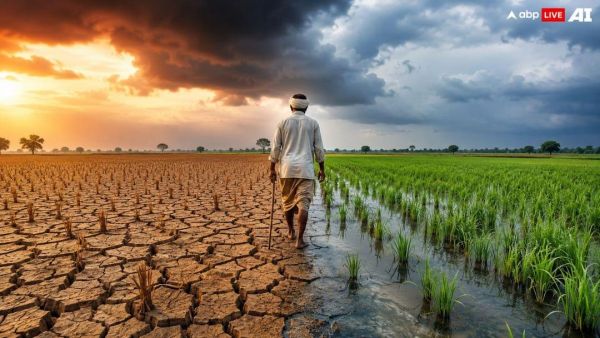
India is on track to record its driest June in more than 15 years, with the southwest monsoon remaining significantly behind schedule and rainfall continuing to lag long-term averages. The shortfall has raised fresh concerns over kharif sowing, food prices and the broader agricultural outlook, while weather experts warn that strengthening El Niño conditions could keep rainfall under pressure in the coming weeks.
Rainfall Deficit Crosses 43%
According to IMD data, India received 85.2 mm of rainfall between June 1 and June 28, well below the Long Period Average (LPA) of 149.8 mm. The cumulative rainfall deficit of more than 43 per cent places June 2026 among the driest corresponding months since records began in 1901.
The weather office had earlier forecast below-normal rainfall for June, projecting precipitation at less than 92 per cent of the LPA.
Based on current trends, total rainfall for the month is expected to be around 95 mm, making it the driest June since 2009, when the country recorded only 85.7 mm of rainfall, around 47 per cent below the long-term average.
Historically, June 2014 and June 1905 also witnessed severe rainfall deficits, with precipitation of 95.3 mm and 87.4 mm, respectively.
Central India Among Worst-Hit Regions
The weak progress of the southwest monsoon has affected almost every region of the country.
IMD data shows rainfall deficiency across all major geographical divisions:
Northwest India: -29%
East and Northeast India: -43%
Central India: -56%
South Peninsula: -31%
Several states have recorded particularly sharp rainfall deficits, including:
Chhattisgarh: -67%
Jharkhand: -67%
Maharashtra: -58%
Uttar Pradesh: -56%
Odisha: -54%
Karnataka: -42%
Madhya Pradesh: -39%
Only a handful of states, including Rajasthan, West Bengal and Andhra Pradesh, have so far received rainfall within the normal range.
Monsoon May Improve Briefly Before Weakening Again
While the rainfall situation remains challenging, weather scientists expect some short-term improvement.
Akshay Deoras, Senior Research Scientist at the Department of Meteorology, University of Reading, UK, told FE that favourable large-scale weather conditions are likely to help the southwest monsoon strengthen until around July 5, allowing it to advance further into central India.
However, he cautioned that forecast models indicate another weakening phase around the middle of July, increasing the possibility that the second half of the month could be drier than the first across much of the country.
July and August together account for nearly 60 per cent of the season's monsoon rainfall and are considered critical for kharif and horticultural crops.
IMD Sees Further Monsoon Advance
In its latest weather bulletin issued on Sunday, the IMD said atmospheric conditions remain favourable for the southwest monsoon to advance into additional parts of Gujarat, Madhya Pradesh, Chhattisgarh, Jharkhand, Bihar, Uttar Pradesh and Uttarakhand over the next two to three days.
Even so, the weather department had last month revised its forecast for the overall June-September southwest monsoon to 90 per cent of the LPA, signalling the possibility of the weakest monsoon season since 2015.
The IMD has also confirmed that El Niño conditions are present over the equatorial Pacific Ocean and are expected to strengthen further during the remainder of the southwest monsoon season.
Delayed Rains Raise Concerns for Kharif Sowing
The rainfall deficit has begun to affect the ongoing kharif cropping season.
Earlier this week, Agriculture Minister Shivraj Singh Chouhan said delayed monsoon conditions could adversely affect sowing, noting that 315 of India's 724 districts may receive deficient rainfall this season.
He added that the Centre has identified 111 districts as particularly vulnerable because irrigation coverage there is below 25 per cent.
Sowing activity resumed only after the monsoon regained momentum around June 20, following an interruption of nearly two weeks.
Impact on Agriculture Could Extend Beyond Farms
Agriculture experts say delayed monsoon progression across western and central India is likely to postpone sowing and transplanting of key kharif crops, including paddy, cotton and pulses, as well as horticultural crops such as onion and tomato.
Despite the delayed start, kharif sowing has covered around 10 per cent of the seasonal area so far.
Government data shows that the total acreage under crops including rice, pulses, oilseeds, sugarcane and cotton stood at 11.79 million hectares as of June 22, remaining higher than the corresponding period last year.
How rainfall evolves during July will now be closely watched, as it is expected to determine both the pace of sowing and the outlook for agricultural production during the remainder of the monsoon season.
-
Could Xhaka Be Next? Ranking Chelsea’s Last 10 Over-30 Signings from Worst to Best

-
Manchester United Face Fresh Competition in Race for Shea Charles

-
BCCI Dragged In As MCA Sacks Coach, Manager Over Sexual Assault In Hotel Room

-
Pet First | 4 Nutrient-Rich Oils That Can Boost Your Dog's Health Naturally

-
Morocco’s Evolving Blueprint: Shaping a New Era for African Football at the World Cup