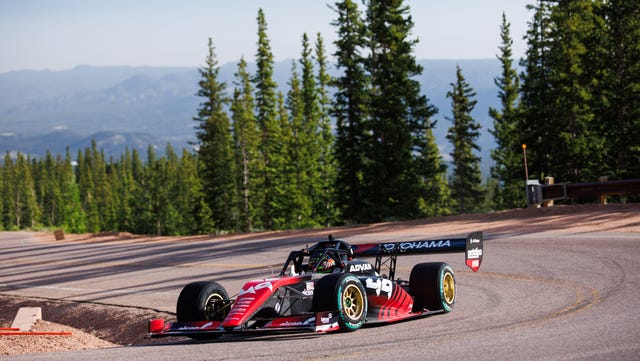
Four-time Pikes Peak International Hill Climb champion Robin Shute is returning to the mountain this year with a completely new creation. His team, the Sendy Club, has retired its modified Wolf chassis to introduce what could be the most extreme car on the grid — a 1300-pound, 850-horsepower custom-built open-wheeler powered by a motorcycle-derived V-8 engine. Appropriately, Shute has named this latest machine the “SendyCar.”
This radical new build ranks among the most extreme vehicles ever to compete in the 110-year history of the hill climb. Yet, it marks a natural evolution for Shute and his collaborators. Shute’s Pikes Peak journey began as an engineer for Faraday Future, where he helped run a large road-going electric vehicle in 2017. When that project ended, the same group aimed to bring an electric single-seater to Pikes Peak the following year. After that plan failed, what would become the Sendy Club pivoted to a Wolf single-seat prototype as its base platform.
The team immediately began modifying the Wolf chassis, first with large turbochargers and later with oversized tyres that required changes to the bodywork. With that car, Shute claimed victories in 2019, 2021, 2022, and 2023. However, the team always intended to create something even more distinctive, leading to the birth of the SendyCar.
The SendyCar is a completely bespoke build, incorporating very few off-the-shelf parts. One of the few carryover components is the central tub from a Tatuus Formula 4 car — an entry-level open-wheeler used to train drivers progressing from karting to higher tiers of single-seater racing. Behind it sits a 2.3-litre engine, a custom-built unit by Synergy based on the BMW S1000 RR motorcycle engine. A Borg-Warner 92-74 turbocharger boosts output to around 850 horsepower at sea level. Shute estimates that even at Pikes Peak’s altitude, the engine will still produce power in the “high seven hundreds.” The long block weighs about 130 pounds and revs up to 13,000 rpm.
With the engine paired to a chassis weighing just 1300 pounds before adding fuel or driver, the SendyCar is capable of astonishing performance. Shute claims it can generate 2 g of acceleration even at 100 mph. The car produces more than 1100 pounds of downforce at that speed, although these figures are calculated at sea level; performance will vary at the mountain’s elevation.
The aerodynamic design was conceived by Shute himself. He began by creating the car’s dimensions using AutoDesk Fusion CAD software, then shaping the body with T-spline surfaces. He repeatedly tested the designs using the online CFD tool Airshaper, refining them after each run. Shute says he went through “hundreds of runs” before finalising the design for production. That’s when the real challenge began.
“We take the concept of the car,” Shute explains, “and then reality hits when building it. We had to constantly update the design to make it a real, tangible car. That’s very difficult. You see all these concept renders of supercars online — they make me wince because they’re so far from reality. Anyone can make a pretty picture, especially now with AI, but turning that into a functioning, competitive machine is a completely different challenge. The people who actually make it happen — like McMurtry — they’re the ones truly walking the walk.”
Although Shute is impressed with how the car performed during its initial shakedown earlier this month, he views this year’s race as a development step rather than a record attempt. His focus is on refining the SendyCar for next year, incorporating improved aerodynamics and possibly reintroducing more enclosed bodywork, as initially planned before the current open-wheel design was finalised. He also believes he can reduce the car’s weight by another 80 to 90 pounds.
This season’s runs will also serve to identify potential issues when pushing the SendyCar to its limits over the 12-mile climb. According to Shute, such challenges are an inevitable part of creating a car this extreme. “To make a 1300-pound car,” he says, “you have to be aggressive with everything. It has to be engineered with absolute precision, so mistakes will happen. If we built it to sixteen hundred or seventeen hundred pounds, everything would be easier, but it would also be slower. That’s the essence of engineering compromise.”
The SendyCar is the result of years of effort, and Shute believes it has a genuine chance of one day surpassing the overall record set by Romain Dumas in a Volkswagen ID.R in 2018. Whether or not he achieves that goal, Shute is deeply appreciative of Pikes Peak for offering a platform to attempt something so ambitious.
“My skill set isn’t in high demand in most racing categories,” Shute admits. “I don’t come from a wealthy background or a family racing legacy — I’ve had to carve out my own path in motorsport. Pikes Peak allows me to do that, and it just happens to align with my passion for designing cars. Honestly, I think I enjoy the design process more than the driving itself, though I love both. It’s been incredibly stressful, and I’ve poured everything into this project, as have many others. I’m very thankful for the opportunity and for all the support we’ve received.”
-
Could Xhaka Be Next? Ranking Chelsea’s Last 10 Over-30 Signings from Worst to Best

-
Manchester United Face Fresh Competition in Race for Shea Charles

-
BCCI Dragged In As MCA Sacks Coach, Manager Over Sexual Assault In Hotel Room

-
Pet First | 4 Nutrient-Rich Oils That Can Boost Your Dog's Health Naturally

-
Morocco’s Evolving Blueprint: Shaping a New Era for African Football at the World Cup