In the high-stakes world of elite sports, talent alone rarely wins medals. What often separates podium finishers from also-rans is that invisible edge: world-class systems, fresh eyes on old problems, and someone who can rewire a team’s belief when pressure mounts.
India’s recent surge across hockey, athletics, wrestling, and more tells exactly this story, one where foreign coaches have stepped in not as saviours, but as catalysts.
The latest such feat is the podium finish that the Indian Men’s Volleyball Team has just scored its first-ever medal at the AVC Men’s Cup 2026 after defeating defending champions Bahrain in four sets: 25-23, 23-25, 25-22, 25-17. This is a landmark achievement for Indian volleyball, trained by Head Coach Dragan Mihailovic, a seasoned Serbian tactician.
View this post on Instagram
On Sunday, the Indian men's volleyball team secured a historic bronze medal at the 2026 AVC Men's Cup in Ahmedabad by defeating defending champions Bahrain 3-1.
View this post on Instagram
Head Coach Dragan Mihailovic instilled discipline, a structured blocking system, and a fearless winning mentality. Under his leadership, the boys played cohesively and bounced back beautifully from the disappointment of their narrow semi-final loss to eventually secure the bronze.
The historic tournament run catapulted India's FIVB world ranking from 60 to 42, which will secure them better seedings in future continental draws. Of course, the path ahead needs a lot of consistent hard work, mental strength, world-class coaching, and self-discipline on the part of the team.
Craig Fulton and the Mental Reset in Hockey
Take Craig Fulton, the South African coach of India’s men’s hockey team. Appointed in 2023 after Australian Graham Reid, Fulton inherited a side coming off Olympic bronze in Tokyo (2020) and tasked with sustaining momentum through Paris 2024 (another bronze) and beyond.
𝐇𝐚𝐩𝐩𝐲 𝐁𝐢𝐫𝐭𝐡𝐝𝐚𝐲 𝐭𝐨 𝐨𝐮𝐫 𝐂𝐡𝐢𝐞𝐟 𝐂𝐨𝐚𝐜𝐡, 𝐂𝐫𝐚𝐢𝐠 𝐅𝐮𝐥𝐭𝐨𝐧!
— Hockey India (@TheHockeyIndia) November 6, 2025
Your leadership, passion, and vision continue to inspire Team India towards greater heights. Wishing you a fantastic year ahead! 🏑#IndiaKaGame #HockeyIndia pic.twitter.com/BMq26orNxf
Post-Pro League campaigns, where results fluctuated as the team rotated youngsters and tested combinations, Fulton was clear: this wasn’t failure, it was preparation. The focus remained on bigger prizes like World Cup qualification, the Asia Cup, and Asian Games gold.
Fulton’s European pedigree (including Belgium’s golden era) brought tactical discipline, GPS-tracked periodization, and zonal structures that moved Indian hockey beyond “run-and-gun” flair.
More importantly, he emphasized mental resilience, navigating slumps by keeping the squad focused on long-term evolution rather than short-term noise.
Players talk of a renewed belief: overcoming mental barriers that once haunted big moments. This is the “mind games” part, more about building faith that turns potential into consistent winners.
Back again for a new show 😊🇮🇳
— Sjoerd Marijne (@SjoerdMarijne) January 2, 2026
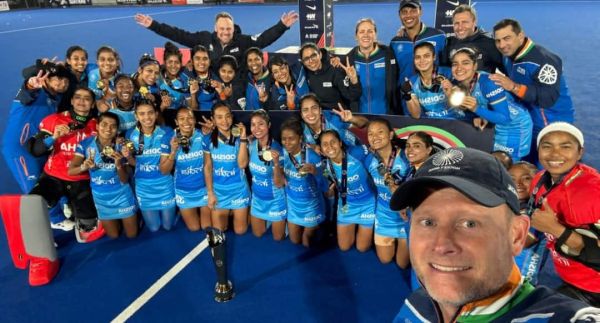
On the women’s side, Dutch coach Sjoerd Marijne (back for a second stint in 2026) delivered India’s historic 4th place at Tokyo 2020.
He transformed a side long out of the global elite through structure, fitness, and defensive solidity.
Even after a Nations Cup win in 2026, Marijne the perfectionist focused on conversion rates: “We create enough opportunities... but we don’t make enough field goals.”
Back to the #HockeyProLeague @TheHockeyIndia @sports_odisha @FIH_Hockey #team pic.twitter.com/SGzjirJYJ0
— Sjoerd Marijne (@SjoerdMarijne) June 21, 2026
That relentless drive for improvement embodies the foreign coach’s edge.
Not “Indian Coaches Are Bad” BUT A Smart Strategic Play.
Let’s be clear: this isn’t because Indian coaches or training facilities are inadequate. India now boasts world-class infrastructure, like the Inspire Institute of Sport and SAI National Centres of Excellence.
Home-grown icons like Pullela Gopichand have produced badminton stars through sheer dedication.
Instead, it’s a calculated strategy by the Sports Authority of India (SAI) and Target Olympic Podium Scheme (TOPS).
Building a deep elite coaching ecosystem takes decades. Hiring proven international experts provides immediate “marginal gains” while mandating knowledge transfer, and “train the trainer” clauses in contracts ensure Indian assistants absorb methodologies for long-term handover.
Foreign coaches bring objectivity (less local politics), exposure to 50+ years of refined sports science elsewhere, and neutrality in selections based on data and performance.
They inject intellectual property from powerhouses in Germany (biomechanics), Australia (hockey systems), South Korea (badminton), and more.
If I were to merely sum it up, we could say they bring ‘Precision, Psychology, and Pride.' But let us elaborate on that.
Remember Neeraj Chopra’s Olympic javelin gold? That included the German biomechanist Dr. Klaus Bartonietz using high-speed cameras to refine release angles and aerodynamics. Neeraj later worked with Czech legend Jan Železný before transitioning back to Indian roots (childhood coach Jaiveer Singh Chaudhary). This full-circle journey scaled him past technical plateaus.
Or the gains in the sport of wrestling in the recent years? Foreign trainers like Kamal Malikov (for Ravi Dahiya) and others introduced multi-directional sparring and energy conservation, turning good wrestlers into world-beaters who conserve for final periods.
Mirabai Chanu’s Olympic silver path involved US specialist Dr. Aaron Horschig fixing shoulder and back issues through targeted pelvic stability work, not just heavier lifts.
At the elite level, physical gaps are tiny. Foreign coaches excel at the psychology: creating distraction-free overseas training bubbles (away from intense home media pressure), fostering “us vs. the world” pride, and building unshakeable team faith.
Fulton’s post-slump clarifications, Marijne’s structured belief-building, Dragan Mihailovic’s tactics and Gary Kirsten’s 2011 Cricket World Cup triumph all show this, turning individuals into a cohesive force that believes it belongs at the top.
In Tokyo 2020, dozens of foreign support staff (coaches, analysts, physios, psychologists) accompanied athletes. The result? Multiple breakthroughs that ended long droughts.
The Hybrid Future: Scaling Barriers Together
India isn’t replacing its system, it’s supercharging it. Elite athletes often train domestically at top facilities, then seek short targeted stints abroad for sparring or specialization. Wrestlers benefit from hybrid camps where Georgians and others work alongside Indians. Neeraj’s return to Indian coaching shows the end goal: absorb the best globally, then lead with home-grown pride.
This isn’t dependency. It’s smart acceleration. Foreign coaches don’t create the raw talent flooding Indian fields and stadiums, they unlock it. They help athletes scale that final mental and technical barrier, bonding over shared sweat and belief in something bigger: India as a rising global sporting powerhouse.
From Fulton steadying the ship through experiments toward World Cup glory, to Marijne demanding perfection after victories, to the biomechanics wizards behind Neeraj’s throws, these partnerships celebrate a confident India that knows when to learn from the world to shine even brighter on it.
The medals, records, and Asian/continental triumphs against powerhouses like China are proof: when belief meets science and strategy, barriers don’t just break, they become launch pads. The story isn’t “foreign vs. Indian.” It’s India winning, smarter, stronger, and together.
(The author is a senior independent journalist)
-
Mykare Closes Round At $3.2 Mn To Enhance AI Capabilities

-
Telangana: BJP leader assaults teacher for allegedly unauthorised Urdu classes, two FIRs filed

-
India's hidden heat: Why 42°C isn't really 42°C

-
Smartworks Appoints Two Independent Directors To Strengthen Its Board

-
Zerodha Seeks SEBI Approval To Enter Investment Banking