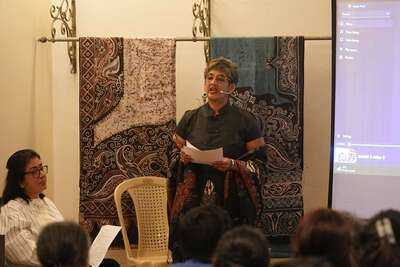
At the latest edition of Weavers Studio's Textile Talks, artist, curator and printmaker Paula Sengupta presented
A River of Unrest, A Delta of Dreams, a textile project that moves between history and imagination to revisit the exile of Nawab Wajid Ali Shah . Travelling from the Gomti to the Hooghly and eventually towards the deltaic landscapes of Bengal, the work interweaves stories of displacement, ecological fragility and the enduring power of memory. The story of the last king of Awadh unfolds not through pages of history books, but across silk panels, fragments of old saris, embroidered landscapes and the winding course of rivers. "This presentation explores a sweeping tale hinged between fact and fiction of the last king of India traversing geographies and sailing rivers from the Gomti to the Hooghly to the Matla in a bid to alter his fragile destiny,"said Darshan Shah while introducing the session. Rendered through batik, shibori, embroidery and appliqué, the work reflects Sengupta 's longstanding engagement with themes of migration, loss, heritage and landscape. Mounted on a collapsible four-fold antique teakwood screen, the installation consists of eight silk panels, transforming the room divider into a moving chronicle of exile.
History through the language of cloth
For Sengupta, textiles are not merely decorative surfaces but repositories of memory. "A lot of times I work with found textiles as opposed to new textiles because I enjoy the histories that are already within those," she said. "Textiles are objects of use. People have used them for generations sometimes. I enjoy the layering of personal associations with larger histories." This relationship with cloth is deeply personal. Among the fabrics incorporated into the work are fragments of a Tangail sari gifted to her by her mother as part of her trousseau. When the sari began to fall apart, Sengupta preserved it instead of discarding it. "I never throw any of my textiles that come apart, I keep them for another day," she said.
The woven portraits embedded within the fabric were salvaged and transformed into imagined kings and queens who accompany Wajid Ali Shah and his begums on their journey downstream. In doing so, a private memory became intertwined with a historical narrative stretching across centuries.
Reimagining an exhiled king
In 1856, Nawab Wajid Ali Shah was dethroned by the British East India Company and forced to leave Awadh. Historical records, Sengupta pointed out, describe his arrival in Calcutta in humiliation. Yet the king's own writings paint a dramatically different picture."The Nawab imagines that he left Awadh in procession, led by his animals, while behind him followed a retinue of soldiers, musicians and dancers. And the women of Awadh wept from the balconies to see their beloved king pass," she said.
When the king finally reached Calcutta, he disembarked at Bichali Ghat — a landing station whose name literally refers to cattle fodder."Of the many landing stations on the river that the city boasts of, Bichali Ghat is the most unlikely for the last king of India to disembark at. Yet, this is the reality," Sengupta observed. In her interpretation, however, history becomes porous. The Nawab sails not only through geography but through memory and imagination, accompanied by creatures from his famed menagerie and surrounded by landscapes that constantly shift with the tide.
The Sunderbans as metaphor
The river eventually opens into the Sundarbans, which emerged as one of the emotional and visual centres of the project. She described the delta as
"a landscape of contradictions" — one where the tiger, despite reigning in folklore, struggles to survive, where species disappear and where ecological balances remain precarious.
"The rhinoceros has vanished. The tiger struggles to survive. The crocodile, native as he is, rules," she said. Reflecting on the presence of humans within this landscape, Sengupta offered one of the session's most striking observations. "Nor is the human being native. He happens to be there by some gross error of history."The breathing roots of mangroves, the clay banks and the changing tides find repeated expression in the textile panels. Alongside them swim zebras, hippopotamuses, giraffes and lions — animals inspired by the Nawab's collection and reimagined as fellow travellers. "Coming full circle, I locate the tragic fate of the Nawab on the river of unrest," Sengupta said. "Trapped between the dark canopy of the great banyan's prop roots on the one bank and the tentacles of the mangrove roots on the other."
The great banyan appears repeatedly throughout the series, functioning as a witness to the passage of time, while the mangrove roots below signify both resilience and vulnerability.
An elegy for vanishing worlds
At the heart of the work lies a larger metaphor. The decline of a kingdom and the degradation of an ecosystem mirror one another. "This tragic scene, poignant as it is, is metaphoric of not just the ebbing of an era, but also the ebb of a fragile, threatened ecosystem teetering on the brink of extinction
," she said. The project also extends beyond textiles. Sengupta spoke about A Palace of Porcelain on a Tower of Mud by the River of Unrest, a book of linocuts inspired by the destruction of the Nawab's palace and its eventual consumption by the river. Printed on walnut-shell-stained rice paper, the book imagines two zebras — Shada and Kalo — from the Nawab's menagerie as protagonists in a tale of chaos and destruction. The work later evolved into a five-and-a-half-minute animation where rivers and weather emerge as central characters, reflecting the cyclones and environmental crises that increasingly shape life in the Sundarbans.
A song of separation
Accompanying the presentation was Wajid Ali Shah's iconic thumri
Babul Mora, a composition often interpreted as the lament of a bride leaving her father's home, but equally evocative of the king's own separation from Awadh. "He is actually talking about his beloved Awadh and drawing a parallel with the bride leaving her father's home
," Sengupta explained. Like the song,
A River of Unrest, A Delta of Dreams is steeped in melancholy. Yet it is also a work of remembrance — one that refuses to let either personal histories or collective losses disappear beneath the tides.
-
Karnataka BJP panel flags 3 suspected cross votes in MLC poll

-
Pakistan: Explosion, Heavy Gunfire Reported In Karachi; 3 Killed Including Suicide Bomber

-
'Context Ignored': Defence Ministry Hits Back After Operation Sindoor Remarks

-
Nico Paz to stay put! Como finalise €60m agreement with Real Madrid as La Liga powerhouse secures a higher buy‑back clause

-
Why is the US targeting Germany's drug industry?