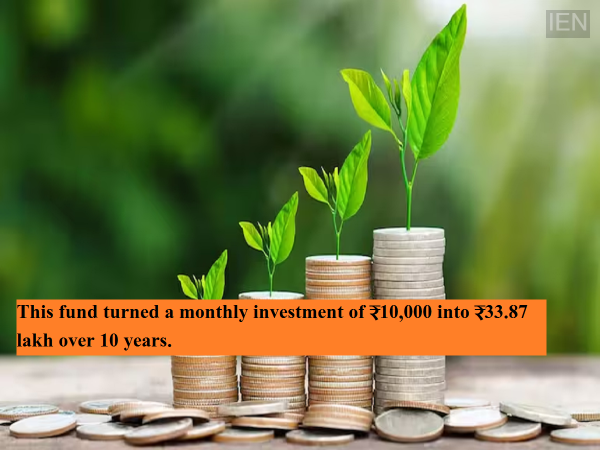
HDFC Mid-Cap Fund Turns ₹10,000 Monthly SIP Into ₹33.87 Lakh in 10 Years; Here's What Drove the Growth
Long-term investing continues to reward disciplined investors, and one of the strongest examples comes from HDFC Asset Management Company's flagship mid-cap mutual fund. As the scheme completes two decades, it has delivered impressive long-term returns while growing into one of India's largest actively managed mid-cap funds.
According to the fund's latest performance data, an investor who started a Systematic Investment Plan (SIP) of ₹10,000 per month 10 years ago would now have accumulated approximately ₹33.87 lakh. Similarly, a lump-sum investment of ₹1 lakh made a decade ago would have grown to nearly ₹5.68 lakh, highlighting the potential of long-term wealth creation through equity mutual funds.
Strong Long-Term Performance
The HDFC Mid-Cap Fund has now entered its 20th year of operations and has built an asset base of nearly ₹1 lakh crore.
The scheme's Direct Plan – Growth Option has generated an annualized return of around 20% (CAGR) over the past two decades. Delivering such sustained returns over a long investment horizon places the fund among the notable performers in the mid-cap category.
While historical returns do not guarantee future performance, the figures demonstrate the benefits of remaining invested through different market cycles.
How Investments Grew Over 10 Years
The fund's historical performance shows the impact of both lump-sum investing and disciplined monthly contributions.
-
₹1 lakh invested as a lump sum 10 years ago would have appreciated to approximately ₹5.68 lakh.
-
A monthly SIP of ₹10,000 over the same period would have accumulated a corpus of about ₹33.87 lakh.
These returns underline the importance of staying invested for the long term and benefiting from the power of compounding.
Why the Fund Focuses on Mid-Cap Companies
The scheme primarily invests in mid-cap stocks, which are generally companies with strong growth potential but are smaller than established large-cap businesses.
Market experts believe that India's expanding manufacturing sector, rising domestic consumption, and improving corporate earnings continue to create opportunities for quality mid-sized companies. Many successful mid-cap firms eventually graduate to the large-cap category as their businesses expand.
However, investors should remember that mid-cap stocks usually experience higher market volatility than large-cap stocks. As a result, they may witness sharper price movements during periods of market uncertainty.
Investment Strategy
According to the scheme's disclosures, the fund follows a bottom-up stock selection approach.
Instead of focusing primarily on sectors or macroeconomic trends, the fund manager identifies individual companies based on their business fundamentals. The investment process emphasizes businesses that demonstrate:
-
Strong and sustainable business models
-
Experienced and capable management teams
-
Competitive market positioning
-
Attractive valuations
-
Long-term earnings growth potential
This disciplined investment strategy has helped the fund maintain consistency over an extended period.
As of May 31, 2026, the fund's Assets Under Management (AUM) stood at approximately ₹97,350 crore, making it one of the largest schemes in the mid-cap mutual fund segment.
Fund Management
The scheme is managed by Chirag Setalvad, an experienced equity fund manager known for his focus on fundamentally strong businesses.
Speaking about the fund's long-term objective, Navneet Munot, Managing Director and CEO of HDFC Asset Management Company, said the primary goal of the scheme is to generate sustainable long-term wealth for investors through disciplined investment in quality mid-cap companies.
Should Investors Consider a Mid-Cap Fund?
Financial planners generally recommend mid-cap mutual funds for investors with a long investment horizon and the ability to tolerate short-term market fluctuations.
Although these funds can be more volatile than large-cap funds, they also offer greater growth potential over extended periods. Investors who remain invested for several years are often better positioned to benefit from business expansion and market appreciation.
Before investing, individuals should evaluate their financial goals, risk appetite, and investment timeline. Diversification across different asset classes and fund categories is also important for managing overall portfolio risk.
Final Takeaway
The HDFC Mid-Cap Fund's long-term performance demonstrates how consistent investing and patience can create significant wealth over time. A disciplined SIP strategy combined with the power of compounding has helped investors build sizeable portfolios over the past decade.
That said, mutual fund investments are subject to market risks, and past performance should not be viewed as a guarantee of future returns. Investors should carefully read the scheme documents and consult a qualified financial advisor before making any investment decision.
Disclaimer: Mutual fund investments are subject to market risks. Past returns are not indicative of future performance. Investors should consult a certified financial advisor before making investment decisions.
-
Who is Francois Letexier? The French referee officiating Cape Verde vs Saudi Arabia

-
Cape Verde to face Argentina in knockout stage after goalless draw with Saudi Arabia

-
Argentina coach Lionel Scaloni to rest Lionel Messi for World Cup group stage finale against Jordan

-
US may relocate military bases from Kuwait, Saudi Arabia: Report

-
Beyond tokenism: CJP and the Muslim youth question