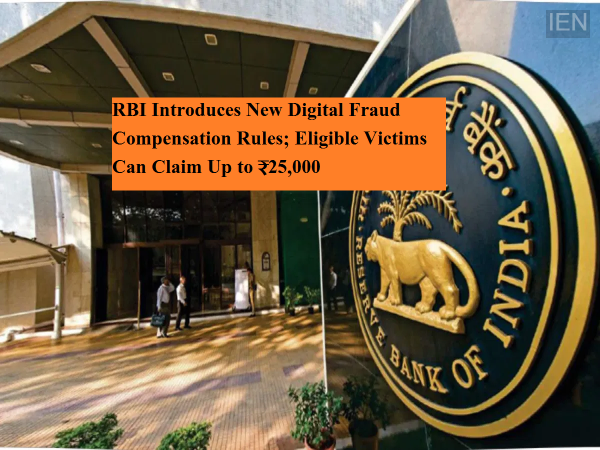
In a major move to strengthen consumer protection in India's rapidly expanding digital payments ecosystem, the Reserve Bank of India (RBI) has announced a new compensation framework for victims of digital financial fraud. The revised rules, which will come into effect on January 1, 2027, are designed to provide financial relief to eligible customers who lose money through online banking fraud, UPI scams, or other unauthorized digital transactions.
The updated framework broadens the scope of customer protection and places greater responsibility on banks to investigate fraud complaints promptly while ensuring timely support for affected account holders.
Compensation Available for Smaller Digital Fraud Cases
Under the new RBI guidelines, customers who suffer financial losses of up to ₹50,000 due to eligible digital fraud may receive compensation.
The compensation will cover 85% of the verified financial loss, subject to a maximum limit of ₹25,000. This benefit is intended to help customers recover part of their losses in cases where they become victims of digital payment scams.
However, the compensation can be claimed only once during the customer's lifetime, provided the individual satisfies all eligibility requirements under the RBI framework.
Wider Coverage for Different Types of Fraud
The revised rules extend protection to a broader range of digital fraud situations than before.
Eligible cases may include:
-
Unauthorized online banking transactions.
-
UPI-related fraud.
-
Theft or misuse of passwords and login credentials.
-
Fraud involving stolen One-Time Passwords (OTPs).
-
Transactions carried out through deception or impersonation.
-
Payments made under coercion, intimidation, or threats.
By expanding the categories of covered incidents, the RBI aims to improve customer confidence in digital payment systems while encouraging stronger fraud prevention measures across the banking sector.
Banks Must Complete Investigations Within Fixed Timelines
The RBI has also introduced strict timelines for handling fraud complaints.
For domestic digital fraud cases, banks will be required to complete investigations and determine liability within 45 days of receiving the complaint.
For cross-border or international digital transaction fraud, the maximum investigation period has been fixed at 60 days.
If a bank is unable to complete the investigation within the prescribed period, it must provide the customer with a valid explanation for the delay.
The objective is to ensure faster complaint resolution and greater accountability among financial institutions.
Additional Protection for Credit Card Users
The revised framework also introduces enhanced safeguards for credit card holders.
If a customer reports a fraudulent credit card transaction, the issuing bank must provide a shadow reversal, also known as a temporary credit, equal to the disputed transaction amount within five days of receiving the complaint.
This temporary credit allows customers to avoid immediate financial hardship while the investigation remains in progress.
Mandatory SMS Alerts for Transactions Above ₹500
To improve transaction monitoring, RBI has also directed banks to send instant SMS alerts for every transaction exceeding ₹500.
This requirement applies even to customers who may not use smartphones or mobile banking applications, ensuring that account holders receive immediate notification whenever money is debited from their accounts.
Timely alerts can help customers identify unauthorized transactions quickly and report fraud without unnecessary delay.
How Eligible Customers Can Claim Compensation
Customers who believe they have become victims of eligible digital fraud should act immediately after noticing the unauthorized transaction.
The recommended steps include:
-
Inform the bank without delay through its official customer support channels.
-
Block the affected account, debit card, credit card, or UPI ID if necessary.
-
Submit a formal fraud complaint along with all available transaction details.
-
Cooperate with the bank during the investigation process.
-
Wait for the bank's assessment under the RBI compensation framework.
Compensation will be processed only after the bank verifies that the case meets the conditions specified under the revised regulations.
Rules to Become Effective in 2027
Although the RBI has announced the new framework, customers should note that these revised provisions will come into force nationwide on January 1, 2027.
Until then, banks will continue operating under the existing digital fraud liability framework while preparing their systems and procedures for the updated rules.
Key Takeaway
The Reserve Bank of India's revised digital fraud compensation framework represents a significant step toward improving customer protection in the digital banking era. From January 1, 2027, eligible victims of online banking fraud, UPI scams, and other unauthorized digital transactions involving losses of up to ₹50,000 may receive compensation of 85% of the verified loss, subject to a maximum of ₹25,000. The new rules also require faster complaint resolution, temporary relief for credit card fraud victims, and mandatory SMS alerts for transactions above ₹500, providing stronger safeguards for millions of digital payment users across the country.
-
US strikes Iran after drone attack on cargo ship in Hormuz

-
14 tonne of govt wheat meant for students seized in Karnataka

-
5 killed after goods vehicle crashes into Omni on NH-63 in Karnataka

-
Indian national among 8 sanctioned by US over Sudan war

-
Lock Upp 2: Full and final list of 14 contestants with photos