Earlier in the tournament, Paraguay’s Miguel Almiron had already fallen foul of the new regulation introduced for the World Cup.
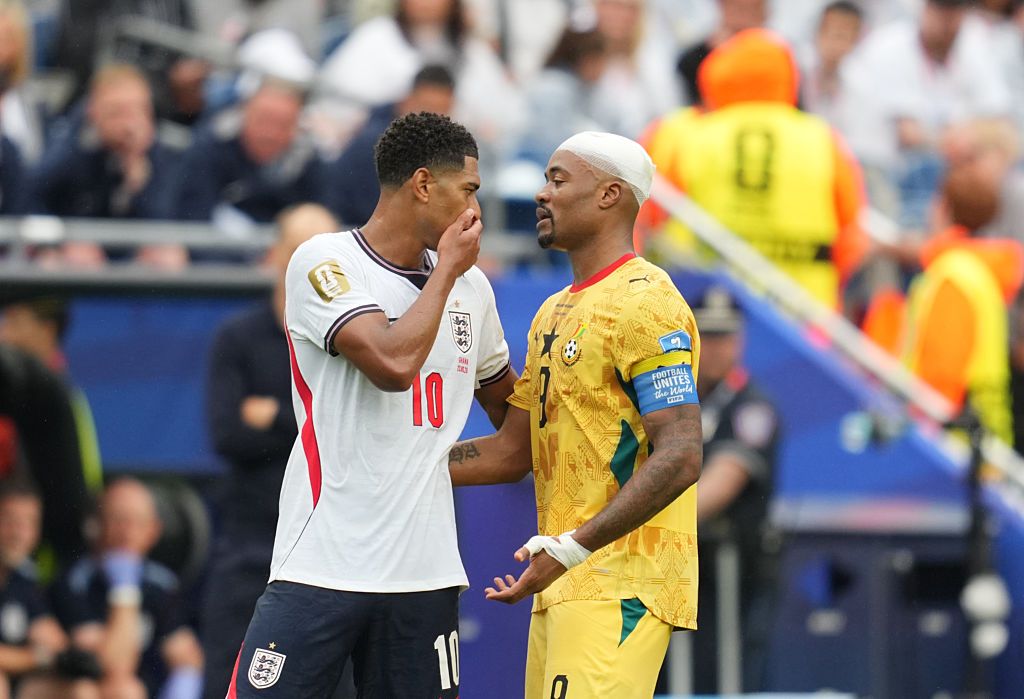
During England’s goalless draw against Ghana on Tuesday, Jude Bellingham was seen covering his mouth with his hand while speaking to Ghanaian forward Jordan Ayew.
This led some fans to question why Bellingham was not shown a straight red card for the gesture, as Paraguay’s Almiron had been when he covered his mouth while talking to Turkiye’s Mert Muldur.
The explanation lies in the context of the incident — as clarified by the wording of the law itself.
According to an official explanation from the International Football Association Board (IFAB), which governs the Laws of the Game: “At the discretion of the competition organiser, any player covering their mouth when communicating with an opponent in a provocative, derisory or inflammatory manner or situation may be shown a red card and sent off.”
The IFAB further stated: “This law change, which competitions may choose to adopt, reflects football’s broader intention to combat racism and discrimination by taking meaningful action and introducing a strong deterrent against players covering their mouth (including with their hand, arm, or shirt) to conceal inappropriate comments, insults, or other forms of abuse directed at an opponent.”
The crucial phrase here is ‘in a provocative, derisory or inflammatory manner or situation’. The rule does not impose a blanket ban on players covering their mouths while speaking to opponents.
This clarity aligns with the vision of FIFA’s referee chief, Pierluigi Collina, who had earlier explained the intent behind the change.
Before the tournament began, the Italian official clarified: “Players can continue to cover their mouth with an arm or shirt when they are chatting with friends. It’s normal to have a conversation before, during, or after a match — if it’s friendly, they can continue without any issue.”
He added: “When the conversation becomes confrontational, covering the mouth implies that something inappropriate might be happening, and in such a case, the sanction should be a red card.”
This distinction highlights why Almiron was punished but Bellingham was not.
Almiron’s act occurred during a heated confrontation following a foul — a clear example of a provocative or inflammatory situation, which made the red card appropriate under the revised rule.
In contrast, Bellingham’s brief exchange with Ayew appeared friendly, with Ayew even placing an arm around Bellingham as they shared a light moment and a brief embrace.
-
Antonio Conte appointed as Italy’s new head coach: Former Chelsea and Napoli manager trusted to revive Azzurri after World Cup heartbreak

-
Jesse Marsch admits Alphonso Davies acted as a 'decoy' before Canada’s 2-1 World Cup loss to Switzerland

-
'My heart was pounding' – Neymar opens up on 'challenging' 981-day break as Brazil star makes 'nervous' comeback against Scotland
-
Carlo Ancelotti owes Vinicius Jr a gift as Brazil star proves him wrong with 'impossible' header against Scotland
-
Frenkie de Jong vs Declan Rice & Vitinha: Ex-Dutch Star Jimmy Floyd Hasselbaink Reveals Where the Barcelona Midfielder Must Improve After Hitting Back at Critics