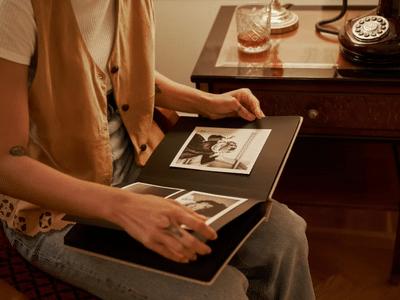
The emotion that appears when mothers look through old family photographs is often described as nostalgia, but nostalgia alone does not fully explain the reaction. Personal photographs are powerful memory cues that can reactivate not only events from the past but also earlier versions of the self. A photograph from pregnancy, early motherhood, or a child’s infancy does more than remind someone of what happened. It can reconnect them with a period of life that carried different routines, priorities, relationships, and identities. The emotional response often comes from encountering a former self that feels familiar yet distant at the same time.
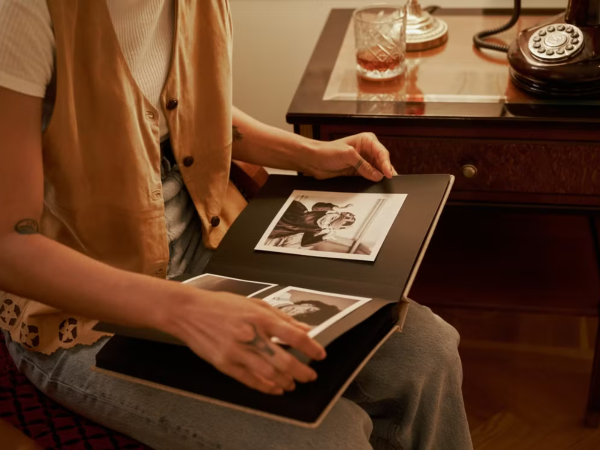 Photographs reactivate more than memories
Photographs are particularly effective at bringing back detailed personal experiences. Unlike a verbal reminder, a photograph can instantly restore faces, environments, emotions, and context.
A study examining the relationship between photography and memory, published in , found that photographs can strengthen later memory for visual details and experiences. This matters because old family pictures are not simply records of the past. They become retrieval cues that help reactivate the experience of living through that moment.
For mothers, this means a photograph of a toddler may not only bring back memories of the child. It may also restore memories of who they were during that period, what their daily life looked like, and how they experienced themselves at that stage.
The emotion is often tied to identity
One of the strongest themes in autobiographical memory research is that memory helps maintain a sense of identity across time. People use memories to understand how different versions of themselves fit together into a continuous life story.
Research published in found that personal memories play an important role in constructing and maintaining the sense of self. This connection helps explain why old photographs can feel emotionally intense. A picture from early motherhood may not simply represent a memory, but rather a version of the self that no longer exists in quite the same form.
The emotional response therefore comes from more than remembering. It comes from recognizing the distance between who someone was then and who they are now.
Major life stages leave strong memory traces
Motherhood often coincides with periods of rapid change involving identity, relationships, responsibilities, and daily routines. Because these transitions are significant, they tend to become deeply embedded in autobiographical memory.
People frequently use memory to maintain continuity across major life transitions, and old photographs can make that process particularly vivid because they provide concrete visual evidence of a life stage that once felt immediate and ordinary but has since passed.
This helps explain why photographs from pregnancy, infancy, or early childhood often provoke stronger reactions than pictures from more routine periods of life. They represent chapters in which identity itself was changing.
 Photos encourage comparisons between past and present
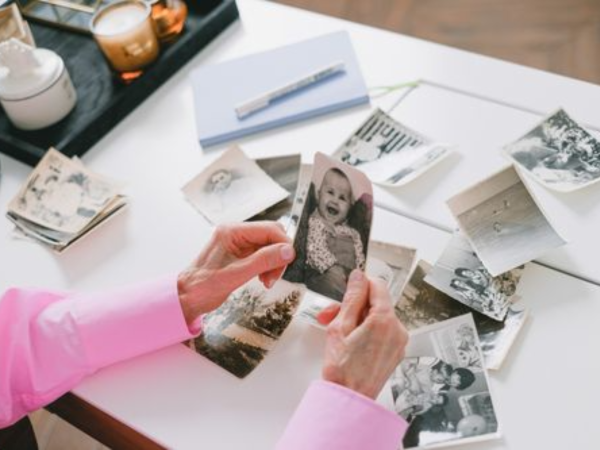
Unlike memory alone, photographs create an opportunity to see the past from the outside. People are not only remembering who they were. They are looking directly at that earlier version of themselves. Research published in suggests that people often hold multiple representations of themselves from different periods of life. A photograph can bring one of those earlier selves into focus and make the contrast with the present more visible.
Pride, gratitude, loss, affection, and sadness may all appear simultaneously because the image highlights both continuity and change. The person in the photograph is still part of the same life story, but the circumstances surrounding that version of the self may no longer exist.
Mothers who become emotional when looking at old photographs are not necessarily responding to nostalgia alone; photographs act as powerful triggers for autobiographical memory, identity, and self-continuity. They can bring back not only events but entire periods of life, along with the roles, routines, and versions of the self that existed within them. The emotion often comes from recognizing how much has changed while also seeing how those earlier experiences remain part of the present story. A family photograph may appear to capture a child, but for many mothers it also captures a former self, which is why the feeling it evokes can be so much deeper than simple nostalgia.
-
From Rajasthan To Ireland: Indian-Born Poised To Debut For Ireland Against India

-
DRDO's ‘Flying Eye’ Netra Gets Final Clearance After Operation Sindoor

-
LPG Curbs Removed As Centre Restores Pre-West Asia Crisis Supply Levels

-
Government Increases Passport Fees; Revised Rates Effective From July 1
-
Staying Healthy At 35,000 Feet! Check Out This Airline's Special Menu On Occasion Of International Yoga Day 2026