
Every day at 4:30 a.m., Le Van Bao, 54, in Hai Phong City gets up to exercise and tend a rooftop garden. This health- and nature-centered lifestyle is part of an “old age blueprint” he has been building for years. So, from his 20s he focused on his business to build a financial foundation, shifted his focus to health at 50, and by 60 aims to be free of financial pressure.
Four years ago, despite having a thriving career and children still in school, he decided to retire. He only supported his children financially until they turned 21. When his three children went abroad to study, the family contributed to some basic costs.
His eldest daughter worked part-time to cover her living expenses and the second chose a school with a higher scholarship rather than her dream school. Even when the children faced difficulties, he and his wife kept their retirement savings untouched and did not step in.
“Selling the house and pouring all savings into children’s education or business ventures is a mistake,” Bao says.
|
Older adults care for children at the Ecohome residential community in Hanoi, June 2026. Photo by Phan Duong |
Bao’s “old age project” represents a quiet shift taking place across the country. Over the next decade, Vietnam will see the largest wave of retirements in its history as the generation born in the late 1960s and early 1970s reaches retirement age.
According to the General Statistics Office, the country currently has nearly 27 million people aged 40-59, with close to 700,000 joining the elderly population each year. Alongside longer lifespans, attitudes toward old age are also changing. The Manulife Asia Care Report 2025 shows a growing number of people prioritizing healthy living and financial independence over simply living longer. A Prudential Vietnam survey found that 85% of people aged 30-44 want to be self-sufficient in old age, but only 40% actually have a financial plan in place.
Professor Giang Thanh Long of the National Economics University says older people today lack self-sufficiency largely due to historical circumstances, war and economic hardship.
“For those approaching old age, the barriers lie in awareness and policy.”
Retirement planning is still seen as a distant concern, resulting in 55% of informal workers not enrolling in social insurance and only around 3% having voluntary coverage. The pressure is compounded by the fact that Vietnamese live long but not well. According to the Vietnam Aging Survey 2022, each elderly person suffers from more than three diseases and spends the last six years of their life dealing with illness.
The heavy burden of healthcare falls on the “sandwich generation,” which is middle-aged adults who are simultaneously stuck between caring for their own dependent children and their aging parents, even as they themselves struggle with their own health conditions. Data from the Global Burden of Disease study also shows rising rates of non-communicable and chronic diseases in this population group.
“Without an appropriate healthcare strategy, they will be unwell before they are even old,” Professor Long warns.
 |
|
Truong Thuy, 44, learns kitesurfing on Nha Trang beach in the summer of 2025. Photo courtesy of Truong Thuy |
To reduce the caregiving burden on the next generation, many middle-aged Vietnamese are proactively setting financial boundaries. Earlier this year, when her son asked for money for buying a house from a 400-million-dong savings fund, Van, 51, and her husband in Phu Tho refused.
“This is our retirement fund,” she says. “The children can borrow from it, but we won’t give it away.”
The couple had accumulated the money since their two children graduated from university. Her husband is a construction worker in their hometown, while she moved to Hanoi to help their son look after his child, and does paid cleaning work. Each month she sets aside five million dong. Her son says his parents’ financial independence relieves him and his wife of the pressure of supporting them.
From France, Bao’s eldest daughter says she was taught from a young age to be independent. The three siblings found their own scholarships and took responsibility for their own choices.
“My parents taught us that everyone is responsible for their own life. I have never felt the pressure of having to shoulder my parents’ old age.”
Having set aside the traditional Vietnamese mindset of “in youth we rely on our parents, in old age we rely on our children,” many people are now designing their own living spaces for the future.
Two years ago, Truong Thuy, 44, quit her banking job in Hanoi to move to Nha Trang. To fund an early retirement, she sold the house her mother left her, invested the proceeds and rented accommodation for years. She took on work as an MC and runs a travel visa services company to supplement her income.
“Coming to Nha Trang, I found a community of middle-aged people who had also left the city for the coast,” she says.
She now manages rental properties and spends her time gardening, traveling, and diving.
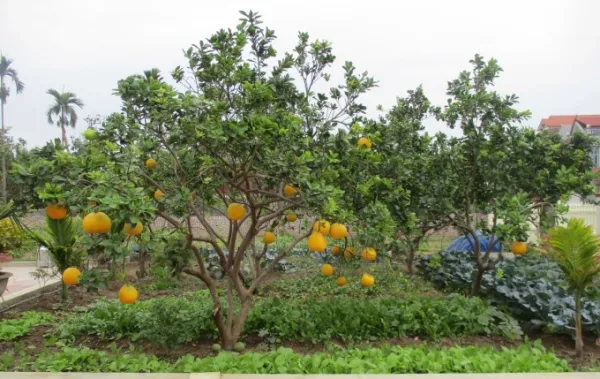
Three years ago, Minh Khang, 44, in HCMC, bought a piece of land in Can Tho for his retirement. He changed his lifestyle and diet to maintain muscle mass from the age of 38. He has been actively building a financial reserve and purchasing health insurance to cover the future cost of hiring a caregiver.
“I don’t want my children to have to put their careers on hold to care for their parents,” he explains.
 |
|
Minh Khang’s retirement garden. Photo courtesy of Minh Khang |
André Gama, a social protection specialist at the International Labor Organization, says countries that have successfully navigated an aging society typically build multi-tiered pension systems combining contributory and non-contributory schemes.
“Vietnam needs to continue developing its social security system to ensure income security in old age.”
This process requires long-term vision, with fundamental steps including expanding social insurance coverage, gradually lowering the age for benefit eligibility toward 70 and eventually aligning it with the retirement age, and developing long-term care policies that recognize the value of unpaid care work, he adds.
Long says the spirit of “preparing for old age while still young” also runs through Vietnam’s current policies.
“Universal social and health insurance coverage will ensure income security and healthcare for people at every stage of life.”
At a policy forum titled “How to Age Well?” held at Fulbright University Vietnam in early June, Dang Thi Phi Huong Giang, a member of the Vietnam Health Policy Research Community, pointed out that quality of life in one’s later years is determined long before a person reaches retirement age.
Giang and other experts proposed five pillars for comfort in old age: financial stability, good health, a suitable living environment, strong social relationships, and opportunities for lifelong learning. “These five factors must support one another.”
Four years into retirement, Bao says his days now revolve around sport, gardening, reading, and writing. “If the day comes when we need special care, my wife and I will use our own funds to hire professional services and not burden our children.”
-
Premature Grey Hair: Causes, Risk Factors And 4 Effective Prevention Tips

-
DGCA Takes Action After Air India Flight Enters Pakistan Airspace

-
Vaibhav Sooryavanshi May Not Share Changing Rooms With Senior Indian Stars On England Tour; Here's Why

-
Jack Fletcher: Manchester United’s New Direction Under Carrick Alters Academy Prospects

-
Jude Bellingham surpasses Wayne Rooney to set new England record at the 2026 World Cup