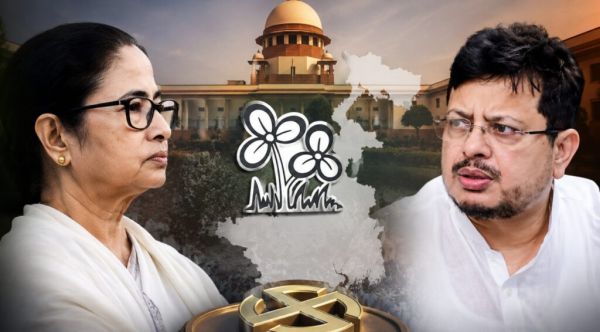
Trinamool Congress (TMC) has reached such a point in the politics of West Bengal, where the fight is not only for leadership but for the right over the party’s identity, election symbol, organization and political legacy. The dissatisfaction that started after the crushing defeat in the assembly elections has now turned into open rebellion and both the parties are busy calling themselves the “real Trinamool Congress”. With this, the matter has reached the Election Commission, from where the decision can decide the direction of Bengal politics.
Now both the groups came forward openly
In the assembly elections held in April, BJP won an overwhelming majority, while Trinamool Congress got far fewer seats than expected. After the electoral setback, questions started being raised within the party regarding leadership and strategy. Gradually this dissatisfaction turned into organized protest.
The situation became more serious when a large number of party MLAs appeared to be separating from the leadership of Mamata Banerjee. The post of leader of opposition, influence in Kolkata Municipal Corporation and many organizational posts also started going out of the hands of Mamata faction. Discussions intensified in political circles that this was not just a disagreement, but the emergence of a parallel power center within the party.
Rebel group’s big bet
On Monday, the group led by Ritabrata Banerjee held an important meeting and passed a proposal to remove Mamata Banerjee from the post of party president. In his place, MLA Arup Roy was declared the president. After this, the rebel group presented the list of its officials and claims before the Election Commission and the Chief Electoral Officer of the state.
On the other hand, Mamata Banerjee camp also filed its own separate list, in which she was described as the legitimate president of the party. Mamata supporters argue that the rebel group is definitely a part of the party, but it is in a minority and the actual command of the organization is still with them. From here, the formal fight has started regarding the name, election symbol and political identity of Trinamool Congress.
What is the ‘two-wing test’ of the Election Commission?
When there is a split in a recognized political party and both factions lay claim to the name and election symbol of the party, then the Election Commission takes a decision under Para 15 of the Election Symbols (Reservation and Allotment) Order, 1968.
In this process the Commission examines the support on two main grounds. The first legislative wing means how many MPs, MLAs or elected representatives of the party are with which faction. Second, the Organizational Wing means which party is under the control of the official committees, officials and organizational structure of the party.
The investigation of both the aspects is called ‘two-wing test’. If one group gets a clear majority at both the levels, then it is generally considered the real successor of the party.
Who has the upper hand in TMC?
The rebel group claims that more than 80 percent of the Trinamool Congress MLAs are with it. If this claim is proved before the Election Commission, then it may get a clear lead in the legislative wing.
The rebel leaders have also argued that the tenure of the party’s national executive has ended, hence the current organizational structure should not be considered valid. If the Commission accepts this argument, the situation may become more challenging for Mamata Banerjee.
However, the Mamata faction is citing organizational control and support of party workers as its biggest strength. In such a situation, the fight will not only be about numbers but also about legitimacy.
This tradition started from Congress
‘Two-wing test’ is not a new system. It started in 1969 during the historic split of Congress. At that time, Congress was divided into two factions (Congress-O and Congress-J) and both claimed the election symbol of the party.
The Election Commission assessed the strength of both the groups on the basis of organization and elected representatives. Later the Supreme Court also justified this method. The famous ‘Sadiq Ali vs Election Commission’ judgment of 1971 provided the legal basis for this test. Even today the same principle is applied in cases of division of political parties.
What signals from the cases of Shiv Sena and NCP?
The two major divisions that have taken place in Maharashtra politics in recent years are the most famous examples of this process. First there was a conflict between Eknath Shinde and Uddhav Thackeray in Shiv Sena. Considering the support of MLAs as an important basis, the Election Commission considered Shinde faction as the real Shiv Sena and gave it the ‘bow and arrow’ election symbol.
After this, there was a dispute between Sharad Pawar and Ajit Pawar in the Nationalist Congress Party (NCP). There too the legislative support proved decisive and the Commission gave its verdict in favor of the Ajit Pawar faction. For this reason, the number of MLAs is being considered the most important factor in the current controversy of TMC.
What is at stake in front of Mamta?
This fight is not just about a political post. The faction which is recognized by the Election Commission will get the official name of Trinamool Congress, the election symbol of ‘two flowers’, the registered vote bank of the party and the status of a regional party.
Apart from this, the claim of the same group on the party’s properties, bank accounts and organizational resources will also be strengthened. At present, the party’s funds worth crores of rupees and many administrative rights are in uncertainty.
Final decision not in Kolkata but in Delhi
Trinamool Congress may be playing politics in Bengal, but its future will now be decided between the Election Commission offices in Delhi and legal arguments. In the coming months, both groups will present documents, affidavits and organizational proof of their support.
Whatever be the decision, it is certain that this fight is not only a test of Mamata Banerjee’s leadership, but also of the political brand that has dominated Bengal politics for two decades. Now the question is that in whose hands will the ‘two flowers’ remain?
-
Heart Rate: Is sudden increase in heart beat an alarm bell? Know when it is normal and when you should immediately consult a doctor

-
Easy home remedies for cleaning doors

-
Dominance of Indian players in ICC rankings, Shubman Gill became world number-2 ODI batsman, after 36 years the player of this team created history.
-
Shadab Chauhan said- ‘Akhilesh Yadav, who remained silent on the Muslims of UP, jumped to save the BJP CM’
-
From fish sauce to fruit trees: Vietnamese couple brings homeland flavors to Greece