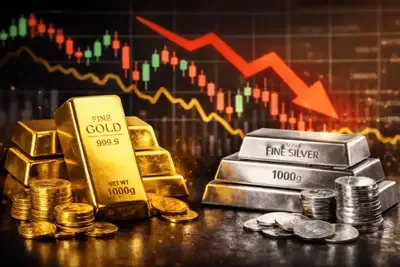

Gold Silver Price Crash 2026: Silver Down Over ₹36,000 This Month, Gold Falls ₹10,748; Key Reasons Behind the Sharp Decline
New Delhi: Precious metal markets witnessed a significant correction on June 23, 2026, as both gold and silver prices registered sharp declines, offering much-needed relief to consumers and jewellery buyers. According to data released by the India Bullion and Jewellers Association (IBJA), silver prices plunged by ₹10,566 per kilogram in a single trading session, while 24-carat gold fell by ₹2,522 per 10 grams. The sudden decline comes after months of strong rallies that had pushed both metals to record highs earlier this year.
Market experts believe that a combination of global economic developments, profit-booking by investors, easing geopolitical concerns, fluctuations in crude oil prices, and changing demand dynamics in international commodity markets have contributed to the sharp fall. While gold and silver continue to remain important safe-haven assets during periods of uncertainty, the latest correction indicates that investors are reassessing their positions amid evolving global conditions.
The decline has generated significant interest among investors, bullion traders, jewellers, and consumers alike. Many buyers who had postponed purchases due to soaring prices are now closely monitoring the market for potential buying opportunities. At the same time, analysts caution that volatility is likely to remain elevated in the coming weeks as global financial markets continue to react to geopolitical developments, central bank policies, and economic indicators.
Gold and Silver Witness Sharp One-Day Correction
According to IBJA data, silver prices declined from ₹2.37 lakh per kilogram on June 22 to ₹2.27 lakh per kilogram on June 23, representing a massive single-day drop of ₹10,566. Such a sharp movement is relatively rare in the bullion market and reflects the intensity of selling pressure witnessed across global commodity exchanges.
Gold prices also recorded a substantial fall. The price of 24-carat gold declined by ₹2,522 per 10 grams, slipping from approximately ₹1.47 lakh to ₹1.45 lakh per 10 grams. Although gold remains historically expensive, the latest correction has provided temporary relief to consumers who were struggling with record-high prices during the wedding and festive seasons.
Market participants suggest that investors who accumulated positions during the recent rally are now booking profits, resulting in increased selling activity. The correction is also being influenced by a moderation in global safe-haven demand as investors shift focus toward riskier assets amid improving sentiment in some international markets.
The decline is particularly noteworthy because it comes after an extended period of bullish momentum in both metals. Throughout the first half of 2026, concerns regarding global economic growth, geopolitical tensions, and inflationary pressures had driven significant inflows into precious metals, pushing prices to unprecedented levels.
Monthly Decline Crosses ₹36,000 in Silver
The latest correction has accelerated the decline seen throughout June. Gold prices have fallen by ₹10,748 per 10 grams during the month, while silver has become cheaper by ₹36,015 per kilogram.
At the beginning of June, gold was trading around ₹1.56 lakh per 10 grams. Since then, a combination of international and domestic factors has weighed on prices, resulting in a sustained downward trend. Silver, which is generally more volatile than gold, has witnessed an even steeper decline.
The sharp monthly correction has attracted considerable attention because silver had emerged as one of the strongest-performing commodities earlier this year. Investors had poured substantial capital into the metal due to its dual role as both a precious metal and an industrial commodity.
Despite the recent decline, analysts note that both gold and silver continue to trade significantly above their levels seen in previous years, highlighting the extraordinary rally that occurred before the correction.
How Far Have Gold and Silver Fallen From Record Highs?
The current decline becomes even more striking when compared to the record highs reached earlier in 2026.
On December 31, 2025, gold was trading at approximately ₹1.33 lakh per 10 grams. Strong global demand, central bank purchases, geopolitical tensions, and investor concerns about economic uncertainty drove prices sharply higher during January.
Gold eventually reached an all-time high of ₹1.76 lakh per 10 grams on January 29, 2026. Since then, the metal has corrected by approximately ₹31,333 per 10 grams.
Silver experienced an even more dramatic rally and subsequent correction. The metal was trading near ₹2.30 lakh per kilogram at the end of 2025 before surging to an unprecedented ₹3.86 lakh per kilogram on January 29, 2026.
Since that historic peak, silver prices have fallen by nearly ₹1.59 lakh per kilogram within just 145 days. The magnitude of this correction highlights the highly volatile nature of silver markets, where prices often react more aggressively than gold to changes in investor sentiment and economic expectations.
While such corrections can be unsettling for short-term investors, long-term market observers note that precious metals have historically experienced cyclical periods of rapid appreciation followed by significant corrections.
Why Are Prices Falling Despite Higher Import Duties?
One of the most intriguing aspects of the current decline is that it has occurred despite an increase in import duties on gold and silver.
The Government of India recently increased import duties on both precious metals from 6% to 15%. The move was aimed at reducing dependence on imports and easing pressure on the country’s foreign exchange reserves amid volatile global conditions.
Under the revised structure, gold imports attract a 10% Basic Customs Duty and a 5% Agriculture Infrastructure and Development Cess, taking the effective tax burden to 15%. This marks a substantial increase compared to the reduced duty structure introduced in the Union Budget 2024.
Ordinarily, higher import duties tend to increase domestic prices by raising the cost of imported metals. However, the steep decline in international bullion prices has more than offset the impact of the higher tax burden.
Analysts suggest that if global prices had remained stable, domestic gold and silver rates could have been significantly higher following the duty hike. Instead, international market weakness has exerted stronger downward pressure, leading to lower retail prices despite increased taxation.
Global Factors Influencing Precious Metal Prices
Several international developments have played a role in the recent correction.
The easing of geopolitical tensions in some regions has reduced immediate demand for safe-haven assets such as gold. Investors often move money into gold during periods of uncertainty, but as concerns moderate, capital tends to flow back into equities and other growth-oriented investments.
Movements in the US dollar have also influenced precious metal prices. A stronger dollar generally makes gold and silver more expensive for international buyers, reducing demand and putting pressure on prices.
Interest rate expectations remain another key factor. Precious metals do not generate interest income, making them less attractive when yields on other assets rise. Any indication that major central banks may maintain tighter monetary policies can negatively affect gold and silver prices.
In addition, profit-booking by institutional investors following the historic rally earlier this year has contributed significantly to the correction.
Why Gold Prices Differ Across Cities
Consumers often notice differences in gold prices between cities, even on the same day. Several factors contribute to these variations.
Transportation and security costs are among the primary reasons. Moving gold across long distances requires extensive security arrangements and insurance coverage, increasing costs in certain regions.
Local demand patterns also play an important role. Southern India accounts for nearly 40% of the country’s gold consumption, creating unique market dynamics that can influence regional pricing.
Jewellery associations in different states and cities often establish local benchmark rates based on demand-supply conditions. These associations play a significant role in determining daily market prices.
Another factor is inventory acquisition cost. Jewellers who purchased stock at different price levels may adjust their selling prices accordingly, leading to variations between stores and regions.
What the Correction Means for Investors
For investors, the recent decline presents both opportunities and risks.
Some market participants view the correction as a healthy adjustment following an extraordinary rally. They believe that lower prices may create attractive entry points for long-term investors seeking portfolio diversification.
Others remain cautious, arguing that global economic uncertainty could lead to continued volatility in the short term. Future movements in gold and silver prices will likely depend on geopolitical developments, inflation trends, central bank decisions, and global growth expectations.
Silver, in particular, may continue to experience larger fluctuations due to its industrial applications. Demand from sectors such as solar energy, electric vehicles, electronics, and renewable infrastructure could provide long-term support for prices even if short-term volatility persists.
Gold continues to retain its traditional appeal as a hedge against inflation and financial uncertainty. Many financial advisers recommend maintaining a modest allocation to precious metals as part of a diversified investment portfolio.
Important Tips for Gold Buyers
Experts recommend that consumers exercise caution and diligence when purchasing gold.
Certified gold carrying a Bureau of Indian Standards (BIS) hallmark should always be preferred. Hallmark certification ensures that the purity of the metal meets prescribed quality standards.
Buyers should also verify prevailing market prices from reliable sources such as the India Bullion and Jewellers Association before making a purchase.
Understanding the difference between 24-carat, 22-carat, and 18-carat gold is equally important, as pricing varies significantly based on purity levels.
Additional charges such as making charges, GST, and design premiums should also be considered when evaluating the final purchase cost.
Four Simple Ways to Identify Genuine Silver
Consumers purchasing silver can use several simple methods to verify authenticity.
The magnet test remains one of the most popular techniques. Genuine silver is not magnetic and will not stick to a magnet.
The ice test can also be effective because silver is an excellent conductor of heat. Ice placed on genuine silver typically melts much faster than on ordinary metals.
A smell test may provide additional clues. Pure silver generally has no noticeable odor, whereas counterfeit items containing other metals may emit a metallic or copper-like smell.
Finally, rubbing silver with a white cloth can sometimes reveal black marks caused by natural oxidation, which is often an indicator of genuine silver content.
As global markets continue to navigate economic uncertainties and changing investor sentiment, the precious metals sector remains under close scrutiny. The sharp decline recorded in June 2026 has provided temporary relief for consumers while creating new opportunities and challenges for investors. Whether the current correction continues or prices rebound in the coming weeks will depend largely on international market conditions, monetary policy developments, and geopolitical events. For now, the substantial fall in gold and silver prices marks one of the most significant bullion market developments of the year.
The post Gold and Silver Prices Crash: Silver Falls ₹10,566 Per Kg in a Day, Gold Drops ₹2,522 Per 10 Grams appeared first on CliQ INDIA.
-
The 20 Costliest Strikers in History: Two Former Manchester United Players Dominate the Top Ten

-
Delhi Capitals Cricketer Faces Serious Allegations After Woman Files Complaint

-
S&P Flags Triple Threat To India’s Economy: Oil, Inflation, And Weak Monsoon

-
Mumbai School Holiday Update: Students Await Decision As IMD Issues Orange Alert For Heavy Rain

-
Cristiano Ronaldo bristles at Lionel Messi question, defends against 'very harsh' criticism after historic two-goal World Cup show for Portugal