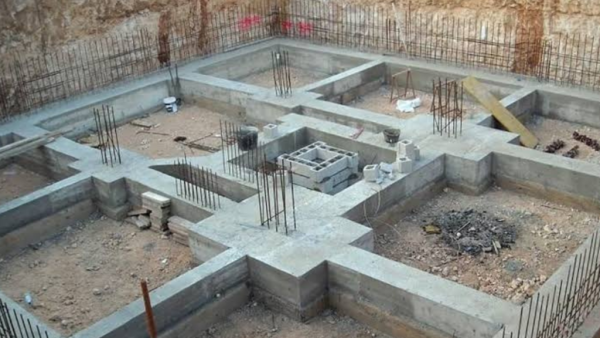
The most important part of building a house is its foundation. The foundation is responsible for supporting the entire weight of the house, and how deep this foundation should be depends entirely on the soil type. According to construction science, different soils have different load bearing capacity. Therefore, it is necessary to determine the depth of the footing according to the type of soil.
1. Muddy or rocky ground: This land is considered the best and safest for building a house. The load bearing capacity of rocky soil is very high. There is no need to dig too deep while building a house on such land. generally 3 to 4 feet If there is hard rock or mud on the room, a strong foundation can be built there. This also saves the cost of construction.
How do plants find water underground? Hypocrisy, tradition or science? Know the truth
2. Black kasabdar or agricultural land:This soil, which is highly fertile for agriculture, is the most challenging for construction. This soil swells by absorbing water during the monsoons and dries out in the summer to form large cracks. In such soils the foundation minimum 5 to 7 feet One has to dig deep, that is, one has to dig until one finds hard yellow murum or black rock underneath. In such places it is necessary to use ‘raft foundation’ or ‘under-reamed piles’.
3. Sandy or silty soil: Such soils are found in agriculture and coastal areas along rivers, near dams or in coastal areas. Because these soil particles are loose, it does not retain water and is prone to erosion. Foundation in such land minimum 5 to 8 feet It has to be taken deep. Sometimes ‘piling’ method has to be used for strengthening as per technical advice.
Enjoy life after retirement! Make sure to visit these beautiful places for a walk, your mind will be refreshed
4. Filled or soft ground: Low-lying lands buried with waste, rubble or loose soil fall into this category. It takes years for this land to stabilize. In such a place, the upper artificial soil is completely removed until the original natural hard soil is found, i.e. approx 6 to 9 feet Deep foundations have to be dug.
Still, It is always beneficial to get the soil tested by a structural engineer before building the house, which will ensure the longevity of the house.
-
Colombia reveal FIFA World Cup 2026 home and away kits: design inspiration, launch details and pricing

-
Cristian Romero addresses knee injury scare after Argentina’s 2-0 World Cup win over Austria

-
Ruben Amorim set to begin AC Milan tenure on July 6

-
Wildfire Near Beaver, Utah Forces Evacuations and Road Closures

-
Word of the day: Sybaritic