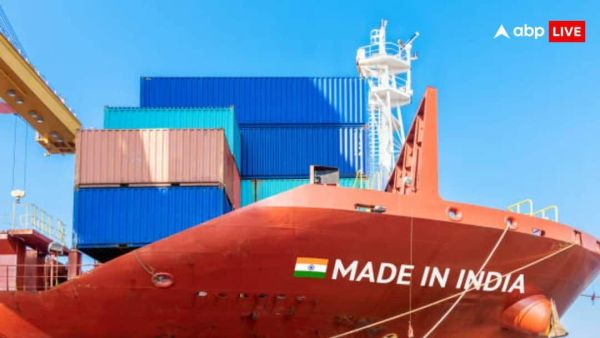
India's trade expanded in the January–March 2026 quarter, but concerns over imbalance persist, according to a NITI Aayog report. Total trade reached $1.84 trillion during the period, registering growth of 5.4 per cent.
However, imports grew at a faster pace of 6.5 per cent compared to exports at 4.2 per cent, indicating that external dependence remains elevated and domestic production is not expanding as rapidly as the global market.
Merchandise Trade Under Strain
The report shows that merchandise exports fell 2.8 per cent to $112 billion, while merchandise imports rose 11.9 per cent to $195.5 billion.
The data suggests that the manufacturing sector remains under pressure. In contrast, the services sector, particularly IT and digital services, recorded a recovery. Service exports increased 9 per cent to $111 billion, generating a surplus of $60.4 billion. This surplus helped contain India's overall trade deficit.
Trade Deficit Remains Manageable
Combined trade in goods and services resulted in a deficit of $23.15 billion, the second-lowest level of the year.
According to the report's data, the deficit narrowed during the second half of the year. However, the improvement is heavily dependent on the performance of the services sector and therefore cannot yet be considered permanent.
Export And Import Trends Highlight Changing Patterns
The report identifies electrical machinery, mineral fuels and nuclear reactors among the leading export categories.
Iron and steel exports grew 18.4 per cent, while vehicle exports rose 14.2 per cent. In contrast, gems and jewellery exports declined, reflecting weaker global demand.
On the import side, gold and silver-related categories recorded the sharpest increase, rising 82 per cent. Meanwhile, imports of mineral fuels declined 11 per cent, while iron and steel imports fell 16.8 per cent.
The report suggests these trends point to evolving domestic consumption and investment patterns.
Trade Diversification Advances
According to the report, India is gradually expanding trade relationships with a wider range of countries.
The share of exports accounted for by the top 10 destination countries declined to 50 per cent. Import concentration also reduced. However, imports from China and Russia continue to rise.
The report notes that dependence on China remains a significant risk, particularly for the manufacturing and pharmaceutical sectors.
Services Sector Strengthens Global Position
India became the world's eighth-largest services exporter in 2025, according to the report.
Service exports nearly tripled between 2015 and 2025, with a growth rate of 10.3 per cent, surpassing the global average of 6.6 per cent.
The report also indicates that India's services exports are becoming more diversified geographically. North America's share declined, while Europe's share increased, a shift that could provide greater long-term stability.
Pharma Sector Shows Volume Strength But Value Gap
The pharmaceutical sector receives particular attention in the report, which highlights a significant contradiction.
India continues to supply affordable generic medicines globally, meeting around 50 per cent of Africa's requirements, 40 per cent of America's needs and 25 per cent of the UK's demand.
However, India's presence in high-value segments such as biologics, vaccines and advanced therapies remains limited at around 0.6 per cent.
The report also highlights key challenges:
- 65 per cent dependence on China for APIs
- R&D expenditure of only 7 per cent, compared with a global average of 15–20 per cent
This indicates that while India is a major player in terms of volume, it continues to lag in technology and value-added segments.
Global Trade Faces Price And Policy Pressures
The report notes continued volatility in the prices of crude oil, coal and precious metals.
Gold and silver prices have risen, while energy markets remain under pressure.
At the same time, developments such as US-China trade shifts, uncertainty around the WTO and the emergence of new free trade agreements point to a rapidly evolving global trade environment.
Focus On Technology And Innovation Needed
According to experts cited in the report, increasing export volumes alone will not be sufficient if India aims to emerge as a stronger global trade power.
Greater emphasis on high-value products, technology development and research and development will be essential for sustaining long-term competitiveness.
-
Indian Wedding Tradition: Why does the groom sit only on a white mare in the wedding? Know the belief behind this

-
Dr. Gurpreet Kaur Mann’s simple fashion: unmatched beauty in traditional look

-
Uttarakhand government alert after Lucknow fire, Chief Minister Dhami gave instructions for fire safety audit across the state.
-
‘Feelings of crores of people were hurt…’, Shabana Khandelwal gets angry on Nazia Ilahi’s statement

-
Simple look of CM Bhagwant Mann’s wife went viral, won hearts in pink suit