On the day before England’s clash with Croatia, I made my way to the John F. Kennedy Museum in Dallas, only to realise I wasn’t the only one with that idea. Located on the sixth floor of the old Texas School Book Depository, the museum is excellently curated, with the exhibits designed to build up to the tragic moment of the assassination. Before you know it, you’re standing just a few feet from the spot where Lee Harvey Oswald allegedly fired the fatal shots — or so the official account goes.
As I read about JFK’s controversial dealings with the communists, I was distracted by a flash of a QPR shirt in the corner of my eye. While studying moving photographs of Jacqueline Kennedy after the assassination, I caught sight of someone wearing an early 2000s England jersey with “Heskey” emblazoned on the back. Another man strolled past wrapped in a St George’s Cross featuring the crest of Luton Town — an unusual backdrop to one of the most defining moments in American history.
That’s one of the true pleasures of the World Cup — the mingling of fans from across the globe, crossing paths in unexpected places. Despite Fifa’s sky-high ticket prices, the spirit of the tournament remains alive. Croatian supporters were chanting in the museum queue, Germans were partying in Toronto, and Argentinians were dancing in the streets of Kansas City.
My journey began in Los Angeles, where I encountered a very different atmosphere. Apart from a surprisingly cheerful border officer at LAX who explained how Ousmane Dembele complements Kylian Mbappe’s runs, most people I met fell into two categories: those who knew little about the World Cup and those who knew even less. In a city as sprawling as LA, the world’s biggest sporting event can feel like a mild breeze brushing against a skyscraper.
In the stylish suburb of Culver City, I found a life-saving breakfast burrito at a café called Culver & Main. The manager — a striking man with perfect hair — told me how excited he was about the World Cup, only for it to emerge later that he had no idea the USA were playing their opening match just 10 minutes away the next evening.
A taxi driver in a Mexico shirt seemed a safe bet for football chat, but he spoke no English and was shocked to learn that Spanish isn’t widely spoken in London. One waiter I met was entirely unaware of the tournament, and even a stadium security guard I spoke to wasn’t entirely sure what event she was working at.
Some cities lend themselves better to the World Cup spirit. Boston, with its compact layout and walkable centre, has been the perfect host. Scottish fans have been filling the streets with the sound of bagpipes, serenading Fenway Park with renditions of “The Bonnie Banks o’ Loch Lomond” and “Yes Sir, I Can Boogie.”
My next stop, Houston, Texas, was an entirely different story — a city divided by endless freeways, massive car parks, and flat-roofed buildings. It feels designed for giant vehicles rather than people. Without a car, you end up meeting all sorts of part-time taxi drivers. One was a 6ft 7in basketball coach who taught pre-1800s history in Boston; I tried to join in with some historical banter but was quickly out of my depth.
Another was a deeply conservative Republican who picked me up from the airport. The son of a pastor and an ardent Donald Trump supporter, he shared his unusual views on slavery and uttered the classic phrase, “I’m not prejudiced but…”. I nodded politely, partly out of caution, before he ended our ride by recommending three promising cryptocurrencies for 2027.
Texans, however, are wonderfully friendly. The faintest trace of a British accent invites a 15-minute conversation with a smiling stranger eager to share personal anecdotes — like how her husband’s law firm once paid the rent for their Kensington flat two decades ago. In Texas, just as in France with its formal and informal greetings, you’re either addressed as “sir” or “baby”, depending on the server.
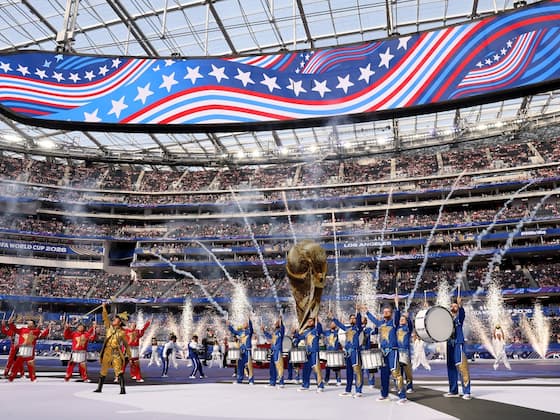
The matches themselves have been spectacular, set within massive stadiums that make most British grounds seem small and old-fashioned. The USA’s opening win over Paraguay took place at SoFi Stadium — so close to LAX that it had to be built into the ground rather than above it. The effect is surreal, as if the pitch lies hidden deep below, like a buried city.
Germany’s victory over Curacao unfolded at Houston’s NRG Stadium — less elegant but equally imposing. It epitomises Houston: big, bold, and unbothered by aesthetics. The walls celebrate the occasional NFL triumphs of the Houston Texans, alongside photos of country singers, monster trucks, and cattle shows.
I watched England defeat Croatia at the Dallas Cowboys’ stadium, a colossal structure resembling an American football resting on the riverbank. Its steep stands offered a breathtaking view — and a touch of vertigo.
There are moments during these trips when you question your life decisions. In Dallas, a steward sent me on a 20-minute trek around the stadium’s perimeter in blistering heat, my skin sizzling like bacon, only for security to inform me that the media entrance was back where I had started.
In Houston, I left my Airbnb under sunny skies, only to watch a torrential downpour unleash itself mid-taxi ride. Each raindrop hit the roof like a bottle of water bursting open. Soaked and far from the stadium, a kind security guard discreetly handed me a poncho like it was contraband — a gesture that felt almost saintly.
Security procedures here are conducted with military precision. One particularly stern officer refused me entry because my bag wasn’t transparent. When I explained I was media, he tapped his headset and declared solemnly, “We will solve this, sir. I have a direct line to command.”
But this remains the greatest sporting event on the planet, hosted by a country of endless fascination. Downtown Dallas came alive as Senegalese and French fans gathered around a giant screen, joined by countless others in a bustling food mall. Former England defender Stuart Pearce was among them, trying to eat lunch while posing for selfies with English supporters.
Between matches, I explored Houston’s culinary side — devouring ribs and tender brisket at a place aptly named Henderson & Kane, playing pool with journalists and locals in a dive bar, and visiting the Museum of Fine Arts. Beneath its concrete exterior, the city has plenty of soul.
Still, football fever here seems limited mainly to stadiums and fan zones. The relationship between America and the World Cup is a complex one — thriving in some areas, barely visible in others. Football is growing in small pockets but remains overshadowed by the NFL and NBA.
Yet in many ways, the USA is the ideal host: a cultural melting pot unmatched by any other nation. Each city feels like a microcosm of the world, filled with communities ready to cheer their ancestral homelands. In Houston, Dutch-American fans turned the stadium a bright orange this weekend.
The World Cup is more than a tournament — it’s a global celebration of sport, hope, and human connection. In downtown Dallas, I met a lively taxi driver who admitted she knew little about football but adored the diverse mix of people she’d ferried that day. She laughed about maybe flying to Boston to party with Scottish fans. “Honestly,” she said, “if anything can bring world peace, it’s the World Cup.”
-
8th Pay Commission Update: DA Hike Likely Soon as Salary Revision Talks Gather Pace

-
Gold and Silver Prices Slide in June 2026: Should Investors Buy the Dip or Stay on the Sidelines?

-
Bank Holiday Alert: Several Bank Branches to Remain Closed Across India During the Last Week of June

-
Quote Of The Day | Winston S Churchill's Timeless Lesson On Success And Failure
-
KC Venugopal Urges Kerala Govt To Address Concerns Over Liquor Tax Cut And Rare Earth Mining