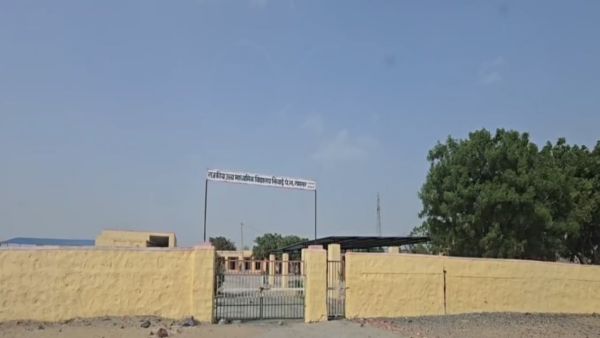
Barmer's administration launched 'Operation Clean,' demolishing illegal encroachments on government land near the India-Pakistan border. The drive included a religious structure, which locals claimed was ancient, sparking controversy.
The local administration in Barmer district launched 'Operation Clean' on Sunday to remove unauthorised encroachments on government land within a 50-kilometre radius of the India-Pakistan border, with authorities using heavy machinery to demolish structures identified as illegal in villages including Kelan ka Paar and Nai Siyai.

'Operation Clean' Targets Border Villages
According to administrative officials, the ongoing drive targets illegal encroachments in border villages as part of a wider initiative to clear government land and enforce regulations in sensitive border areas of Barmer district.
During the operation, structures that had been built on encroached government land in Kelan ka Paar and Nai Siyai villages under Ramsar subdivision were demolished.
Locals Contest Demolition of Religious Site
Locals allege that they had received a notice two or three days prior regarding the religious structure built on encroached government land; they had even visited the Sub-Divisional Officer's office to present their case to the administration.
According to a villager," The religious site is used solely for offering Namaz and was constructed using donations collected from the local community. The border is located 8-10 kilometres away, and residents claim the religious site is 200 years old."
Despite these claims, administrative teams arrived at the site, directed residents to return to their homes, and proceeded with the demolition using JCB machines as part of the drive.
Ashok Gehlot Criticises Move, Warns of Polarisation
Meanwhile, Congress leader and former Rajasthan Chief Minister Ashok Gehlot criticised the ongoing action against mosques and madrasas in Rajasthan's border districts, alleging that such measures could disturb the long-standing communal harmony of the region, asserting that the "central and state governments should not create unnecessary controversies."
Taking to his official X account on Saturday, Gehlot highlighted the history of "peaceful coexistence in Rajasthan's international border districts adjoining Pakistan and said the region has remained largely free from communal tensions since Independence."
"The international border districts of Pakistan adjacent to Rajasthan have always maintained an atmosphere of harmony since independence. No matter what kind of communal environment prevailed across the country, it is likely that mutual tensions never even arose here," Gehlot wrote.
Emphasising the spirit of unity in the region, the former chief minister said that people of all faiths have historically stood together, including during times of national conflict. "Here, Hindu and Muslim religious sites are in the same category, and people from both sides fully respect each other's sacred places. Whether it was the 1965 war or the 1971 war, people of all religions in this region extended complete cooperation to the army and the government in giving Pakistan a decisive defeat," he wrote.
Gehlot further alleged that the action against mosques and madrasas was selective in nature and warned that such steps could lead to social polarisation in an area known for communal harmony.
Similar Anti-Encroachment Drive in Jaipur
His remarks come amid recent administrative actions concerning encroachments and religious structures in parts of Rajasthan, including Jaipur. Earlier, on June 8, the Jaipur district administration imposed a temporary ban on internet services as a precautionary measure to maintain law and order in view of an anti-encroachment drive proposed by the Jaipur Development Authority (JDA).
A joint operation by the JDA and district administration was underway in the Jagatpura area to widen the road running parallel to the railway line near Nandpuri Underpass from its existing 25-30 feet to the designated 80 feet.
The drive involved the removal of five religious structures, including a mosque, two temples, a satsang hall, and a mazar (shrine), which fall within the road's right-of-way. Additional police forces were deployed to maintain law and order during the demolition drive.
Anand Sharma, Deputy Inspector General (DIG) of the JDA Vigilance Wing, noted that 134 encroachments were removed during a previous drive on May 22. Owners of the religious structures and other encroachers were given time to dismantle the constructions themselves; with the deadline now expired, the administration has initiated direct action. Officials highlighted that the road in question remains significantly narrower than its recorded width of 80 feet in several stretches, necessitating the current drive to ensure compliance with planning norms. (ANI)
(Except for the headline, this story has not been edited by Asianet Newsable English staff and is published from a syndicated feed.)-
FIFA World Cup: Iran hold Belgium 0-0 for historic point

-
Belgium vs Iran FIFA World Cup match result: Iran survive Belgian pressure to secure hard-fought 0-0 draw

-
Weekly Horoscope 2026: From Aries to Cancer, know on which zodiac sign there will be rain of money and who will have to be careful

-
Chennai’s Avartana Wins Most Innovative Indian Restaurant For Reinventing South Indian Fine Dining

-
AVC Men’s Volleyball Cup: India beat New Zealand in campaign opener