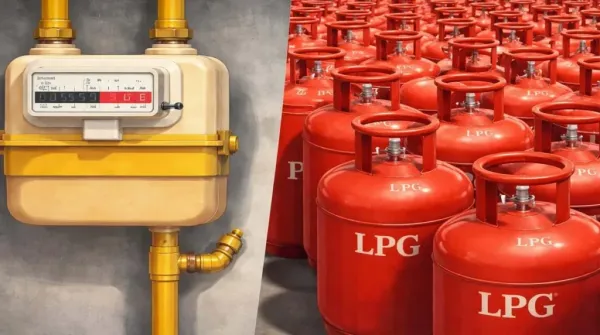
Amidst the long-running fierce conflict and tension in West Asia (Middle East), the Government of India and the country’s state oil companies have taken a big step to save the general public from the big shock of inflation. India has made a major and strategic change in the sources of LPG purchase internationally. To reduce its traditional dependence on Gulf countries, India has significantly increased the import of gas from America, Iran and many other countries. The most reassuring thing during this entire crisis was that the government fuel companies themselves shouldered the huge burden of the huge price increase in the international market, so that it did not have any direct impact on the budget of the common and middle class families of the country.
Before the start of this global conflict, India was importing about 90 percent of its total LPG requirement only from West Asian suppliers. Because of this, there was always a huge risk that any disruption or war-like situation in the Gulf region would have a direct impact on India’s energy security. According to a recent report by rating agency CRISIL, India took swift action sensing this threat and by April 2026, the share of America alone in India’s total LPG imports will increase to almost one-third (33 percent). You will be surprised to know that in the month of February this year, this share was only around 8 percent.
Gas supply to India increased from many countries of the world including America
A major annual agreement signed with America at the end of the year 2025 played a major role in this historic change made by India in its import route. Under this agreement, a contract was signed to supply 2.2 million tonnes of LPG every year from America, which is about 10 percent of India’s total annual import requirement. Apart from this, amid the changing equations, Iran has once again become one of the major import sources for India. Iran’s share in the total imports in the month of April was recorded at about 6 percent. Not only this, to strengthen its security, India also obtained gas supplies from non-traditional countries like Argentina, Chile, France and Netherlands.
Although this diversification of supply sources helped a lot in maintaining uninterrupted gas supply in the country during the crisis, it also required India to use a long supply chain, which increased the freight cost significantly. The impact of this huge freight cost and some supply problems was also seen on the market demand. Due to decline in industrial usage due to temporary shortage in supply and rising prices, the total consumption of LPG within the country dropped significantly to just 2.47 million tonnes in the month of April from 3.2 million tonnes in February.
Sharpest decline in consumption of commercial and industrial users
If we look at the figures, the total consumption of LPG in India in the financial year 2026 had crossed a record 33.2 million tonnes with an increase of 6 percent. But after this, a huge decline of 13 percent was seen in LPG consumption on year-on-year basis in both the months of March and April. At the same time, in the month of May this decline increased directly to 20 percent.
The biggest and most direct impact of this recession or decline has been on commercial and industrial users. Consumption from these commercial sectors declined much faster than domestic demand from ordinary households, as these directly marketed customers reacted quickly to increased international prices and supply constraints and limited their use. It has also been made clear in the CRISIL report that due to this geopolitical conflict there was a huge jump in global LPG prices. Saudi Aramco contract prices, considered the main benchmark for Indian imports, had become costlier by nearly 46 per cent between the months of February and June.
Huge difference in prices of domestic and commercial LPG cylinders
Only a very small and limited part of this huge boom in the international market was passed on to the domestic consumers of the country so that the common man does not suffer. Talking about the country’s capital Delhi, the price of 14.2 kg domestic LPG cylinder was increased only marginally by around 10 percent between February and June. In contrast, the prices of 19 kg heavy commercial cylinders operating at market rates have increased by a whopping 79 per cent during the same period.
The report also highlights that keeping domestic cooking gas prices in a tight range led to a huge surge in ‘under-recovery’ (i.e. net loss from selling LPG at below cost) for the country’s major oil marketing companies (OMCs). The main reason for this was that the cost of purchasing gas for companies was rising much faster than the retail prices they were selling at. This under-recovery on selling domestic LPG cylinders in Delhi had reached a record level of Rs 651 per cylinder in the month of May. Due to this, in just three months from March to May, the fuel retailers of the country have suffered a huge financial loss of about Rs 22,000 crore.
Hope for relief! There may be a big reduction in LPG prices soon
Now a good and relieving news is also coming for both common consumers and oil companies. There is a strong possibility of the ongoing tension in West Asia gradually reducing and the world’s main trade routes (sea trade routes) being fully reopened. With this, all the immediate concerns regarding supply will be reduced to a great extent in the coming days and LPG prices are expected to soften significantly in the global market.
However, this entire incident and the global disruption has once again exposed to the world the huge risks associated with India’s heavy dependence on imported LPG and procurement from only a limited number of countries. The report concludes that even though India’s purchases from various countries and a partial increase in domestic production have helped to significantly reduce the impact of this global crisis, our energy sector still remains extremely sensitive to geopolitical turmoil, freight market fluctuations and sudden changes in international energy prices.
-
Shraddha Kapoor to play Lavani legend in Eetha

-
It is very important to wash blackberries thoroughly before eating them, otherwise it may cause harm instead of benefits.
-
3 Zodiac Signs Experience Hope They Haven’t Felt In A While Starting On June 21, 2026

-
5 Common Problems With Samsung Refrigerators

-
Billionaire Ambani wants AI in every call, app, and home