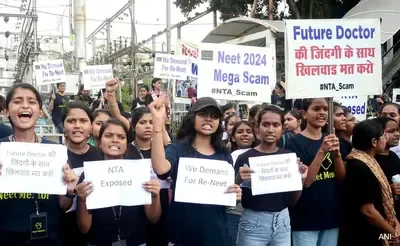

Rajasthan Police Arrest 19-Year-Old for Selling Fake NEET Question Papers on Telegram Ahead of Re-NEET 2026
The nationwide controversy surrounding the National Eligibility cum Entrance Test (NEET) 2026 has taken another dramatic turn after Rajasthan Police arrested a 19-year-old youth for allegedly selling fake NEET re-examination question papers through a Telegram channel just days before the scheduled re-test on June 21. The arrest has once again highlighted the growing challenge faced by authorities in combating digital fraud, misinformation, and exam-related scams that continue to target anxious students and their families across the country.
The accused, identified as Akash Chaudhary, was arrested in Rajasthan’s Bhilwara district after investigators uncovered an online operation allegedly designed to deceive NEET aspirants by offering counterfeit question papers in exchange for money. The development comes at a sensitive time when thousands of students are preparing for the re-examination ordered after the cancellation of the original NEET 2026 test due to allegations of paper leaks and irregularities in several states.
Authorities believe the accused exploited the uncertainty surrounding the examination process and attempted to profit from the fears and anxieties of students desperate for information ahead of the crucial medical entrance examination.
Telegram Scam Exposed Days Before Re-NEET Examination
According to police officials, the operation came to light after intelligence inputs were received through the Government of India’s S-Mek monitoring portal. The information pointed towards suspicious activity on social media platforms related to the circulation of alleged NEET examination papers.
Investigators traced the activity to a Telegram channel reportedly operated under the name “Paper Mafia.” The channel allegedly claimed to provide access to the re-NEET question paper before the examination date and attracted dozens of students seeking advance access to exam content.
Police officials said the accused was allegedly charging ₹4,000 for each fake question paper. The operation reportedly targeted students preparing for the re-examination and used social media platforms to build credibility among potential buyers.
The arrest was carried out by the Pratapnagar Police Station team in Bhilwara after a preliminary investigation established sufficient grounds for action. Officers detained the accused and later formally arrested him after questioning.
Authorities recovered a mobile phone, educational material, a NEET preparation guidebook, and several documents believed to be connected to the alleged operation. Digital forensic experts are now examining the seized devices to determine the scale of the network and identify any accomplices who may have been involved.
The case has generated widespread attention because it occurred despite the temporary restrictions imposed on Telegram in connection with the re-examination process.
VPN Technology Used to Circumvent Restrictions
One of the most significant aspects of the investigation is the alleged use of Virtual Private Network (VPN) technology by the accused.
According to investigators, Akash Chaudhary reportedly accessed Telegram through a United States-based VPN service, allowing him to bypass restrictions and continue operating the channel even as authorities attempted to curb misinformation and fraudulent activity ahead of the examination.
The use of VPN services has emerged as a growing concern for law enforcement agencies because such technology can mask a user’s actual location and make it more difficult to trace digital activities.
Officials said the accused allegedly relied on VPN and proxy services to continue communicating with users and managing the Telegram channel despite efforts to limit access to the platform during the critical examination period.
The case has reignited debate about the effectiveness of temporary platform restrictions in preventing exam-related fraud. While authorities argue that such measures reduce the spread of misinformation, cybersecurity experts note that determined individuals can often find alternative methods to continue operating online.
The investigation is expected to provide valuable insights into how fraudsters exploit technological tools to evade detection and target students.
Students Targeted Through Digital Platforms
Police officials revealed that approximately 52 individuals were connected to the Telegram channel at the time of the arrest.
Investigators are now examining whether any financial transactions took place between the accused and members of the channel. Authorities have reportedly discovered that a personal bank account linked to the accused was connected to a QR code used for receiving payments.
The financial trail is expected to play a crucial role in determining the extent of the alleged scam.
Bank records will be scrutinized to identify transactions, verify payments received, and establish whether students were misled into purchasing fake examination material.
Law enforcement agencies are also working to identify students who may have transferred money to the accused believing they were purchasing genuine examination papers.
Officials emphasized that those who were deceived by the operation would be treated as victims of fraud rather than participants in criminal activity. However, investigators are also examining whether any individuals knowingly attempted to obtain leaked examination material.
The case underscores the increasing sophistication of online scams targeting students during competitive examination seasons.
NEET 2026 Controversy Continues to Unfold
The arrest comes against the backdrop of one of the most controversial examination cycles in recent years.
NEET 2026, one of India’s largest and most competitive entrance examinations, was originally conducted on May 3. However, allegations of paper leaks, irregularities, and examination malpractice soon emerged from multiple regions of the country.
Following an extensive review, the National Testing Agency (NTA) decided to cancel the examination on May 12 and announced a fresh test for affected candidates.
The decision sparked intense debate nationwide, with students, parents, educational experts, and political leaders expressing differing views on the handling of the situation.
For many students, the cancellation meant restarting months of preparation and enduring additional uncertainty regarding admissions to medical and dental colleges.
As the re-examination date approached, concerns about misinformation, fake question papers, and fraudulent schemes increased significantly.
Authorities feared that social media platforms could become vehicles for spreading false information and exploiting students’ anxieties.
The Bhilwara case appears to confirm those concerns, demonstrating how fraudsters attempted to capitalize on the confusion surrounding the examination process.
Growing Threat of Fake Exam Paper Networks
Educational authorities have repeatedly warned students against claims of leaked examination papers circulating online.
Experts note that fake paper-selling operations often emerge before major competitive examinations. Such schemes typically involve individuals claiming to possess confidential examination materials and demanding payment from students.
In most cases, buyers either receive fabricated documents or no material at all after making payments.
These scams not only cause financial losses but also create psychological stress for students already under immense academic pressure.
Cybercrime specialists say social media applications and encrypted messaging platforms have become attractive tools for fraudsters because they enable rapid dissemination of information and provide a degree of anonymity.
The challenge for authorities lies in distinguishing genuine threats from fabricated claims while acting quickly enough to prevent large-scale deception.
The Rajasthan case demonstrates how exam-related scams continue to evolve in response to changing enforcement measures and technological restrictions.
Investigation Expands Beyond Single Arrest
While Akash Chaudhary remains the primary accused, investigators believe the case may extend beyond a single individual.
Police officials have indicated that they are examining communication records, financial transactions, and digital footprints associated with the Telegram channel.
The investigation aims to determine whether the accused acted independently or was part of a broader network involved in examination-related fraud.
Authorities are particularly interested in identifying the source of the fake question papers and understanding how the channel gained members.
Investigators are also exploring whether similar channels exist on other platforms and whether coordinated efforts were underway to target students across multiple states.
Digital forensic analysis is expected to play a key role in uncovering the full scope of the operation.
Officials have not ruled out further arrests as the investigation progresses.
Legal Action Under Multiple Laws
Police have registered a case against the accused under several legal provisions.
The charges reportedly include fraud, sale of fake examination papers, violations of the Information Technology Act, and provisions under the Public Examination Act.
The inclusion of the Public Examination Act reflects the government’s increasing focus on preventing malpractice and protecting the integrity of competitive examinations.
Recent legislative measures have strengthened penalties for those involved in examination fraud, paper leaks, and related offences.
Legal experts say the case could become an important example of how authorities intend to enforce these provisions in the digital age.
If convicted, individuals found guilty of such offences may face significant penalties, including imprisonment and financial fines.
The case also sends a broader message regarding the consequences of exploiting students through examination-related scams.
Impact on Students and Examination Integrity
The incident has once again highlighted the vulnerability of students during high-stakes examinations.
Medical entrance examinations like NEET represent life-changing opportunities for millions of aspirants. The intense competition and limited number of seats often create an environment where rumors and misinformation spread rapidly.
Fraudsters exploit this environment by presenting themselves as insiders capable of providing examination advantages.
Educational counselors have urged students to remain vigilant and rely only on official information released by examination authorities.
Experts stress that legitimate examination agencies never sell question papers, provide advance access to examination content, or authorize third parties to distribute confidential materials.
Students are advised to report suspicious activities immediately to authorities rather than engaging with individuals claiming to possess leaked papers.
The latest arrest serves as a reminder that shortcuts often lead to financial loss, legal complications, and emotional distress.
Authorities Intensify Monitoring Ahead of Re-Exam
With the re-NEET examination scheduled for June 21, authorities have significantly strengthened monitoring mechanisms across the country.
Law enforcement agencies, cybersecurity units, and examination authorities are working together to identify potential threats and prevent misinformation campaigns.
Special teams have been deployed to monitor social media platforms, messaging applications, and online forums for suspicious activity.
Officials have assured students that extensive measures are being implemented to ensure the integrity and fairness of the re-examination process.
The arrest in Rajasthan is being viewed as evidence that surveillance and enforcement efforts are producing results.
Authorities remain confident that prompt action against fraudulent networks will help maintain public confidence in the examination system.
As the investigation continues, the focus remains on ensuring that students can appear for the examination without fear of deception, misinformation, or unfair practices.
The Bhilwara case may have exposed one fraudulent operation, but it also serves as a broader warning about the evolving nature of exam-related cybercrime in India. With millions of students relying on transparent and credible examination systems to pursue their academic ambitions, the battle against digital fraud has become an essential component of protecting educational integrity. The coming days are expected to bring further developments as investigators unravel the network behind the fake paper racket and authorities work to ensure a smooth and secure re-NEET 2026 examination.
The post Fake NEET Paper Racket Busted Before Re-Exam as Rajasthan Police Arrest Teen Operating Telegram Channel appeared first on CliQ INDIA.
-
How many players in Scotland’s World Cup 2026 squad were born outside Scotland?

-
Planning The Tungnath-Chandrashila Trek? IMD Issues Rain And Thunderstorm Advisory

-
Reliance Jio Crosses 524 Million Users As Mukesh Ambani Announces IPO Filing, Satellite Broadband Push At 49th AGM
-
Iran Sentences Singer Parastoo Ahmadi To 74 Lashes After Viral Performance Without Hijab

-
Gippy Grewal Recalls 2023 Canada Home Firing By Bishnoi Gang: 'Didn't Have Close Friendship With Salman Khan, But They Assumed...'