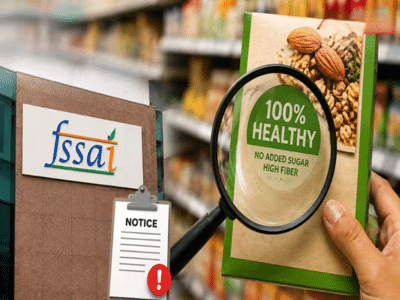
FSSAI has issued a notice to companies. Under this notice, companies will no longer be able to make "anything" claims to sell their products. Any claims they make about their products must have a scientific basis.

FSSAI sent notice to companies
This time, FSSAI's action focuses not just on companies but on the claims made on everyday food and beverage products. The investigation revealed that many products made exaggerated health claims that either lacked a scientific basis or were not permitted to be made.
The biggest question arose regarding claims directly linking food and beverages to diseases. Some claimed to control diabetes, others claimed to be effective in maintaining heart health and even treating asthma. While regulations clearly state that such claims cannot be made without approval, these claims were openly stated on the packaging.
A game of deception in the name of 'healthy drinks'
"Healthy" and "functional" drinks have emerged, even claiming water can help with weight loss, detox, and improve skin. According to the FSSAI, such general health claims mislead people because they lack solid evidence.
Label something and inside something else
Labeling errors were also discovered. Many products used terms like “natural sugar” or “100% natural,” but in reality, they contained added sugars or processed ingredients, meaning the packaging was telling one story and the truth was something else.
Supplements make bold claims without the science.
A similar pattern was observed with health supplements and protein powders. Claims such as "100% pure," "build muscle quickly," "improve digestion," and "improve brain health" were made, but no solid scientific basis was provided. FSSAI has clearly stated that every such claim must be substantiated.
The 'heart-healthy' tag is also in question.
In some cases, the use of terms like "heart healthy" and the heart symbol is also questionable. This could send the consumer a message that the product is directly beneficial for the heart, whereas regulations only allow limited nutrition claims.
Trying to sell food as medicine
Serious claims like “anti-cancer” were also found in food products, which were considered completely banned, meaning an attempt was made to present food items as medicine.
Hygiene and quality are also in question.
Complaints also surfaced regarding hygiene and quality. Some questioned kitchen cleanliness, while others reported spoilage and mold in dairy products. This makes it clear that the issue isn't limited to marketing; monitoring is needed at the ground level as well.
Now every claim will have to be proved.
The FSSAI's message is simple: every word on a package will now be subject to scrutiny. Words like "natural," "healthy," "pro," and "immunity booster" will no longer be used casually, meaning that simply selling a product won't be enough; claims will need to be supported.
-
Neeraj finishes fourth in his season-opening event in Doha Diamond League

-
EU ban on BPA chemical in food packaging takes effect
-
Train Collision in Bedford, England Results in Serious Injuries

-
NYPD Officer Injured in Brooklyn Standoff with Barricaded Suspect

-
Quote of the day for children Alan Alda: “Your assumptions are your windows on the world. Scrub them off every once in a while, or the light...”