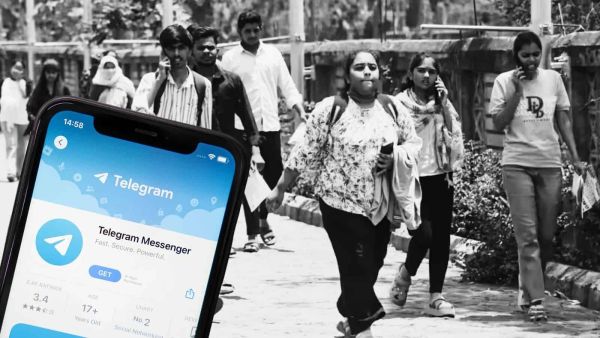
New Delhi: The Delhi High Court on Friday, June 19, rejected Telegram’s petition challenging the Centre’s decision to block the messaging platform until June 22, clearing the way for the temporary ban to stay in force through the NEET-UG 2026 re-examination scheduled for Saturday, June 21.
Justice Tejas Karia pronounced the order after hearing arguments from both sides over two days.
“After considering all the arguments, we find that given the emergency nature, the reasons supplied are sufficient and government has followed the procedure in Section 69A,” the court said.

Why the Centre blocked Telegram
The blocking order, passed under Section 69A of the Information Technology Act on June 16, was issued on the recommendations of the National Testing Agency (NTA) and the Department of Higher Education. The NTA said the measure was a last resort, taken after coordinated channel-by-channel takedowns by the Indian Cyber Crime Coordination Centre failed to produce adequate compliance from the platform.
NTA Director General Abhishek Singh told PTI there had been no actual paper leak, but that fabricated messages circulating on the platform were causing serious anxiety among students. “We had to take this action,” he said.
Solicitor General Tushar Mehta, appearing for the Centre, told the court that Telegram’s architecture made it uniquely difficult to police. A single account could create up to 40 bots, he said, and once a bot was blocked, it could automatically mirror to another.
“Bots are machines; they can further multiply. This feature permits creation of sophisticated networks with minimal human oversight,” Mehta said, adding that law enforcement agencies could not trace actual users because the platform operated through the cloud.
The Centre also flagged a specific exploitation that had prompted the parallel order requiring Telegram to disable its message-editing feature until June 30. Channel administrators had been editing old posts to insert question paper content after an examination, while retaining the original timestamp, and then circulating screenshots as purported proof of a prior leak.
Telegram’s defence
Telegram argued before the court that it had proactively taken down more than 900 links involving unlawful NEET-related content and had deployed artificial intelligence and machine learning tools to address the problem. During the hearing, Justice Karia had orally asked the Centre whether the rights of 150 million users could be curtailed because one set of citizens was appearing in an exam.
Both Google and Apple delisted the Telegram app from their respective stores following the blocking order.
Pavel Durov hits back
Telegram chief Pavel Durov pushed back sharply on X, saying the ban “punishes 150 million ordinary Telegram users in India, not the insiders who leaked the exam materials,” and claiming that the leaks had simply moved to other platforms.
Durov also alleged, without citing evidence, that Reliance, which he described as partially owned by Meta, WhatsApp‘s parent company, may have lobbied to have Telegram banned in India.
The Internet Freedom Foundation described the government’s action as “a band-aid solution” and “a disproportionate answer to exam fraud.”
The original NEET-UG 2026, held on May 3, was cancelled by the NTA amid widespread allegations of paper leak and irregularities. The matter is under investigation by the CBI. The access restriction on Telegram is set to lapse on June 22, the day after the re-examination.
-
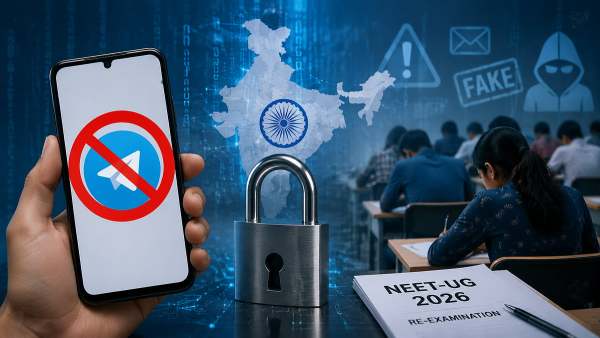
Delhi High Court Upholds Temporary Ban On Telegram During NEET UG 2026 Re- Exam
-
Odisha Govt Orders Probe Into 1,678 Errors In School Textbooks, Report Due In 7 Days
-
MHT CET 2026 PCM 2nd Attempt Result Out At cetcell.mahacet.org; Here's How To Access Scorecard
-
NMC Bars Medical Colleges From Granting Leave On June 20-21 Ahead Of NEET UG 2026 Re-Exam
-
Bharat Bhhagya Viddhaata Box Office Collection Day 7: Kangana Ranaut's Film Shows 18% Drop, Collects ₹45 Lakh