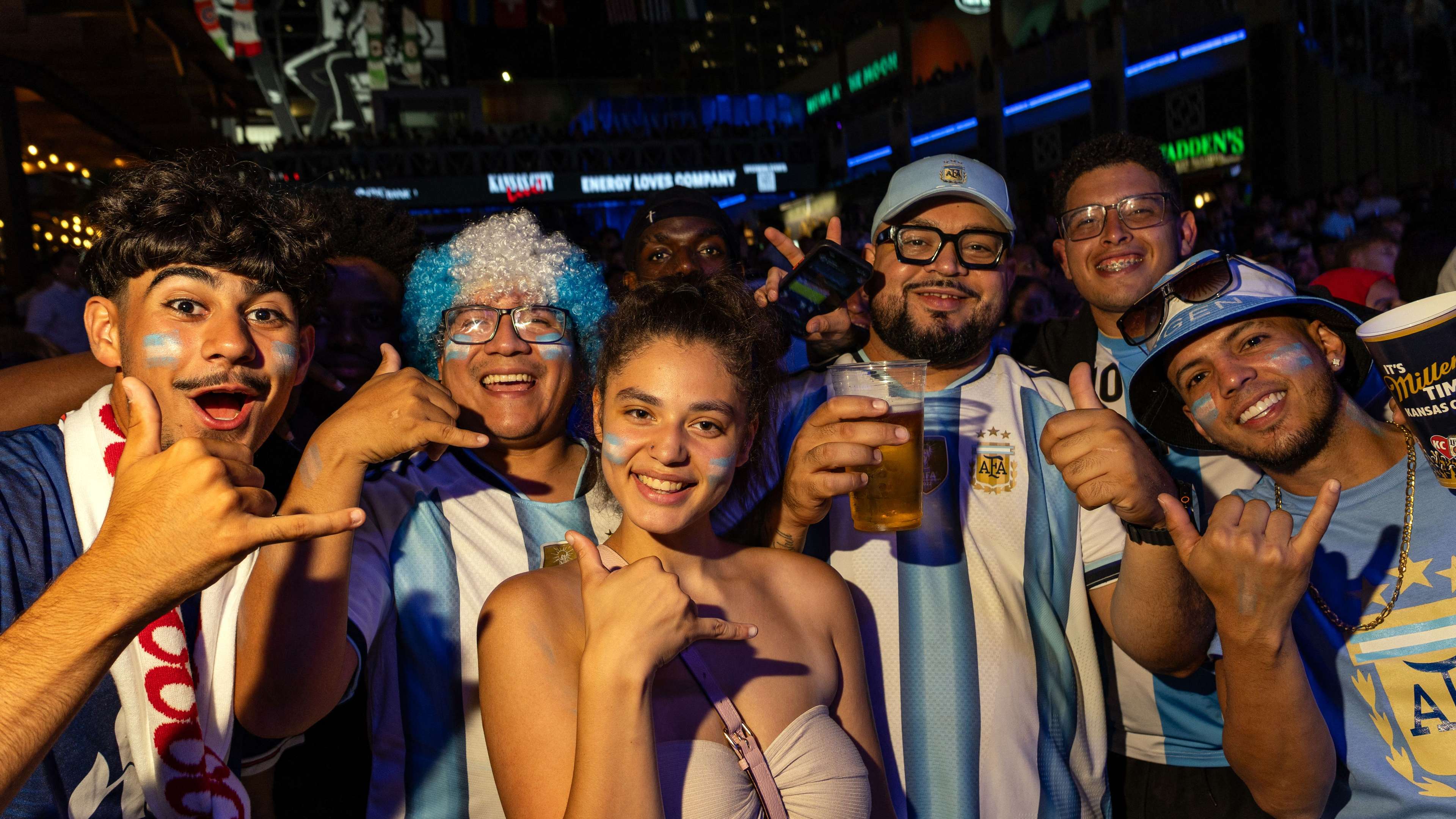
Thousands of Argentina supporters transformed Kansas City into a Lionel Messi pilgrimage site, complete with banderazos, all-night festivities, and unshakable devotion ahead of the World Cup opener.
KANSAS CITY, Missouri — “Baseball? Baseball? Why would I ever do that? I’ve got football!”
The question to La Banda’s Christian was meant to be simple.
Christian, one of the leaders of Argentina’s largest national team fan groups, had arrived in Kansas City days before La Albiceleste’s first World Cup match. When asked whether he planned to attend a Kansas City Royals game at nearby Kauffman Stadium, his answer made his priorities clear.
Fair enough.
It also perfectly captured the spirit of the tens of thousands of Argentine fans who flooded Kansas City ahead of Argentina’s title defence. Some possessed match tickets for Argentina versus Algeria, many did not. But for most, that wasn’t the point. They came to live and breathe the rhythm of their beloved team, beating drums, waving flags, and singing songs with a passion that feels almost sacred.
Given that this could be Lionel Messi’s final World Cup — unless he defies age and returns at 42 in 2030 — the opening match was unmissable. Whether that meant paying thousands to get inside Kansas City Stadium (technically Arrowhead Stadium, as FIFA renamed it) or spending a smaller fortune just to be nearby, being present was non-negotiable.
For many, it was the purpose of the month — or even their lives.
“Messi, he’s God,” one fan said passionately. “He’s the greatest player ever, a good father, a good husband — he’s the best.”
So yes, America’s pastime wasn’t on the agenda.
“Honestly, it was a silly question,” laughed Guido, a financial consultant. “I agree with Christian. Baseball is boring, especially for Argentines.”
Soon after that WhatsApp exchange, Christian sent over a banner inviting the reporter to a banderazo.
What began as a casual chat about baseball turned into a two-day immersion in Argentina fandom — the cost, the chaos, the unity, the emotional highs, and the sheer devotion of supporters for whom football is more than a sport.
That is what sets Argentina’s fans apart. And in the heart of America, they made sure everyone noticed.
What is a banderazo?
Forty minutes before the scheduled start at Kansas City’s Mill Creek Park, the anticipation was palpable.
Cars rolled through the city’s upscale Plaza district adorned with stickers of Pope Francis, banners of Diego Maradona, and flags of Lionel Messi. Horns blared. Even a black-and-green Ferrari zoomed past with an Argentina flag fluttering behind.
Then came the drums.
What started as a few dozen fans quickly swelled into hundreds. The singing began soon after.
“Soy argentino, es un sentimiento,” they chanted, stamping in rhythm as the sound grew louder. The air grew thick with smoke. Then came the flags — the heart of the ceremony.
One by one, they were unfurled: Messi, Maradona, various supporter groups, even one featuring Scarface. Each had its own rhythm, its own chant, its own identity. To miss a beat was to stand out. “We call this a banderazo,” one fan explained. “All Argentines in a place decide a time and place, and then come together to sing and dance.”
Then came the largest banner — at least 20 feet long — rippling above the crowd like a wave. Everyone beneath had a role, including the journalist, who was quickly recruited to help hold it up.
The cost of devotion
Despite the joy, there was an undeniable truth: being there was expensive, especially for those travelling from Argentina.
Reports surfaced of fans selling cars, taking out loans, and stretching finances to the limit to witness what could be Messi’s final World Cup. Some drove across Central and South America, following La Albiceleste north in what felt more like a pilgrimage than a road trip.
“This is Messi’s last World Cup,” one fan declared. “This is our moment.”
Others found creative ways to secure tickets.
A group of four fans, who preferred to remain anonymous, revealed they had joined Algeria’s ticket lottery for discounted seats. Instead of paying over $1,000 on resale sites, they paid $500 each.
They knew where they’d be seated, but hardly cared.
“FIFA is greedy, the United States is greedy, f*ck corporations,” one of them said bluntly.
“Listen, we’re Argentina,” another added. “We have the biggest fan base in the world. Eighty percent of the stadium will be ours. We’ll respect the Algerians, but we’ll be loud.”
United, yet divided
For all the unity at Mill Creek Park, divisions still lingered. Argentina’s national team unites, but club loyalties divide.
“People talk about Knicks fans celebrating after their 53-year drought, but that’s fake passion,” Guido said. “Half of them didn’t follow the team before the finals. My passion is only for football — it’s my life’s connection.”
He offered an example.
His fiancée once invited him to a friend’s wedding — until he learned the theme was blue and yellow.
“Those are Boca Juniors colours,” said Guido, a River Plate supporter, with a grimace.
He wasn’t alone.
“They’re so cold,” said Aileen Ortiz, a freelance journalist from Buenos Aires and a Boca fan. “The red and white is banned by me.”
“Red is a terrible colour,” another fan quipped.
For the record, neither Boca nor River has lifted the Primera División title since 2023, though five other clubs have won in that time. But in this rivalry, facts rarely matter.
The debate extended to Mauricio Pochettino, the Argentina-born coach leading the USMNT, who wasn’t spared criticism.
“He doesn’t have a style,” one fan remarked.
Another added, “He doesn’t play Argentine football.”
Partying through the night
During the 2025 Club World Cup, Boca fans famously partied from 11 p.m. to past 5 a.m. in South Florida. Would Kansas City see a repeat before Argentina’s opener?
“No,” one fan laughed. “This is Kansas City, not Miami!”
That prediction didn’t quite hold.
Kansas City’s Power & Light District turned into an Argentine takeover on Monday night. The renowned Bresh party drew thousands in blue and white into the city centre. At Laila Lounge, champagne glasses clinked as DJ Hernán Cattáneo performed before a packed crowd, uniting generations in celebration.
This, too, was Argentina.
Everything built toward Tuesday’s much-awaited clash with Algeria.
What it all meant
For a few moments on Tuesday night, the noise subsided.
After days of chants, drums, and anticipation, Argentina’s World Cup opener briefly teetered toward disaster. Algeria’s Farès Chaïbi latched onto a pass from Ibrahim Maza and slotted past Emiliano Martínez. The 69,045 fans at Kansas City Stadium — a crowd Peter Schmeichel estimated on FOX to be 90 percent Argentine — fell silent.
Then VAR intervened. The goal was disallowed. The olés returned, louder than ever. And Messi, as always, took control.
The 38-year-old scored his first World Cup hat-trick, shattered multiple records, and gave the travelling supporters exactly what they came for.
After the match, Argentina manager Lionel Scaloni credited more than just his captain.
“In our darkest moments, they help carry us through,” Scaloni said, referring to the fans.
Messi, rarely one for long interviews, took a moment to thank them too.
“First of all, I thank them, because they’ve shown once again that Argentina is something special,” Messi said. “They filled the stadium again... I don’t know if there were 80,000 spectators or more!”
Argentina’s mission remains formidable. The defending champions aim to become just the third team to retain the World Cup, and even in a 3-0 win, they looked heavily reliant on their 38-year-old icon.
“Argentina had 10 shots, seven of them from Messi,” Algeria coach Vladimir Petković noted.
That may be true.
But for 72 hours in Kansas City, Argentina’s fans made their point. They transformed America’s heartland into a sea of songs, flags, and devotion. They came for Messi, for their country, and for a cause that, to them, was never optional.
Next stop: Dallas.
How far can Argentina go at the World Cup?
-
Coconut oil: best remedy for hair care

-
‘One Friday can change everything ‘: Suniel Shetty on anxiety , ensemble casts and the unpredictable box office

-
A Couple’s Photos Reveal If They Actually Like Each Other

-
Life Gets A Lot Easier For 4 Chinese Zodiac Signs On June 20, 2026

-
7.8 crores were lost from photos and accounts posted on WhatsApp, such cyber fraud happened with former PM’s son