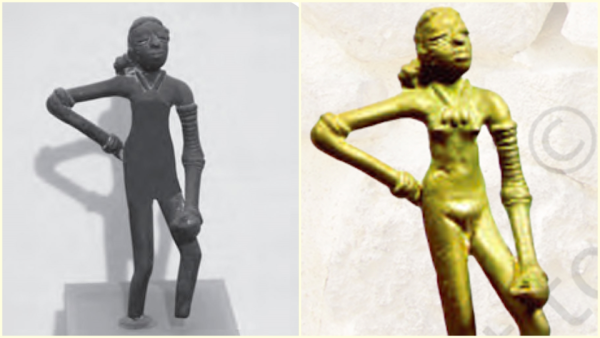
Indus Valley's 'Dancing Girl': Among the archaeological remains of the Indus Valley Civilization, the 'Dancing Girl' figurine is considered the most distinctive and historically significant. The statue was created during the era of the Indus civilization; estimates date it to approximately 2600 BCE (about 4,500 years ago). The original figurine is housed at the National Museum in New Delhi.
Discovery and History of the Figurine
This historic figurine was discovered in 1926 by the renowned British archaeologist Ernest Mackay during excavations at Mohenjo-daro, located in present-day Pakistan. Standing approximately 10.5 centimeters (about 4 inches) tall, this small figurine is an exquisite example of ancient metallurgy and art.
The 'Lost-Wax Technique' of Creation
According to official records, this figurine was crafted from bronze using the 'Lost-Wax Technique' (also known as *Madhuchchhishta Vidhi*). In this ancient process:
A figure was first sculpted out of wax.
A coating of fine clay was applied over it.
Once the clay dried, it was heated, causing the wax to melt and drain out through a small opening.
Molten bronze was then poured into the hollow clay mold.
After the metal cooled and solidified, the clay was removed, revealing the finished figurine.
Interestingly, this ancient metal-casting technique remains in traditional use today in certain regions of Indian states such as West Bengal, Jharkhand, and Chhattisgarh.
Physical Features and Cultural Significance
The figurine's physical features and ornaments have long been a subject of great fascination for historians. The following features of the figurine are officially documented:
Physical Posture: The figurine’s chin is slightly raised, one knee is bent, and one hand rests on the hip.
Ornaments: One arm is adorned with bangles or bracelets extending up to the upper arm, whereas only a few bangles are visible on the other arm.
Cultural Significance: According to one interpretation by archaeologists, an identical posture has been observed on pottery shards found at Bhirrana; this suggests that the pose likely held cultural significance during that era.
Does it have an official name?
No specific individual name for this figurine is recorded in archaeological or official documents. Since the Indus Valley Civilization's script remains undeciphered, it is unknown what the people of that time called it. Historians and experts note that the figurine displays a *Tribhanga*-like pose (one hand on the hip and one leg slightly bent), leading to it being named the 'Dancing Girl' or 'Bronze Dancer'—a name that has since become its global identity.
Why is the 'Dancing Girl' currently a topic of discussion?
The historic 'Dancing Girl' figurine has recently become a subject of controversy and discussion, primarily due to 'Madhurima'—a new art education textbook for Class 9 published by NCERT. The image of the figurine featured in the book's first chapter has been altered from its original visual appearance. Shading has been used to cover the figurine's torso, obscuring the intricate anatomical details visible in the original sculpture.
Many historians, including Michel Danino—an expert and former head of the NCERT Class 6 textbook committee—have expressed strong displeasure regarding this visual modification.
Disclaimer: This content has been sourced and edited from Amar Ujala. While we have made modifications for clarity and presentation, the original content belongs to its respective authors and website. We do not claim ownership of the content.
-
Predicting the Winner of the 2026 FIFA World Cup Golden Boot

-
World Kidney Cancer Awareness Day: Kidney damage or hidden kidney tumor could be early symptoms, experts warn

-
OnePlus 15R Now Available in New 16GB RAM variant in India with higher price tag: specifications, features

-
Good news for users! Now you can send a voice message without opening WhatsApp, an amazing feature is coming soon to the app

-
After Telegram is banned in India, know about those 5 features which are available on Telegram but not on WhatsApp.