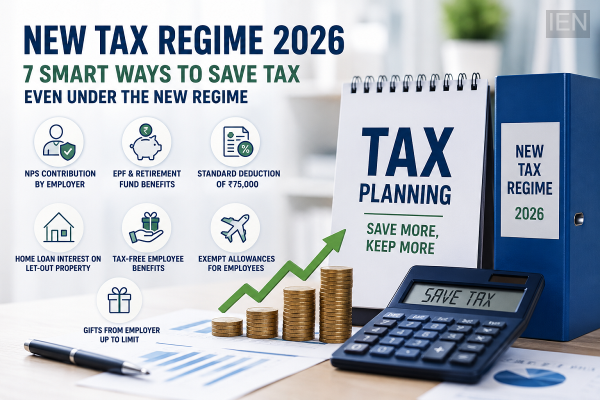
Many taxpayers assume that choosing the New Tax Regime means giving up nearly all opportunities to reduce their income tax liability. While it is true that several traditional deductions and exemptions are no longer available, the regime still offers multiple tax-saving benefits that can significantly lower taxable income for salaried individuals and pensioners.
As taxpayers prepare to file their Income Tax Returns (ITR) for FY 2025-26, understanding these provisions can help optimize tax planning and avoid paying more tax than necessary. Here are seven important benefits that remain available under the New Tax Regime.
1. Employer Contributions to NPS Can Lower Taxable Income
One of the most valuable tax benefits under the New Tax Regime is related to employer contributions to the National Pension System (NPS).
If an employer contributes up to 14% of an employee’s basic salary and dearness allowance (DA) towards NPS, that contribution qualifies for a tax deduction. Importantly, this benefit is available over and above the standard deduction offered under the regime.
For example, if an employee has a combined basic salary and DA of ₹12 lakh annually, and the employer contributes 14% of that amount to NPS, the eligible tax-free contribution could reach ₹1.68 lakh. However, employees should note that their own NPS contributions do not qualify for a separate deduction under the New Tax Regime.
2. Tax Benefits on Employer Contributions to EPF and Retirement Funds
Although employee contributions to the Employees’ Provident Fund (EPF) are not eligible for deductions under the New Tax Regime, employer contributions continue to enjoy tax advantages within prescribed limits.
Contributions made by employers to Recognised Provident Funds (RPF), NPS, and approved superannuation funds remain tax-free up to a combined annual threshold of ₹7.5 lakh.
If the total employer contribution exceeds this limit during a financial year, the excess amount becomes taxable. In addition, any interest, dividends, or gains generated from the excess contribution will also be taxed.
3. Standard Deduction of ₹75,000 Remains Available
Salaried employees and pensioners continue to benefit from the standard deduction introduced under the New Tax Regime.
For FY 2025-26, eligible taxpayers can claim a flat deduction of ₹75,000 without submitting any supporting bills or expenditure proofs. The deduction is automatically available and directly reduces taxable income, making it one of the simplest tax-saving provisions under the regime.
4. Home Loan Interest Benefit on Let-Out Property
Taxpayers who own a property that has been rented out can still claim benefits related to home loan interest payments.
The interest paid on a loan taken for a rented property can be adjusted against income earned from that specific house property. However, any resulting loss cannot be set off against salary income or other income sources under the New Tax Regime.
Even with this restriction, the provision can provide meaningful relief for individuals earning rental income while servicing a housing loan.
5. Tax-Free Employee Benefits and Reimbursements
Several employer-provided benefits continue to receive favorable tax treatment under the New Tax Regime.
Mobile and Internet Reimbursements
If an employer reimburses expenses incurred for official use of mobile phones, broadband connections, or internet services, these reimbursements generally remain tax-free, provided valid bills and documentation are submitted.
Company Device Leasing Programs
Employees receiving mobile phones or similar devices through approved corporate leasing arrangements may also enjoy tax-efficient treatment, subject to company policies and proper compliance procedures.
Health and Wellness Programs
Many organizations provide access to wellness initiatives, including fitness memberships, preventive health check-ups, sports facilities, and financial wellness programs. Such benefits may remain tax-exempt if offered uniformly to employees and cannot be converted into cash.
Meal Vouchers and Food Benefits
Beginning with the relevant tax year, employer-provided meals, non-alcoholic beverages, and meal vouchers up to prescribed limits can continue to offer tax advantages for employees.
6. Certain Job-Related Allowances Still Qualify for Exemption
While many allowances have become taxable under the New Tax Regime, some employment-related allowances continue to enjoy exemptions.
These include:
-
Official travel allowances
-
Transfer-related allowances
-
Reimbursements for duties performed during employment
-
Transport allowances for specially-abled employees
-
Uniform maintenance and purchase allowances, where uniforms are mandatory for work
Employees receiving these benefits should maintain proper records to ensure compliance with tax regulations.
7. Gifts Received From Employers Can Be Tax-Free
Employer-provided gifts remain exempt from taxation up to specified limits.
For FY 2025-26, gifts worth up to ₹5,000 received from an employer are generally tax-free. The exemption limit is expected to increase in the upcoming financial year, providing additional relief to employees.
Apart from employer gifts, assets or gifts received through inheritance, wills, or from specified relatives are generally exempt from income tax, subject to prevailing tax laws.
Additional Relief for Family Pension Recipients
Individuals receiving family pension after the death of a salaried employee can also claim a deduction under the New Tax Regime.
The deduction is limited to either one-third of the family pension received or ₹25,000 annually, whichever is lower. This provision helps reduce the tax burden on dependent family members receiving pension income.
New Tax Regime Still Offers Planning Opportunities
Although the New Tax Regime eliminates several traditional deductions, it does not completely remove tax-saving opportunities. Employer-sponsored retirement contributions, standard deduction benefits, tax-free reimbursements, eligible allowances, and pension-related provisions can collectively make a significant difference to an individual's final tax liability.
Taxpayers should carefully review their salary structure, employer benefits, and eligible exemptions before filing their returns to ensure they make full use of the benefits still available under the New Tax Regime.
-
Marcelo Bielsa’s ‘I’m not a model’ remark epitomises why the Uruguay manager remains football’s most fascinating figure at the 2026 World Cup

-
The dark side of the ultra-rich’s anti-aging pursuit

-
Why celebrities are launching their own wellness brands in 2026

-
Do not make these 6 mistakes while making Malai Chaap at home, only then you will get the creamy and smoky taste like restaurant…

-
The Hard Part Is Finally Over For 3 Zodiac Signs After June 18, 2026