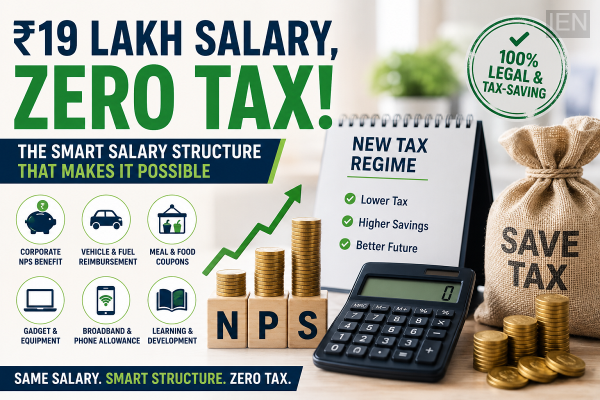
For many salaried professionals, the New Tax Regime appears to offer limited opportunities for reducing tax liability. Most taxpayers believe that once annual income crosses the commonly discussed tax-free threshold, a significant tax burden becomes unavoidable.
However, tax experts say that with the right salary structure and proper use of employer-provided benefits, even an employee with an annual package of ₹19 lakh may be able to reduce their income tax liability dramatically — and in some cases, bring it down to zero through fully legal and compliant methods.
The strategy does not require additional investments or large out-of-pocket expenses. Instead, it focuses on optimizing salary components to make better use of tax-efficient benefits already available under the New Tax Regime.
Same CTC, Completely Different Tax Outcomes
Imagine two employees working at the same company with identical annual compensation packages of ₹19 lakh.
At the end of the financial year, one employee ends up paying more than ₹1.5 lakh in taxes. The other, despite earning the same amount, manages to bring their tax liability down to nearly zero.
The difference lies not in how much they earn, but in how their salary package is structured.
Why Traditional Salary Structures Can Increase Tax Burden
Many organizations still follow older salary models that heavily rely on taxable allowances.
A conventional salary package may include:
-
Basic Salary: ₹7.60 lakh
-
House Rent Allowance (HRA): ₹3.80 lakh
-
Special Allowance: ₹6.65 lakh
-
Provident Fund Contribution: ₹95,000
Under the New Tax Regime, several exemptions associated with allowances such as HRA are no longer available. As a result, a large portion of the compensation remains fully taxable, pushing taxable income well above key tax-benefit thresholds.
This often leads to a substantial tax outgo despite having the same overall compensation package.
The Smarter Approach: Replace Taxable Components With Tax-Efficient Benefits
Instead of receiving a large portion of salary as fully taxable special allowance, some employees are restructuring their compensation packages to include employer-sponsored retirement contributions and legitimate reimbursement-based benefits.
A modern tax-efficient salary structure may include components such as:
Corporate NPS Contribution
Employer contributions to the National Pension System under Section 80CCD(2) continue to enjoy tax benefits under the New Tax Regime.
Example:
-
Employer NPS Contribution (14%): ₹1.06 lakh
This amount can be deducted from taxable income, making it one of the most valuable tax-saving tools available to salaried employees.
Meal and Food Benefits
Employer-provided meal cards, food coupons, or business meal benefits can form part of a tax-efficient compensation structure when implemented according to company policy and tax regulations.
Gadget and Equipment Reimbursements
Reimbursements for laptops, work devices, and approved office equipment used for professional purposes may qualify for favorable tax treatment.
Fuel and Vehicle Maintenance Expenses
Where company policies permit, fuel and vehicle maintenance reimbursements linked to official usage can reduce taxable compensation.
Driver Salary Reimbursement
For employees whose job responsibilities require transportation support, driver-related reimbursements may be structured under eligible corporate policies.
Broadband and Mobile Expenses
Internet, broadband, and mobile phone expenses incurred for work purposes often remain eligible for reimbursement-based tax benefits when properly documented.
Learning and Skill Development Support
Professional certification courses, skill enhancement programs, and job-related training expenses reimbursed by employers can also contribute to a more tax-efficient salary package.
How Taxable Income Drops Significantly
When multiple eligible benefits and reimbursements are combined with employer NPS contributions, the total non-taxable portion of compensation can become substantial.
In a typical example, tax-efficient components may collectively account for more than ₹6 lakh of the total package.
As a result, taxable income can decline sharply compared to a traditional salary structure.
For some employees, this reduction can bring taxable income within the effective tax-free range available under the New Tax Regime, significantly lowering or even eliminating their final tax liability.
Important Compliance Rules Employees Must Follow
Tax experts caution that these benefits are available only when implemented correctly.
Benefits Must Be Part of the Official Salary Structure
Employees cannot independently claim these exemptions while filing their Income Tax Returns if the components are not officially included in the employer's compensation framework.
Documentation Is Essential
Reimbursements generally require:
-
Original bills
-
Invoices
-
Receipts
-
Expense records
-
Proof of official usage where applicable
Without supporting documentation, tax benefits may be denied during verification.
Company Policies Must Support the Claims
All reimbursements and allowances must be approved under the employer's salary policy and payroll structure. Informal arrangements or unsupported claims may not qualify.
Salary Structuring Is Becoming a Key Tax Planning Tool
As the New Tax Regime gains wider acceptance, employees are increasingly focusing on compensation design rather than traditional tax-saving investments.
Corporate NPS contributions, work-related reimbursements, learning allowances, communication expenses, and other employer-sponsored benefits can collectively create substantial tax savings while remaining fully compliant with tax laws.
For professionals earning higher salaries, reviewing their salary structure with HR and payroll teams could unlock significant tax advantages without requiring any additional investment, making salary restructuring one of the most effective tax-planning strategies available today.
-
Marcelo Bielsa’s ‘I’m not a model’ remark epitomises why the Uruguay manager remains football’s most fascinating figure at the 2026 World Cup

-
The dark side of the ultra-rich’s anti-aging pursuit

-
Why celebrities are launching their own wellness brands in 2026

-
Do not make these 6 mistakes while making Malai Chaap at home, only then you will get the creamy and smoky taste like restaurant…

-
The Hard Part Is Finally Over For 3 Zodiac Signs After June 18, 2026