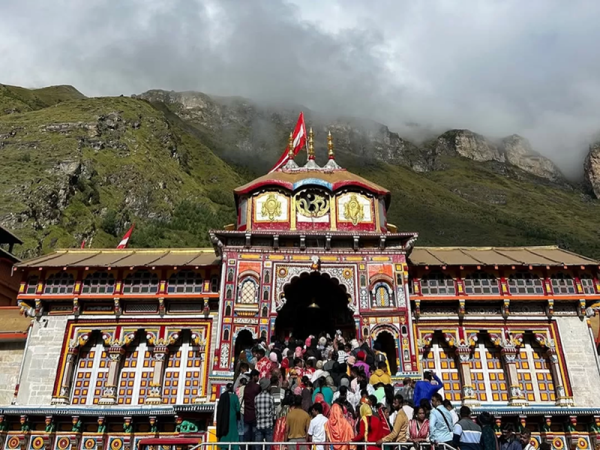
In India's Sanatan tradition, a pilgrimage is not merely about reaching a single temple; rather, it is a spiritual journey rooted in faith, belief, and age-old religious customs, where the visit to one holy site is often intrinsically linked to another. Consequently, there are numerous pilgrimage sites across the country where a visit to a specific temple is not considered complete unless the associated holy site is also visited.

**The Connection Between Kedarnath and Pashupatinath**
This tradition remains a focal point of faith for millions of devotees today. A prime example is the deep spiritual bond shared between Kedarnath—the renowned abode of Lord Shiva in Uttarakhand—and the Pashupatinath Temple in Kathmandu, Nepal. According to religious belief, Lord Shiva is worshipped in the form of His torso at Kedarnath and in the form of His face at Pashupatinath. Therefore, many devotees believe that a pilgrimage to Kedarnath remains incomplete without visiting Pashupatinath.
**Traditions: Expressions of Reverence and Devotion, Not Just Religious Rules**
Elaborating on this, Pandit Deeplal Jaipuri, an astrologer from Ambala, explains that holy sites in Sanatan Dharma share profound spiritual interconnections. Many pilgrimages are not confined to a single temple; the full spiritual merit of the journey is believed to be attained only after visiting the associated holy sites as well. He notes that these traditions are not merely religious mandates but expressions of reverence and devotion that people have upheld for centuries.
**Tradition Linked to Gangajal (Holy Water of the Ganges)**
Similarly, the pilgrimage to the famous Rameswaram Dham in South India is linked to *Gangajal*. It is customary for devotees to first collect holy water from Gangotri or the Ganges River, travel to Rameswaram, and perform *Jalabhishek* (ritual bathing of the deity with water) on Lord Shiva. Millions of devotees continue to observe this tradition, undertaking a spiritual journey that spans from the North to the South of the country.
This tradition is also regarded as a symbol of the nation's cultural and spiritual unity. He noted that the Omkareshwar and Mamleshwar temples in Madhya Pradesh hold special significance for devotees; situated on opposite banks of the Narmada River, these two temples are regarded as two forms of the same Jyotirlinga. He mentioned that religious scriptures also refer to the site as ‘Omkar-Mamleshwaram.’ Consequently, devotees consider their pilgrimage complete only after visiting both temples.
**The Tradition of Baba Baidyanath Dham**
He pointed out that Baba Baidyanath Dham in Deoghar, Jharkhand, is another prime example of this tradition. Here, Lord Shiva resides in the form of a Jyotirlinga, and the site is also counted among the 51 *Shakti Peethas*. It is believed that the heart of Goddess Sati fell at this spot; therefore, devotees consider their pilgrimage spiritually fulfilled by worshipping both Baba Baidyanath and Goddess Shakti.

**A pilgrimage to one shrine is considered incomplete without visiting the other**
According to Pandit Deeplal Jaipuri, there is also a tradition of performing acts of charity, chanting (*Jap-Tap*), singing devotional songs (*Bhajan-Kirtan*), and distributing *Prasad* after the pilgrimage. These practices further enhance the spiritual significance of the journey. He observes that pilgrimage sites are not merely physical locations but mediums that connect individuals to faith, self-restraint, and spiritual energy. Even in today's modern era, these traditions continue to bind people firmly to their faith. This is why a pilgrimage to one shrine is deemed incomplete without visiting the other, and devotees observe these traditions with deep reverence.
PC Social Media
-
Golden opportunity for a government job in Delhi; DSSSB announces recruitment for various posts; check the last date

-
Aligarh Shines in UP B.Ed Entrance Exam; Nitin Pachauri Secures Second Rank Statewide

-
Summer Holidays Extended in UP Schools; Classes to Resume on June 25

-
UGC NET 2026 Admit Card: UGC NET admit card released—how to download it before the exam?

-
UP B.Ed. Result 2026 Declared; Vandana Singh from Aligarh Tops the Entrance Exam