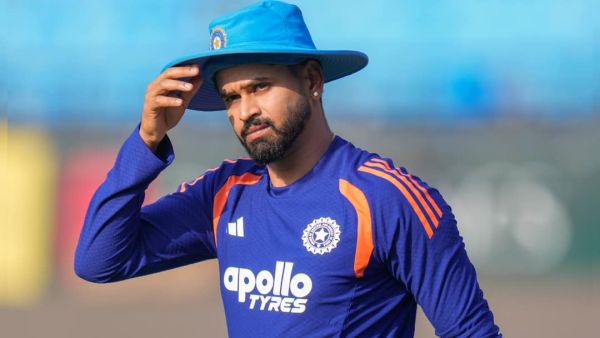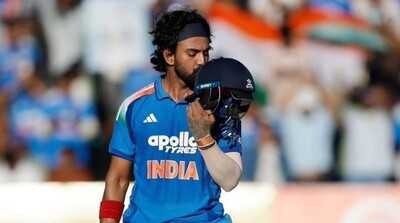
KL Rahul has done, like basically everything for India across formats, in one role or another. But his displays in the ODI middle order during the last two years, maybe they are, honestly, his most important contribution while playing in Indian colours.
Batting in the middle order is one of the hardest gigs in white-ball cricket, and especially so for someone who spent most of his career as an opener. Still, Rahul has not only adapted to what the team requires, he has also really shone from there, kind of rising to the occasion.
KL Rahul’s middle-order Magic:
From 2024, Rahul has put together 579 runs when he bats at No. 5 or 6 in ODIs, with an average of 64.33 and a strike rate of 111.13. Among players who’ve had at least 10 innings in those batting spots in this window, he’s the top for average, and he also holds the second-best strike rate.
The only batter ahead of him in strike rate is Glenn Phillips, who has scored at 112.36. Rahul meanwhile has found the boundary once every 9.14 balls.
These numbers kind of show how well Rahul balances consistency with more assertive scoring, and that blend is rarely seen in modern ODI cricket. His impact looks even more notable when you compare him with other middle order batters who played in the very same matches.
In those games, every other No. 5 and No. 6 batter combined managed a strike rate of just 91.22, and they needed 11.32 deliveries for a boundary. That gap is what really underlines Rahul’s massive worth in one of cricket’s toughest batting slots.\
What is even more striking is his steady output, no matter the situation, or the opposition. His strong showing versus pace makes him suited to this role, really.
A good example came in that South Africa game in Raipur last year. While Washington Sundar and Ravindra Jadeja, those fellow lower middle-order batters were still figuring out the older ball, Rahul stayed composed and somehow still found rhythm to make a crucial 66-run cameo . Even with hardly any help around, he steered India to a big first-innings total.
The Batting versatility:
Rahul’s best asset is how he deals with different phases of a match. Batting at No. 5 or 6 means you need quick switching , and he has delivered in basically every type of role that was asked from him.
Also, his entry points are never really the same, which shows that required adaptability inside India’s ODI machinery. Ever since 2024, Rahul has walked in before the 20th over at times , and at other moments after the 40th over as well, depending on what the team actually needed in that particular moment.
When batting before, or sort of around the 20th over Rahul has scored at a strike rate of 157.14 since 2024, and he has required just 5.09 deliveries per boundary. These kinds of scenes typically pop up after those early collapses, so he ends up attacking even when the pitch feels difficult, and the conditions are a bit grim.
That is pretty much what occurred in Perth last year. In a rain-affected contest , Rahul came in when India were 25/3, and then the score slipped, not long after, to 45/4.
As more wickets kept tumbling he answered with a sharp 38-run spell, including two fours and two sixes. That burst moved India to 136/9 in 26 overs, and honestly it looked out of reach when they were stuck at 84/5 after 20 overs.
Rahul, more often than not, comes into the game somewhere between overs 20 and 35. In this stretch he has piled up 320 runs at an average of 64, with a strike rate of 99.38, which really shows he can keep the scoreboard ticking over while avoiding needless hazards.
Earlier this year in Rajkot, New Zealand reduced India to 118/4 in the 24th over, after dismissing basically the whole top four. Rahul then came back with a stubborn century, scoring 112 while stitching together key alliances with Ravindra Jadeja and Nitish Kumar Reddy.
His innings accounted for 39.43% of India’s total and really steered the side to 284/7. It was like a neat example of his worth at this point in the innings… he calmed things down after the jolt while still keeping a decent scoring rhythm. If the first segment shows Rahul the attacker, and the second segment shows Rahul the stabiliser, then the final stretch lets Rahul be the closer. A pair of fast wickets gave New Zealand some genuine belief during the Champions Trophy 2025 final.
Rahul , though, stayed level headed and delivered a crucial 34 off 33 balls on a tough pitch. He managed the chase well, and made sure India finished it cleanly, with no awkward late complications.
Rahul’s Impact in the middle order:
The common thread through all these roles is really Rahul’s strong feel for match situations, like he just understands what’s going on. His ability to modulate his tempo based on what the game is asking for, makes him far more than a typical middle-order batter, if you think about it.
KL Rahul has locked in a solid spot as a dependable middle-order option, right when India seems to need one most. At this point, both the designated finishers , Hardik Pandya and Ravindra Jadeja, have had trouble when the ball is coming in with real pace.
Pandya especially struggles with back-of-a-length and short-pitched deliveries, mainly because his batting base looks a bit unstable. Since 2025, fast bowlers have sent him back four times in only 26 balls on those same areas. Jadeja meanwhile, doesn’t really have the same closing power he used to carry earlier and he often needs time before he can really quicken. On quicker pitches and faster surfaces, those weaknesses stand out even more.
So , as a result India’s ability to manage the high pace in the middle and death overs still looks like a big worry heading into the 2027 World Cup. Rahul’s ongoing run in the No. 5 or No. 6 position might be really important too, like it could help to fix that problem.
Also Read | Watch: Yashasvi Jaiswal teases Nitish Reddy for being late, opens door for him
A fair amount of pressure will fall on him once the outfield spreads out , and sides start operating with a single ball after the 34th over. His solid base, the balance he keeps in the crease, and his knack for producing power will matter a lot when the ball reverses , or when bowlers go for the shorter length.
Since 2025, Rahul has kept up a sort of strike rate of 140.09 in those slog overs while he’s basically landing a boundary every 7.21 deliveries, so yeah beyond just stabilising an innings, his effectiveness vs pace could really end up mattering a lot, especially in South African conditions.
Honestly not many batters in world cricket can mix the aggressor role, the stabiliser bit, and the finisher part with that much ease, and it shows. If India are really going to get past the rather special challenges of the 2027 World Cup in South Africa , then Rahul’s versatility might become one of their most important strengths.
-
‘I’ve admired him since his debut’: Former England star Wayne Bridge backs Manchester City’s Nico O’Reilly to make a mark at the 2026 FIFA World Cup

-
Lionel Messi Creates World Cup Milestone with Stunning Solo Hat-trick Performance

-
8th Pay Commission: Preparations underway to revise death benefit rules; updates on gratuity limits too

-
WATCH: Vaibhav Sooryavanshi Pulls Off Stunning Diving Catch To Dismiss Afghanistan A Batsman

-
Shreyas Iyer Surpasses Virat Kohli With Spectacular Record In Lucknow ODI